|
|
Click here and sign up for our Elder Care Tips monthly newsletter and receive 10 free recipes!
 |
|
 |
|
 Mary's Blog
-
Posted by Mary on June 22, 2009 at 11:41 AM under
• 0 comments
It is important for you, a caregiver of the elderly, to remember to care for yourself too. Often times a caregiver for the elderly put their lives on hold to care for their parents. It becomes such a stress on you that you should remember to take time for your own emotional needs. You have your own life to lead and you have taken on the responsibility to care for your elder.
The stress from care giving can make you ill or depressed. You want to take time for yourself so you can rejuvenate yourself, restore your energy, and get balance back in your life.
At least monthly (weekly if possible) go out for a movie and/or dinner. You can even take some sometime for a quick overnight vacation. I know it is very hard to say that you need a break and you feel that you can’t leave your elder, but for you to take great care of your elder; you must care for yourself too.
There are a great number of resources available to you for taking a few hours or a day or two off. Here are a few resources (do a Google search in your area for these resources):
- Adult Day Care Centers
- Respite Care Centers
- Caregiver Support Groups
- Community Based Alternatives (CBA)
Most of the above listed charge some sort of fee, and some can be paid by Medicare (your elder must qualify under their guidelines).
I know in these days and times that money is tight, and especially if you are using your own money to supplement your elder’s care, but remember, you can’t do your elder any good if you don’t care for yourself.
Try asking your friends to come over and help out for a night so you can run and get some dinner many will certainly help for a few hours. You can always get them a “little gift” to show your appreciation. My husband would do just about anything for a big bar of chocolate or a bottle of wine.
Remember you need care too! You are important and you have important work to do with your elder.
Here is a video about dealing with the tough decisions you have to make as an elder care giver.
-
Posted by Mary on June 19, 2009 at 1:49 PM under
• 0 comments
As your elder ages their eyesight may seem to be getting worse. Your elder may need to get an eye exam and check to see if your parent may have cataracts or some other eye disorder. We noticed that my husband’s grandmother wasn’t reading as much as she used to. We asked her what the issue was and she just said she didn’t feel like reading anymore. Well, we eventually got her to the eye doctor and it turns out that she had cataracts in both of her eyes. She is a pill and we had a hard time getting her to do the surgery. Finally she agreed to get one eye done and she did very well with the surgery. A month later, the second eye was done and she has pretty good vision now. She is able to read books again. What a joy the results were for her. A cataract is a clouding of the eye's natural lens, which lies behind the iris and the pupil. The lens works much like a camera lens, focusing light onto the retina at the back of the eye. The lens also adjusts the eye's focus, letting us see things clearly both up close and far away.
Below is a video that I found that describes cataracts:
-
Posted by Mary on June 15, 2009 at 1:06 PM under
• 0 comments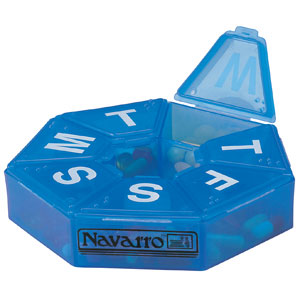
If you are taking your elder away from home for a doctor’s appointment or to a movie, dinner etc always take your elder’s medications with you. You never know how long you may be gone and those really shouldn’t be taken late or skipped. Just get a little pill container and put in the pills you may need for the day and drop them in the back pack or purse. Men can carry them in their shirt pockets too! My Dad used to carry his in his pocket (he used one like the one shoen above) . He would get up in the morning and Mom would place them in his shirt pocket. Of course, she made sure he would wear a t-shirt or button down that has a breast pocket.
Some people think that they can just take their medications when they return home even it fit late. However; what happens is that now it is too close to the next dose. So it is very important to keep to your elder’s schedule. It can really throw off their blood glucose levels. Here is little video that I found about people who are skipping their drugs such as blood pressure medications. Remember you need to take your pills as the doctor suggests.
-
Posted by Mary on June 11, 2009 at 8:00 AM under
• 0 comments
] 
Ed and Ellie Christmas 2003
My Dad had prostate cancer and they removed his prostate back in 1990. After the surgery he had issues with incontinence. He would often have an accident while we were out of the house at a doctor’s appointment or out for dinner. He was ok if you could get him to the bathroom quickly, but if he got excited or was in a hurry unzipping, he would have an accident or get some urine on his clothes. A great help for you, the family caregiver, is to assemble a backpack that was filled with incontinence clean up items and a few other supplies.
Here is what we had in our backpack:
· Baby Wipes
· Gloves (lots of them for you)
· Adult Diaper or (maxi pad – at one time we used to stick a maxi pad in his underwear to catch the drips)
· Butt Cream – as I call it, most people call it diaper rash cream. I personally dislike calling them baby products because they aren’t babies.
· Clean Underwear if not using adult incontinence products
· Clean Pair of Shorts or Pants
· Clean Shirt (yes, sometimes the pee gets on the shirt especially with our Dad, you know that “thing” has a mind of its own sometimes)
· Clean Socks (again, it happens)
· Baby Powder (this helps with the sweating in the summer from the adult diapers)
It is so much better on him to be able to get out of wet clothes and not be embarrassed. You can also keep these supplies in the trunk of the car, so you don’t have to carry them with you, you can just run out to the car when needed. I know everyone doesn’t have a car and you may use public transportation, that’s where the back pack really comes in handy.
Here is a great video that describes incontinence and how the bladder works:
-
Posted by Mary on June 5, 2009 at 9:53 AM under
• 0 commentsIt’s that time of year again when Houstonians prepare for hurricane season. One area of hurricane preparedness that many people forget about is how to care for the elderly in the hurricane season.
Elderly are very uncertain of changes and last year during Ike many elderly were very confused during the power outages and the lack of services that were not available.
One way to help you with caring for your elder during a storm is to be prepared.
Here are some helpful hints for you to consider:
- Stock up on incontinent supplies such as adult diapers, baby wipes (you can use these for yourself too), gloves, and other personal care supplies.
- Have a month’s supply of your elder’s medications on hand.
- Be sure to have a lantern type light and batteries. These lights provide more room lighting like they are used to having and they don’t have to carry them in their hands which may interfere with canes and walkers.
- Buy some Ensure or other type of dietary supplement. These are great because they are non-perishable and provide a lot of vitamins which they may need due to the extra stress of the situation.
- Register your elder with the Houston-Harris County 211 Special Needs Transportation Registry. Dial 211 on your phone to register your elder. This service is designed so the Officials know about the special needs of your elder and can provide assistance if needed.
- Locate businesses your elder may need during an emergency (such as dialysis treatment centers, oxygen supply companies, etc) and find out their emergency plan if they have no power to serve your elder. You want to have a back up plan.
- Remember that power scooters and wheelchairs need power to operate so you may want to get a back up regular wheelchair for your elder.
- Don’t forget some form of entrainment such as cards or board games. These are a great way to occupy your elder so they forget about the storm for a while.
Of course the items listed above are in addition to your regular hurricane supplies such as food, water, batteries, flashlights, battery operated radio or TV, cash, first aid kit, and other essential items that your family may need during a storm.
-
Posted by Mary on April 21, 2009 at 10:17 AM under
• 0 comments
Nail hygiene is very important as well as elder skin care. Check the toe nails at least every 2 weeks as well as the fingernails. The toe nails if left unclipped can curl under the toes and become very painful and will make walking harder on your elder. Keep fingernails short and groomed as your elder can scratch themselves and cause bleeding sores. If any of these are at pressure points, a scratch can turn into a pressure or bed sore.
-
Posted by Mary on April 17, 2009 at 3:16 PM under
• 0 comments
Today, I want to chat to you about your elder and the upcoming hurricane season. Here in Texas we have a great resource available to our elders, it is called the 211 Special Needs Transportation Registry. This registry is great for the elderly. The registry is designed so that you can pre-register your elder with the State of Texas so that in the event of an emergency, such as a hurricane, the State can provide you with some help such as evacuation out of danger areas. This is very important if you have an elder on a ventilator, dialysis, are non-ambulatory, Oxygen dependent, or are in a home hospice situation.
During our past hurricane, IKE, some parts of the Houston area were out of power for 2 to 3 weeks. It was hard for the City and County to help the elderly because they didn’t know where they were. Can you imagine not being able to provide the basic necessities for your elder? I am sure that if my Dad had still been alive during IKE, he would not have made it with out any electricity for 2 weeks. He was on an oxygen concentrator, feeding pump, and needed breathing treatments to name a few of his electrical uses.
So my point is to pre-register you elder today so that if you need help, you are on the list. All you have to do is dial 211 and register. The phones are open 24/7. Below is the info on the Registry.
211 Special Needs Transportation Registry
Explanation of Medical Special Needs Levels
If you live in the hurricane evacuation zone, you don’t have a ride and you have a disability or special health care need, it is very important for you to dial 2-1-1 now to register for a ride.
Level 1
People who rely on or need others to provide their daily, routine care such as a child under 18 without adult supervision, etc.
Level 2
People who are blind, hearing impaired, deaf/blind, or have an amputation.
Level 3
People who need medical assistance including nursing care and help taking medicine. People who are dependent on equipment or those having mental health disorders.
Level 4
People who are not in a hospital, a long-term care/assisted living facility or state school but require important medical assistance (i.e., IV chemotherapy, ventilator, dialysis, life support equipment, including needing a hospital bed, total care, or who are morbidly obese).
Level 5
People in settings such as a hospital, long-term care/assisted living facility, or a state school.
People in the Level 5 category do not need to dial 2-1-1. The nursing home and/or assisted living facility will provide rides for their patients
-
Posted by Mary on April 8, 2009 at 10:16 AM under
• 0 comments
As your elder ages they may have trouble getting up from and sitting on a regular toilet. You can get a “chair height” toilet and have someone install the toilet. Another option is placing a bedside toilet over the toilet. This also gives them hand rails to help in getting up. A bedside toilet may be covered by Medicare. A third option is a toilet seat adaptor which raises the height of the seat. You may have to try a few different items to find the perfect one for your elder.
-
Posted by Mary on April 2, 2009 at 12:15 PM under
• 0 comments
I am currently reading a book called T for Trespass by Sue Grafton. In this Kinsey Millhone mystery, Kinsey is the neighbor of an 89 year old elderly gentleman named Gus. Gus is an active elderly man who fell and hurt his shoulder. He goes to the hospital and is in need of private home care since he lives alone and has no immediate family. In the story a very bad woman becomes his private duty nurse and proceeds to steal him blind as well as drug him so he is in a semi-unconscious state.
This story reminds me that the elderly need to be especially careful with their checkbooks and savings account passbooks. Even though you hire a person to take care of your elder and you trust them to provide great care, you must always be careful with others in your elder’s home. In the story, the nurse also alienates Gus from all his friends. This is a huge warning sign for anyone caring for your elder. Remember you are hiring them they are not just free to take over your home. Set boundaries and stick to them.
I highly recommend T for Trespass it is a wonderful book for anyone who is responsible for caring for their elder. I haven’t finished the book yet; it is also very hard for me to read since I really hate to hear about elder abuse.
-
Posted by Mary on April 1, 2009 at 10:14 AM under
• 0 comments
When you take your elder out of the home for outings, doctor’s appointment or just to go to a movie, be sure to carry some elder care supplies. Our family used an old backpack, you sure can stuff a lot of items in there.
We had it all prepared to scoot out of the hose at a minute’s notice. We packed it with a change of clothes (Dad sometimes would have an accident and not make it to the toilet in time. He would be right there and not be able to get his pants down quick enough and he would get urine on his pants), a few snacks such as peanut butter crackers, some of those small kid sized drinks, some of those little fruit cups – with a spoon of course, and some adult diapers with some wipes and you can’t forget the GLOVES.
Oh, my gosh, this saved us so much time because we wouldn’t have to rush back home for the clothes. Actually my Mom, before she had her stroke, used to keep some depends, wipes and a change of clothes in the trunk of her car at all times. This can be a life saver especially if your elder soiled their clothes, you could whip them out and change their clothes and they wouldn’t get embarrassed, you just pop off the dirty clothes and get the new ones on and you are good to go.
-
Posted by Mary on March 31, 2009 at 11:13 AM under
• 0 comments
Turn your elder’s water heater down. This will prevent scalding themselves with hot water if they only turn the water to the hot position or forget to turn on the cold water (if you have a double handle faucet). My Dad only knew one way to turn on the water and that was full blast. So it is a good idea to keep your elder safe is to keep it cool.
-
Posted by Administrator on March 25, 2009 at 10:12 AM under
• 0 comments
When our parents begin to age, it’s important to reassure them that their children are willing and able to care for their needs. Too often we forget that our parents cared for us when we were not able to, and we place them in a retirement home with strangers they might not know or recognize. The wisdom of our elders is something which should be cherished and appreciated for years to come. Elderly people might not always be up to date on the latest technology, but their knowledge of life is often rich and should be recognized by people of all ages. If you can’t make room for elderly parents in your home, make them as comfortable as possible at their home, and remember to visit often; even if it’s just a few minutes a day, that’s better than an hour a week.
When you partake in activities and interaction with your elders you will begin to appreciate all that they have to offer. You might even learn something about you, your family, or the world that you wouldn’t have otherwise!
-
Posted by Administrator on March 12, 2009 at 10:10 AM under
• 0 comments
When I was younger I had a good friend who was adopted. She was very happy with her adoptive family and never really cared to find her blood parents. When she was in her late teens she developed a rare blood disorder that doctors didn’t know how to treat.
A specialist asked my friend what she knew of her family history. He said that if he knew more about her family history, he may be able to find a treatment. Alas, it was too late. My friend died before she could trace her blood parents. Now I always tell people that their family medical history is of the greatest importance. It could save their lives one day!
-
Posted by Mary on February 26, 2009 at 10:05 AM under
• 0 comments
Having an accident in public is never fun. What you probably didn’t know is that millions of adults in America suffer from incontinence. That means they have little control over their bladder and bowels. Incontinence can lead to humiliation and depression.
There’s no reason why an experience with incontinence should ruin anyone’s day or their life. Adults should be educated on the adult diaper. Wearing an adult diaper doesn’t keep accidents from happening, but it will prevent others from knowing about them.
-
Posted by Mary on February 2, 2009 at 2:08 PM under
• 0 comments
When our parents grow older, it’s common for children to have to play a more active role in their care. It can be frightening and sad when adults put their parents in a retirement home, and thus family caregivers are quite common. When caring for your elderly parents, it’s good to allow them a sense of independence (as much as can be allowed given their health). This means installing railings, appliances, and furniture that are accessible for your parents. When the elderly can take care of themselves, just like all people, they feel more fulfilled and more active. Having others do everything for you can become tedious.
It’s also a good idea to take an active role in your elder’s care; know their diet, know their ailments and how to act in an emergency if necessary, and above all, let them know that you care about them. These are the secrets to success when it comes to elder care.
-
Posted by Administrator on February 2, 2009 at 1:09 PM under
• 0 comments
When we get older, our bodies cease to produce all the necessary vitamins and minerals to maintain our health. It’s common for older people to need to take medication to maintain their body’s normal functions. Taking more medication as you grow older is completely normal, but if the medication isn’t taken on a proper schedule, it can be harmful. It’s important to tell your doctor about all the medications you are taking, even if it’s just standard vitamins or painkillers.
Maintaining a medication schedule is essential for all patients, young and old, on medication. It’s important that you get the correct dosage to ensure your condition doesn’t worsen and the medication is having the full benefit. The reason new diseases and illnesses develop is often because people don’t take medication on schedule, and the bacteria mutates into something different that isn’t affected by the same medicine.
-
Posted by Mary on January 29, 2009 at 10:03 AM under
• 0 comments
Check your sink and shower handles for ease of use for elders. Dad had a very hard time turning the faucet handles and would often leave the faucet running because the handles were too hard for him to turn. The best types of handles are the one handed levers that control the temperature and water flow with one easy movement. Jerry’s Granny had a hard time too with the round handles on the sinks. Granny has arthritis real bad and she just would wait for someone to come over and then she would fill up a basin in the sink so she would have hand washing water. The best types of handles are the one handed levers that control the temperature and water flow with one easy movement that way your elder can use the faucet easily and they can adjust the water as needed.
-
Posted by Administrator on January 5, 2009 at 10:04 AM under
• 0 comments
When beloved family members grow older, it’s often necessary for the younger generation to take care of them, even to the extent of inviting them to live in their home. In order to promote the finest elderly care, there a couple of steps necessary to take if they will be living with you. You should first make the bathroom more safe; this includes installing shower rails, a bathmat, and a raised toilet seat (depending on circumstances). You will also want to ensure that your elder can get around the house as easily as possible, so if you have stairs, try to make it more convenient for them to stay in one floor of the home. It’s also important to keep an eye on your elder’s diet; you will want to promote healthy and nutritious food in the home.
Taking these steps will allow your elder to live in comfort, and also help them to avoid asking the younger members of the household for help. It’s just as embarrassing for them as it is for the other person when you need help getting out of the shower!
-
Posted by Mary on December 30, 2008 at 7:59 AM under
• 0 comments
Here is an article that I thought would be of interest to you from the Wall Street Journal
Have a wonderful New Years! Mary
DECEMBER 22, 2008, 8:42 P.M. ET Wall Street Journal
How to Fund Retirement Living
Older Americans who banked on selling their homes to finance care in assisted-living facilities and retirement communities have seen their dreams go up in smoke amid the housing-market bust. At the same time, their investment portfolios have nose-dived.
In these rough economic times, funding long-term care poses a challenge for seniors and their families. There are a range of strategies you can pursue.
For people without long-term care insurance, which is the majority, the financial hit can be hard if care is needed. The average cost of a private room at a nursing home runs $76,500 per person annually, while a one-year stay in a one-bedroom unit in an assisted living facility costs $36,000 and periodic care from a home health assistant at $18,000 or more per year doesn't come cheap.
While there are no easy answers, shopping around, switching the care setting, pooling family finances and looking at loan options can be conduits to affordable care.
Many independent-living and assisted-living facilities, in particular newer facilities or those that embarked on ambitious expansion plans when the economy was riding high, are offering specials to boost flagging occupancy rates.
"Many facilities are offering to defer rent until seniors can sell their homes or are offering lower introductory rates for the first six months" as sweeteners, says John Temple, chief operating officer at A Place for Mom Inc., a national senior-housing referral service. (The service is provided free to consumers. A Place for Mom is compensated by the facilities when a senior is placed.)
Many facilities will waive the "community fee," a deposit typically equivalent to one-month's rent, for those who ask. The best deals to be had are often at smaller residential homes because they need to fill vacancies quickly and have more latitude to cut individual deals, according to Mr. Temple.
Continuing-care retirement communities, which offer more health services as seniors age, typically require entrance fees of hundreds of thousands of dollars, plus monthly fees.
Cheryl J. Sherrard, a certified financial planner at Rinehart & Associates in Charlotte, says switching to a smaller apartment can be a money-saving strategy for older Americans who've set their hearts on moving into a specific retirement community.
"I've seen communities allow couples to move in with a percentage of the entry fee due initially, but a delay on the remainder being due for a period of six months after move-in," giving seniors wiggle room to complete the sale of a house, she says.
"Retirement communities backed by nonprofit religious organizations can be a more-affordable option," says Karen Schaeffer, president of Schaeffer Financial in Rockville, Md. (These communities welcome people of all beliefs.)
Mr. Temple recommends asking independent and assisted-living facilities about "non-premium rooms" that can be real bargains, but generally aren't advertised. Longer walks to the dining room and less desirable layouts or views account for the cheaper rates. Having a roommate might not be everyone's cup of tea, but "companion rates" can shave $1,000 a month off rent for single seniors who are willing to share, he says.
Widening your geographic search even by just a few miles can produce more budget-friendly options, says Karen Altfest, vice president of L.J. Altfest & Co. Inc., a fee-only financial-planning firm in Manhattan.
Family members can pitch in toward the cost of care in a variety of ways. For instance, individuals can make gifts of up to $12,000 per person per year without paying a federal gift tax. That exclusion amount will increase to $13,000 in 2009.
Another option is an intrafamily loan. This could provide a mechanism for adult children to lend money to cash-strapped parents who need funds now to pay for care until they can sell their homes.
A reverse mortgage is another option. Reverse mortgages enable homeowners age 62 or older, who own their home outright or have a small mortgage balance to convert home equity into cash without selling the house. The Home Equity Conversion Mortgage, or HECM, insured by the Federal Housing Administration and backed by the U.S. Department of Housing and Urban Development, or HUD, is the most popular kind. Lending institutions also offer their own proprietary products.
The amount you can borrow will depend on your age, how much your home is worth and current interest rates. For a HECM the limit is $417,000, but proprietary products may allow you to borrow more.
Payments can be taken as a lump sum, in regular installments or as needed, or through a combination of these options. The accrued principal and interest comes due when the last borrower dies, sells the home or moves out permanently.
A big drawback of a reverse mortgage is the high fees, which closely mirror the closing costs on a regular mortgage.
For this reason, says Sue Hunt, a housing counseling programs manager for Consumer Credit Counseling Service of Greater Atlanta, reverse mortgages tend to make the most sense for people who want to spend the rest of their lives in their homes and whose total income, including the loan, will be sufficient to cover all their future expenses, she says.
With any type of loan, it's important to ensure you understand the fees, interest rates and repayment terms.
For instance, an important safety feature of an HECM is that your payments from the lender are guaranteed by the federal government. Plus, if your home is sold for an amount lower than the value of the loan, neither you nor your heirs will be liable for the balance, which isn't always the case with proprietary products.
-
Posted by Mary on November 14, 2008 at 10:49 AM under
• 0 commentsOne of the best purchases we made was a thermometer that takes the temperature on the forehead. My Dad constantly has his mouth wide open. You cannot get an accurate temperature from him using his mouth. Sometimes you can use a regular thermometer under the arm, but you have to convert the temperature. Ear thermometers are good too, but we found the forehead thermometer works much more quickly and you don't have to buy the disposable ear probe covers. This product is a winner. In our home we keep a daily track of his temperature and record it on our log. This way we can see a glance what his temperature is running. This can help identify if he is beginning to get an infection and we can get treatment before the infection progresses. See my vital signs log for an easy way to document your elder's vital signs.
I do not recommend any particular brand, I just don't recommend one of the disposable strips because you will sepend more money just buying new ones. The other one is a one time purchase and you can use it a long time.
-
Posted by Mary on November 13, 2008 at 9:00 AM under
• 0 comments
Shopping for elderly home care products you need to take care of them can literally break your bank You want to get the most bang for your buck My favorite place is to shop at a wholesale store (Sam's Club, Costco, BJ's etc) for your elder's needs as much as possible. The discount stores are the way to go. If you just look at gloves and diapers for instance. Two boxes (50 pairs) of gloves cost about $10 at the wholesale store and one box (50 pairs) at a drug store runs about $13. You get twice as much for $3 less. Same with diapers, toilet paper, diabetic or non-diabetic drinks such as Ensure®. You definitely get back your yearly fee in just one trip.
Another great place to shop is on-line. You have to search the web to find the best deals, but it can be well worth your time, especially for medically related products. I shop at the local medical supply store, but their prices are very high, but if you need something now, you just have to suck it up and shop there. One issue with the on-line shopping is sometimes you have to buy in bulk and unless you have a place to store the products or if your elder is not going to use up the products, you may want to look locally.
-
Posted by Mary on November 12, 2008 at 12:52 PM under
• 0 commentsConsider putting your elder's bed up against a wall or purchase bed rails if they have any disabilities where they don't have complete control of their bodies. Rails may seem like you are taking always their self esteem by putting them in a "crib" type situation, but it offers them a feeling of protection and keeps them safe.
When our Aunt Jay came to live with us, we had her in a twin bed in the middle of the room (so we could attend to her on both sides) with the head up against a wall. The first night she was with us, she fell out of bed. We had to get her to a doctor and have x-rays to see if she broke any bones. We felt so bad, but it never happened again. Bed rails were installed the next day.
-
Posted by Mary on November 10, 2008 at 10:53 AM under
• 0 commentsA good idea is to keep your walking elder in shoes and socks around the house. This will prevent them from injuring their feet. This is especially true if your elder is a diabetic. A diabetic or just any elder in general can have issues with their feet and not even know that they are having a problem. Diabetics are extremely at risk because they don't feel as well due to possible nerve damage caused by high blood sugar levels.
The lack of feeling in the feet is called diabetic neuropathy. Another issue that diabetic can encounter is peripheral vascular disease (PVD). PVD occurs because you don't have enough blood flow to the legs and feet. A major cause of PVD is smoking. Smoking makes blood flow problems much worse. The carbon monoxide from the smoke damages a layer of cells that coats the lining of blood vessels allowing the plaque to stick to the walls of the vessels. This in turn doesn't allow proper blood circulation to the legs and feet. For example if your elder is walking around barefooted and they step on a splinter of wood, they may not feel that there is a splinter in the foot and it become infected. The elevated sugar level in their blood feeds the infection causing it to get worse and could get into the blood stream. We don't want that to happen, so keep those tootsies covered and protected.
-
Posted by Mary on November 7, 2008 at 8:46 AM under
• 0 commentsOne of the issues my Dad encountered was his unsteady elderly gait. He just had issues with walking and not hanging on to items such as door jams, furniture, or just the plain old walls. Dad refused to use a cane or walker. It drove us crazy that his ego was too large to use the cane. Dad was always stumbling and we were afraid that one time he would fall as he leaped from door jam to door jam. My father-in-law made wooden canes from tree branches and would carve our designs and paint them. I took 2 of them to their house in Florida and he wouldn't have anything to do with them. So my tip for today is to add handicap rails to long hallways to assist in their walking down the halls, if possible. Dad was so happy that we added the rails, he would smile when he grabbed one, but of course never admitted that he needed them. We also added one next to the toilet so he could pull himself up when he got off the toilet and would steady himself with the rail when he was standing in front of the potty.
-
Posted by Mary on November 5, 2008 at 8:44 AM under
• 0 commentsWell, the election is over and we have a new President-Elect and we will have to see how his administration will affect our elderly health care. Mr. Obama stated in his campaign that he will increase the amount of income that is taxed to provide monthly Social Security benefits. He also stated that Social Security is the most important social program in our country. As to Medicare, his view is that he wants to keep it strong. Obama's Illinois Senate website states "Medicare is a promise we have made to our seniors, and along with Social Security, it is essential to a dignified and financially sound retirement. Cuts to Medicare will seriously harm those who have worked all their lives, paid into the system, and need medical care." Not sure what that means, but we will just have to wait and see what changes will come to our seniors. I am hopeful that our elderly will be taken care of and not forgotten.
-
Posted by Mary on November 4, 2008 at 10:03 AM under
• 0 commentsToday, November 4th is Election Day and it is an exciting day for your elderly parents as they get out casting their vote. Your elder may need a little help with the actual machines that the United States is currently using. All you need to do is ask the attendant at the polling place to help them. That is one of the functions that they provide.
In the Presidential Election of 2000 my parents lived in Florida (if you remember that is where we had the issue with the "hanging chads"). Well, Mom took Dad to vote and he went to the booth to punch his ballot for his candidate. He stepped out from the booth and shouted to Mom that voted for them all while he was waving his ballot!! Mom had to get the attendant to help Dad vote on a new ballot. They got him all fixed up and he cast a legal vote for only one candidate. So they are very willing to help your elder.
You know it was funny, my Dad always used to say "Vote and Vote Often" I guess that day he did just that in the 2000 election. Gosh, I sure do miss him and his sense of humor.
P.S. Today is Mom's birthday she would have been 86 :(
-
Posted by Mary on October 30, 2008 at 8:03 AM under
• 0 commentsIt's that time of year to protect your elderly parents against the Flu. The flu shot is available and should be give to all people over the age of 50 (according to the CDC guidelines) and especially those elderly who live in nursing homes and long term care facilities. In addition you should consider the flu shot for all the family members that are living with your elder.
The flu kills about 36,000 annually and 200,000 are hospitalized from the flu every year. Wow, that's a lot of people dying from a preventable illness! The CDC also states that on average 5%-20% of the entire population get the flu annually. That's a bunch of folks running around potentially infecting your elder.
Last year my husband's cousin's son, Luke, died from the flu. He was a very active 12 year old boy who played all the sports. He was playing the last game of the year for his school's basketball team and fell over on the court. He was rushed to a local hospital and later taken by helicopter to a large children's hospital a few hours away. He died the next day. Oh, was that a tough funeral to attend. The tears let me tell you, not a dry eye in the large church. The family thought that he must have had a heart defect or some such because he died so suddenly, but the autopsy showed that he died from complications from the flu. It turns out he was "just getting over the flu" when he played the basketball game that day. What a tragedy.
Anyway, get your elder their flu shot. It is a low cost (free if you have Medicare) prevention that can make a huge difference in your elder's health. I know many of you think that you get the flu from the flu shot. Studies have shown that that is not true. The shot contains dead flu virus from the last season. It may not totally keep a person from getting the flu, but if you get the flu, it is usually a milder case.
I have had the flu once before and I thought I was going to die. I never felt so bad. I was living alone with just my 2 cats and I stayed on the couch for a week. There wasn't anyone to help me or give me any sympathy (which when you are sick is a very important thing), it was just me and the cats. Every year since, I have gotten the flu shot and I have never had the flu again. YEA!!!
Seriously, protect your elder from the flu.
-
Posted by Mary on October 29, 2008 at 9:59 AM under
• 0 commentsQ. One topic that has surfaced in my world recently is having to hire someone to sit with my mother while I am at work. Is there any source of compensation for elder care like there is for child care apart from the temporary offerings which I have used?
A. In answer to your question about sitter care for your Mom there is really not any help at all. Our family looked into this extensively and we found out a few things.
Our parents needed 24/7 care and the expense was about $6K a month and the only thing we could do was to claim the expense for care (allowable by the IRS) on THEIR taxes under section 1 Medical and dental expenses on Schedule A. You are permitted to take off the cost of "medical care" but she has to exceed the 7% of her income and then you can take off what is over the 7%. However, all you will get back on the taxes is the amount of taxes that you paid. For example, one year we listed $74,980 on that line of for care and with all the other deductions the total was $75,906. The amount that was gotten back on the taxes was a refund of $3,171.00. Not much back. We had to pay the sitters and issue them a 1099 MISC - Miscellaneous Income form.
If you can claim your Mom as your dependent (there are a lot of legal issues with that and if she earns an income such as retirement/social security the limit is $3,200 a year to qualify) you can use the flexible spending dollars for dependent care, but you can only contribute $5K annually. It is tough to get a parent qualified under this plan.
If your Mom is a retired Veteran, you can try the aid and attendance help from the VA. This help is very tough to get. I couldn't get it for my bed ridden Dad, he earned too much money (over $18,000) and since he was on total feeding tube nourishments they said I couldn't anticipate his feeding needs so they excluded the $100K of nourishment costs. Anyway you can always try it takes months to get an answer and there is a HUGE amount of paperwork that you have to do and your Mom's doctor to do. Here is the link http://www.veteranaid.org/ These are the only financial help that we were able to find for in-home sitter care. Mostly you are on your own financially.
I did find one little thing that helped some. Our flexible spending dollars for healthcare can help you some. If you take the money out of your pay and put it into the flexible spending account you can be reimbursed for some of the incidentals that you use on your Mom under the "Over the Counter Healthcare Reimbursement." You can get your money back for things such as incontinence products, band aids, antibiotic cream, eye drops, cold medicines, analgesics, antacids, ear care products, etc (Aetna has a full list of items). I saved a bunch by saving the receipts for the incontinence products alone. This is at least one way to defer some of the cost associated with her care. I hope this helps and sorry there really isn't anything out there that helps with elder care it really is a shame.
-
Posted by Mary on October 28, 2008 at 3:58 PM under
• 0 commentsThe end of an elderly parent's life can be a very rough time for the caregivers, and many difficult decisions may have to be made for your parent. One choice you may be faced with is to place your parent in hospice. Hospice is designed to care for a person who is in the final stages of life suffering from a terminal condition and is for making the person as comfortable as possible so they may "enjoy" the last days of their lives. Hospice focuses on pain management rather than curing the person and can be provided in a facility or in home. Most hospice plans have the person in their home or familiar surroundings and can be done in a nursing home, hospital or any place that you choose. Hospice also provides the caregivers and family members emotional, spiritual and social support. People who go on hospice usually are not expected to live longer than 6 months.
Palliative care is a medical specialty that focuses on pain relief and other symptoms of an illness. The goal of palliative care is to ease suffering and to offer the best quality of life for the ill person. This type of care is not dependent on an end of life period of time, but can be given for any serious illness. Hospice care involves palliative care, but you do not have to have your elder on hospice to get palliative care. The palliative care team also helps the family of the patient make medical decisions and choose treatments that are in line with the family's goals. This care can be discontinued when the person's symptoms lessen.
Both hospice and palliative care can be covered by insurance plans, Medicare, and Medicaid. As always check before you admit your elder, just so you don't get any financial surprises.
-
Posted by Mary on October 27, 2008 at 2:54 AM under
• 0 commentsDoes your elder have a feeding tube? Actually both my Mom and Dad each had one, but lucky for us they didn't have them at the same time. One issue that we had was that they tend to get gunky and sometimes they get clogged up and nothing will go down. One solution, literally, is to give your elder some Coke® or Pepsi® through the feeding tube. The acids in the cola products will help clean out the gunk in the tube. If your elder is a diabetic, you can do the same with a diet product to keep their sugar down. Don't be too forceful when you add the soda, just let it sit there a percolate for a while. Keep this up until the line can accept your regular feedings. Remember always to run a little water after you finish with the feedings, it will help keep the line clean.
-
Posted by Mary on October 24, 2008 at 9:53 AM under
• 0 commentsA long term care facility is one that provides rehabilitation and/or ongoing skilled nursing care for elderly or other people that have a need for assistance with activities of daily living. Long-term care facilities include nursing homes, rehabilitation facilities, inpatient behavioral health facilities, and long-term chronic care hospitals.
If your elderly parent fell and broke their hip (God Forbid), their doctor may place them in a LTC for a period of a few weeks so that they can get physical therapy and restore the use of their hip.
Long term care facilities can be paid by Medicare and Medicaid depending on the reason for the admission. If the admission is considered a medical necessity, most likely it will be covered (broken hip, stroke recovery, etc.). Check with the facility before you admit you elder for their payment requirements. Also, you need to check for the length of stay. My Mom was in a LTC for 4 months, well Medicare only pays for 90 days, and then we had to self pay for the remainder of her stay (30 days at $190/day). It can become quite costly. Again, as with any type of care facility DO YOUR HOMEWORK before you admit your parent.
-
Posted by Mary on October 20, 2008 at 4:45 PM under
• 0 comments
Do your elderly parents have difficulty getting in and out of chairs? If so, I have an easy low cost solution to your needs. If your elder is tall, put large chairs such as a recliner up on a sturdy wooden box to elevate the chair. If they are short and the chair legs are assessable you can either remove the legs on an item as a sofa (where it has 4 or 6 short legs) or cut them off to make them shorter. This makes the chair the correct height so they are not putting stress on their body trying to pull themselves up out of the chair. If your elder is short, cut a few inches of the legs of chairs so it is easier to get in and out of. You can also go the higher cost way and purchase a lift chair or a lift device. A chair lift device is a small device that you place in a chair and it gives them a boost up. These cost anywhere from $100 on up.
-
Posted by Mary on October 17, 2008 at 8:49 AM under
• 0 comments
Nursing homes or skilled nursing facilities are one of the last places most children want to put their elderly parents, but sometimes that is the only option that is available to you. Nursing homes are for elderly people who have physical limitations, for younger people who have severe disabilities, or for people who were recently injured. These people need a tremendous amount of constant personal care. Nursing homes are required to have a licensed RN (nurse) on duty 24 hours a day. There are also many staff members who assist in caring for your elder. Many nursing homes do not have an adequate staffing to take great care of your elder. In our area of the country, there tends to be a shortage of Certified Nursing Assistants in the nursing homes and you can typically find 1 staff member to a wing of the unit and be caring for as many as 20 people on their shift. That’s a lot of diaper changes in one shift for one person.
I know that nursing homes can be a good thing for people, but I am very, very cautious about them. My Dad had to be in one for a short time while he received some IV antibiotics. I paid 3 people to stay with him 24/7 during his 4 day stay because of my impressions of nursing homes. I wasn’t all wrong about my impressions. The man in the bed next to my Dad was 93 years old and he was still walking, but needed help getting to the bathroom. They came to get him maybe once in 12 hours and then would leave him on the pot for 1 hour. Not kidding!!!
You have to be extremely vigilant if your elder is in a nursing home. My friend had her Mom in a nursing home for 8 years and had great luck with that home. She did visit her Mom almost EVERY day (except when she was out of town for business) and did a head to toe look over her body at every visit and paid close attention to her care. Remember there are excellent nursing homes, you just have to find them in your area.
Nursing homes can be paid by Medicaid or by private pay. DO YOUR HOMEWORK if you are looking to place your parent in a nursing home for an extended period of time or even for a short time. There are many, many rules and regulations that must be followed to have your elder’s care paid for by Medicaid.
-
Posted by Mary on October 14, 2008 at 4:52 PM under
• 0 commentsKnow the Signs
Because stroke injures the brain, you may not realize that your elder is having a stroke. To a bystander, someone having a stroke may just look unaware or confused. Stroke victims have the best chance if someone around them recognizes the symptoms and acts quickly.
What are the symptoms of a stroke?
The symptoms of stroke are distinct because they happen quickly:
Sudden numbness or weakness of the face, arm, or leg (especially on one side of the body)
Sudden confusion, trouble speaking or understanding speech
Sudden trouble seeing in one or both eyes
Sudden trouble walking, dizziness, loss of balance or coordination
Sudden severe headache with no known cause
What should a bystander do?
If you believe someone is having a stroke - if he or she suddenly loses the ability to speak, or move an arm or leg on one side, or experiences facial paralysis on one side - call 911 immediately.
Act in Time
Stroke is a medical emergency. Every minute counts when someone is having a stroke. The longer blood flow is cut off to the brain, the greater the damage. Immediate treatment can save people's lives and enhance their chances for successful recovery.
Why is there a need to act fast?
Ischemic strokes, the most common type of strokes, can be treated with a drug called t-PA, that dissolves blood clots obstructing blood flow to the brain. The window of opportunity to start treating stroke patients is three hours, but to be evaluated and receive treatment, patients need to get to the hospital within 60 minutes.
What is the benefit of treatment?
A five-year study by the National Institute of Neurological Disorders and Stroke (NINDS) found that some stroke patients who received t-PA within three hours of the start of stroke symptoms were at least 30 percent more likely to recover with little or no disability after three months.
What can I do to prevent a stroke?
The best treatment for stroke is prevention. There are several risk factors that increase your chances of having a stroke:
High blood pressure
Heart disease
Smoking
Diabetes
High cholesterol
If you smoke - quit. If you have high blood pressure, heart disease, diabetes, or high cholesterol, getting them under control - and keeping them under control - will greatly reduce your chances of having a stroke.
--------------------------------------------------------------------------------
"Know Stroke. Know the Signs. Act in Time.", NINDS. January 2008.
NIH Publication No. 08-4872
-
Posted by Mary on October 13, 2008 at 9:53 AM under
• 0 commentsAs you age your skin changes and elderly skin care is much different than regular skin care. As a person ages, they may become sensitive to many chemicals that they were not sensitive before. Many products that are on the market now are "new and improved" and often have lavish scents. My elderly father, became allergic to many of perfumes and dyes that are added to the laundry soap and fabric softeners. When we took over care of Dad while Mom was in the hospital, he began having rashes on his legs mostly where his socks were touching his legs. So what did we do? We bought ankle height socks instead of the mid calf height. Did that work? No, it just lowered the height of the rash. We did switch to a laundry soap with no perfumes and no dyes, and were using a free and clear fabric sheet.
Well, Dad's rash still was there and wouldn't go away, finally the doctor told us that it was the fabric softener sheets. She said to change to a liquid fabric softener that you put in the washer and use one that is perfume free and dye free. The is only one on the market, Downy in the white bottle. It is a bit hard to find, but we found that if we use a hypoallergenic laundry soap, such as Dreft® it helps to reduce the risk of rashes and use the liquid fabric softener, his delicate elderly skin will be soft and beautiful. So my hint for the day is to wash all your elder's clothing, bedding and any other item that touches their skin in a hypoallergenic laundry soap and use a liquid fabric softener.
-
Posted by Mary on October 9, 2008 at 11:55 AM under
• 0 commentsAdult day care is just what you think it is, elderly care for adults just like day care for kids. Adult day care is a wonderful solution for people who have their parents or elder living with you, but can't leave them at home alone for 8 hours while you go to work. At adult day care centers the elder is in an environment where there are activities (if they are able to participate), meals, recreation and some hands on care (i.e. medication administration). Other adult day care centers have a more health related program where physical therapy is conducted, for example, and more severe health related issues are addressed.
Again, as with any program, you need to do your homework before you send your parent to an adult day care center. They may or may not have a license; they may offer services that are totally different from other centers. You need to find one that fits the need of your parent. The price ranges varies greatly for these types of centers. They can be as low as $25 a day to $100+ a day. This variation depends on the type of services your elderly parent needs and your physical location in the city or state. Adult day care centers are generally paid for by you or your elder, but you may be able to find some assistance from Medicaid or Veteran's Administration etc.
-
Posted by Mary on October 8, 2008 at 8:58 AM under
• 0 commentsWhen we moved my elderly parents from Florida to Texas one of the things that we worried about was Dad wondering out of the house here in Texas. Since Dad couldn't be home alone, right after Mom had her stroke, we had a system where each of the kids and a few other relatives would take a turn to stay with Dad at their home in Florida, a week at a time, and to make sure things were ok at the nursing home. A few times when my sister, Joan, was "on duty" with Dad, Joan was awakened by Dad hollering for Mom outside of their home at 2 am. He would just stand outside and yell "Eleanore, Eleanore, where are you?" We decided that Dad wondering off could be an issue for our family. We didn't want Dad running off from the house in Texas and not be able to find his way home. On one family vacation on St. George Island, Fl, an elderly man in a house across the street, left the rental home and was wandering the island. They finally found him, but the family of the elderly man was so upset.
Since our elderly parent had a bit of dementia and tended to wander around the home, our solution was to get a wind chime and put it on the door, so when the door opens the chime ring. This is an inexpensive way to have an audible signal that someone is leaving or arriving. There are many other ways of monitoring your elder's whereabouts, but an alarm system is very expensive. A wind chime is just a few bucks. The wind chime also acted as a door alarm when Dad was bedridden and our staff would be back in the bedroom with him and one of us would come in, they would know that there was someone there and not be surprised. Remember, in Asia, windchimes are considered good luck and a part of Feng Shui!
-
Posted by Mary on October 7, 2008 at 5:00 PM under
• 0 comments
When your elderly parents get to the point where you feel that they are unable to live alone, but they still want to be independent, Assisted Living may be a good option for them.
An assisted living facility is for those people who need help with activities of daily living. An assisted living facility reminds me of a college dorm. The elderly couple or person has their own apartment (some have separate kitchens and bedrooms), but mostly eat in the dining room. There are many activities which your parent can participate in. These facilities provide a tremendous amount of socialization for your elder, a major bonus!
Assisted living facilities also can help care for your elder. They provide laundry, housekeeping and maintenance services (my college dorm never did my laundry or cleaning for me) as well as hands on care of your elder for such tasks as bathing, eating, dressing, and assistance with medication. Of course you will pay for these extra “hands on care” services in addition to the rent for the room or apartment.
If your parent doesn’t need too much care this is a wonderful choice. In my situation with my parents, they needed too much care and this wasn’t a good choice for them. Be careful when evaluating an assisted living facility they can have many hidden charges. It is best to get all your potential costs known upfront otherwise your parent’s (or your) wallet may be in for one heck of a surprise. Assisted living facilities are not covered under Medicare or Medicaid as far as I know, these is a private pay facilities.
-
Posted by Mary on October 2, 2008 at 5:04 PM under
• 0 commentsEveryone knows the importance of good skin care, but many may not realize the added importance when it comes to the elderly. Good elderly skin care is one of the easiest and most important ways to keep healthy in your later years.
Dry skin is the biggest culprit when it comes to skin problems for the elderly. As people age, the skin becomes thinner, and can't retain the same level of moisture, which often leads to dry, flaky skin. Thin, dry skin is also more susceptible to tearing, and easily lets bacteria in, which can lead to infection.
The most important thing is to keep skin clean - but not to overdo it. Hot water and too frequent showering will actually dry the skin out worse. Warm water and bathing every other day is the recommended method for the elderly. The elderly should also avoid bubbly soaps and shower gels, which generally contain harsh detergents, and stick to cream-based cleansers. And finally, keep the skin hydrated by moisturizing with a cream lotion after every shower.
-
Posted by Mary on October 2, 2008 at 8:02 AM under
• 0 commentsBed sores are just one of the myriad problems that can affect seniors who are bedridden or in a wheelchair. They are the result of constant pressure on one part of the body, which causes the blood vessels feeding that part of the body to shut down. Eventually, the skin will break down to form blisters, then dead skin, and can even infect the tissues, bones and joints. Treating bed sores can be a difficult process, and often leads to painful surgery. The most effective step against these lesions is preventative.Some tips for avoiding bed sores:
• Reposition at least every two hours to relieve pressure
• Inspect the body for signs of bedsores; if any red spots are found, keep all weight off of them until the redness is gone
• Lay flat in bed; raising the head causes the body to slouch deeper in bed, which increases pressure
• Use pressure-reducing aids such as sheepskin, gel, foam or air for cushions
• Immediately clean skin that becomes damp; the moisture will increase the skin's likeliness to break down
• Change sheets frequently, and keep them wrinkle-free
• Massage the skin two to three times daily to promote circulation
-
Posted by Mary on September 30, 2008 at 1:07 PM under
• 0 commentsYou can't have too many gloves in your home for adult diaper changing. Gloves can be one of you're your best friends if you are changing an adult diaper. Most people don't use gloves when changing a baby diaper, but if you are going to change an adult diaper you better get some gloves. I can't begin to stress the need to have many boxes of gloves on hand.
One night, for example, my sister, Anna, was taking care of Mom and Dad by herself. She heard Mom cry out at about 2 am and knew that she needed her adult diaper changed. In the middle of getting the diaper off her, Dad got up from his bed and had poo going all down the backside of his jammies. Both had a very bad case of diarrhea. Anna found out we were out of gloves and she had go get both of them clean up with no gloves. Oh, what a mess, and to have all that poo all over your hands, arms, legs etc. ICK!!! We always kept a good supply of gloves in the house after that incident.
-
Posted by Mary on September 29, 2008 at 12:09 PM under
• 0 commentsOne thing that is on the minds of many is elderly care. There are many different choices that an adult child can be faced with concerning their elderly parents. One of the difficult choices is what do you do when your elderly can't live alone. Some choices are assisted living, adult day care, nursing home, long term care, hospice and in home care.
When our family was faced with the decision on what to do with Mom and Dad, we choose in home elder care. This choice was the best for our situation, but it was one that that was very hard on the "kids" and a financial drain. All choices are hard, because it can be the choice of life or death, literally, if your family picks hospice. In upcoming blogs I will discuss some of the "housing" options for your elder.
-
Posted by Mary on September 24, 2008 at 7:51 AM under
• 0 comments
The elderly are especially vulnerable to changes of any kind, but the changes with this new post hurricane situation have many elderly in a tail spin. Many people just do not understand why they have no phone service or electricity. Gas and groceries has also been a challenge for the elderly. Many elderly can't wait in line for 2 hours for gas and many grocery stores aren't stocking the offbeat items the elderly need.
Try to make your elder feel safer and more secure in the post hurricane times by:
- Listening to their complaints. I know you have to explain over and over again what is going on, but remember they are really confused at this time, don't make it harder on them by fussing at them because you are frustrated too.
- Keep your elder hydrated. This is especially important if you don't have air conditioning or power.
- Keep the same schedule if you can. Elders like order and consistency. Try to keep things as "normal" as possible.
- Get your elder involved in the "clean up." Now, I don't mean to work them to death, but give them something to do that they can do without too much physical exertion and make them feel useful.
- Keep them clean. Without air conditioning you elder will be more vulnerable to developing skin conditions such as rashes. A quick fix that helps with keeping the skin dry to apply a thin coat of baby powder. The talc will help absorb the excess moisture.
I hope all of you will get power back on soon and keep your elder healthy!
-
Posted by Mary on September 17, 2008 at 10:57 AM under
• 0 comments
Hi Everyone, I wanted to let you know we are all fine here after Hurricane Ike passed through Houston on Saturday morning.
Anna left Houston on Tuesday morning to attend a seminar in Calif. and was able to get out of town on her scheduled flight at 6:15am. She is due back tonight about 7 pm. Anna's house did not have any damage from the storm except she has 2 of the 3 fences knocked down due to the posts holding the wooden fence snapped at the base. Here home had no damage what so ever.
Our house did not have any real damage per se. The fiberglass cover on our patio is mostly gone and we also had part of our back fence blow over (again due to the posts snapping at the base). The biggest problem we had was a tree fell over in our front yard and landed on all three of our vehicles. Jerry's work truck was closest to the tree and it took most of brunt of the tree damage. The windshield was busted out, the hood severly dented in and the side view mirror fell off. Jerry's regular truck had the windshield crack and the top of the cab of the truck has a 6 inch dent in the top. My Saturn Vue (what I baught to replace the handicap van) was parked closest to the house only had the upper branches on it so it didn't get any real damage at all. Funny thing is we don't know when the tree fell (the tree's 2 ft diameter base just snapped in two and the roots are still in the ground) and it must have made a big noise falling on the trucks/car. We woke up around 4am when the storm came through and the tree had fallen by then.
Our house got the power back on after two days (Sunday afternoon), but Anna's house is still without power. Her dogs came to stay with us because of her trip and will have to stay until she gets power back and the fence fixed.
Jerry and I went over last night and cleaned everything out of her frig (trash day is today) so at least it wouldn't be too bad when the power comes back on. It's weird that only a few homes in our subdivision has power and 90% doesn't. We are blessed that we do have power.
The City of Houston is getting back to normal so to speak. It is still very hard to get gas and food. Most stores that have power and are open have limited items and the lines are long. We are also under "boil" precautions for our water until further notice. We never lost water, which is a great thing.
My hospital did really well. We didn't have any power outages and any real damage to the main hospital. We have an outlying building that had a 6 inch domestic water line break on the top floor and the building had at least 4 inches of water on the 6th floor ran down the riser and thoughout the building. My co-worker and I did an assesment of the building's sheetrock and a huge amount has to be removed and replaced. That will keep our contractors busy for a bit.
Anyway, that is our latest update her in Houston.
Oh, as of yesterday, my friend Kelley and her Mom still are out of power.
Love and hugs to all, Mary et.al
-
Posted by Mary on September 3, 2008 at 11:34 AM under
• 0 comments
In 1970, a West Virginia housewife, Marian Lucille Herndon McQuade, the mother of 15 children, 40 grandchildren, and eight great grandchildren, initiated a campaign to set aside a special day just for Grandparents so that we can honor our grandparents, can give our grandparents the opportunity to show their love for their grand children, and for the grandchildren to become aware of the value that their grandparents can provide with their skills and knowledge. In 1978, the United States Congress passed legislation proclaiming the first Sunday after Labor Day as National Grandparents Day. The legislation was signed by President Jimmy Carter. The month of September was chosen for the holiday, to signify the "autumn years" of life.
September 7, 2008 is National Grandparents Day. Take the time to celebrate with your family and honor your elders. I never had a chance to be with my grandmothers because they were deceased when I was born. I didn’t have an opportunity to learn and grow from them. Only one of my grandfathers was alive when I was born and he lived in another part of the country from us and I only remember him speaking Polish.
I, however; have adopted my husband’s grandmother, we call her Granny. Interestingly, my mom and his grandmother are the same age, but I never thought of Granny like a mom, always a grandmother. Granny has so much wisdom to bestow and has so much to share with the entire family. It’s hard to see Granny age. It seems like just the other day when I met her. Granny’s oldest son, was burned in a fire at home and was in the local burn unit. My husband I went every day to see Granny during our lunch hour.
At that time, I had no idea she would become my Granny, but we formed a life-long bond. Granny and I have become close over the past 11 years since I met her. She has been through the death of her son, the law suits over her son’s estate, the deaths of all her brothers and sisters, and her own failing health issues. She is still corner stone of the family.
Sorry, I have rambled, but my point is taking the time on Sunday, September 7, 2008 and show your love to your grandparents or and your children’s grandparents. You don’t have to spend any money on them, if you don’t want to, but at least pick up the phone and give them a call and tell them you love them!
-
Posted by Mary on August 26, 2008 at 10:00 AM under
• 0 comments
Hi Everyone,
Yesterday, on my way home from work, there was a posting on the signs around Houston for a missing elderly man from San Antonio. It makes me so sad to see those postings. I sure hope they found him safe and sound.
One year our family was vacationing on St. George Island, Fl and one of the other vacationers lost their father. He just up and walked out of thier vacation home rental. Our family went out to help hunt him down (he was eventually found safe), but it sure did scare us that it could happen to our Dad.
One of the things that our family feared was that our Dad would get out of the house and just wander around the neighborhood like the man did when we were on vacation. When Mom and Dad lived in Florida, and Mom was in the Nursing Home, sometimes Dad would stand out in the middle of their yard and holler for Mom in the middle of the night. He would just call out her name and she never did come home to him. It just broke my heart to see him that way.
Just a few short months we moved them to Houston where they were together. When we got them here we really worried about Dad getting outside and lost in the area. I went on-line and found a bunch of high priced "patient alarm" systems, but that just didn't feel right. We ended up in putting wind chimes on all the doors. Dad never could sneak out without someone knowing that he was out and about.
Across the stree from us there is an elderly man who has Alzheimer's and his daughter has alerted all the neighbors that he is not supposed to go past the stop sign at the end of the street. She asked us that if we found him wandering, to lead him back home. Great Idea to alert your neighbors to your elder's conditions and ask for help to keep them safe.
It turned out that we never did have to worry about him leaving the house, because Dad was never going to leave his beloved wife.
Your elder care tip of the day: A low cost solution to knowing if your elder has left your home is attach a noise maker like a wind chime to the door. Another low cost solution are those door bells that you put a gizmo on one door frame and the matching gizmo on the door and when the door opens an electronic noise is emitted.
I hope everyone has a blessed day and enjoy your elder while they are with you even if they drive you crazy.
Mary
-
Posted by Mary on July 17, 2008 at 9:10 AM under
• 0 comments
Thu 7/17/2008 8:10 AM
Good Morning All,
Anna had her cardiac catherization yesterday and all went well. The doctor did not have to put in any stents and she is clean as a whistle. It turns out that the artery in question (I can't remember which one it is, but it is on the left side) has a place that is narrow. It is due to the way God made her. It really isn't a "defect" but as the doctor said, just the way she is.
The doc said that he will just have to watch her so that that spot doesn't collect plaque etc by keeping her bad cholesterol down and her good cholesterol up and keeping her blood pressure normal.
There isn't anything else wrong with her heart. YEA!
So that was great news. She had to stay at the hospital for about 3 hours after the quick (30 minute cath) and we were headed home by 2pm.
Oh, and I have to tell you that I had to feed her lunch because she couldn't sit up at all for a few hours. The nurse tilted her bed so she wouldn't choke but she had to keep her head flat on the pillow.
She ordered a Lobster salad. I joked with her that she was just like Aunt Jay ordering Lobster! and of course I was well trained at feeding someone who can't feed themselves in bed (that would be Mom and Dad). Now Dad would close his eyes and open his mouth like a little baby bird waiting for Momma bird to feed her. We joked about this while I was feeding her.
She is doing well. Thanks again for all the prayers and we can stop worrying about her.
I am still working on getting the funeral pictures posted for you to see. I will let you know when they are up.
Love and hugs to all,
Mary
-
Posted by Mary on July 7, 2008 at 7:20 AM under
• 0 comments
I never did write an e-mail about the last day of Ed's life. I realize many people didn't know how he passed.
I got a call from the hospital about 10 am on 7/3/08 and the hospital nurse said that Dad's blood pressure was very low. She said it was 54/45 or something like that. I said to her that it was better than it was the night before. I really thought that he was a bit better. In fact we sisters had talked to Tom that night and told him we didn't think that it was time for him to come, and that he would pull out of it as he had done in the past.
I didn't leave work when the nurse called at 10 am since we had planned to be at the hospital at noon to meet with the hospice company. I thought that we would have plenty of time and since his blood pressure was higher than last night, all was fine.
At 10:45 am I got a call from Jerry's Aunt who was visiting Dad at the hospital and she told me Dad looked really bad and that his blood pressure was very low 30/20 and to get up at the hospital right away. She was there with Fred and no one else was there. I told her I would leave immediately. I ran out of work and called Joan to get up to the hospital. Joan was waiting to get up to hospital for the meeting at noon and was preparing the crock pot for our dinner that evening.
I also called Anna and Jerry and told them to get to the hospital ASAP as they were at work too.
I was just getting on the freeway when I got a call from Fred and he said "Mr. Ed isn't breathing, we called the nurse and she is on her way." Again, I didn't panic since Dad had these breathing episodes when he would stop breathing for about a minute and started back up again. No one else called me on my way home. I didn't call Anna and tell her anything else. I figured that would have called me back to tell me that he died.
So I was driving like a mad woman, crying and speeding. All of a sudden, I felt like Dad was in the truck with me and I told him that I was ok and that he would be with Eleanore, his brothers, his sisters and his parents and he would have a great time and he wouldn't be in any pain any more. I instantly had this feeling of calmness, I stopped crying and in that instant, felt that he was gone.
Joan was only 10 minutes away from the hospital and she got there pretty quickly. We figure she was somewhere in the hospital when he passed, only Martha and Fred were with him.
Anna arrived soon after I did and had called talked to Tom on her way and didn't know he had passed. Everyone thought she knew. The only thing she knew was that he was not doing well. So much for our communication.
Anyway, Dad passed without anyone of the kids being with him. I think that he wanted it that way. He passed at 10:55 am Central time, but wasn't pronounced until 12:15pm (the official time on the death certificate).
Again, we kids didn't get either Mom or Dad into a hospice. Mom passed on the official New Year's Day holiday (1/2/06) and hospice was coming the next morning and Dad passed 1 hour before they were to admit him. Strange, neither make it to hospice and maybe they wanted it that way.
-
Posted by Tom on July 3, 2008 at 1:38 PM under
• 0 comments
Thu 7/3/2008 12:38 PM
Hi to all,
Just wanted to let you know that Ed passed away this morning. We got a call from the staff folks who have been taking such great care of him that his blood pressure had dropped rapidly. He died shortly thereafter.
We all want to thank each and every one of you for your prayers, thoughts, encouragement and kindness that you all extended to us over the years that we have been providing the Ed and El Updates. You have no idea how much this has helped us.
We will be sending details concerning services as they develop.
Thanks to all, The Dombrowski sibs
-
Posted by Tom on July 3, 2008 at 9:08 AM under
• 0 comments
Thu 7/3/2008 8:08 AM
Hi, How you all doing today? I want to try to get a hold of y'all before you talked to the hospice folks. I had some thoughts upon waking up this morning. The folks at work brace themselves when I tell them that I had this thought or that thought when I woke up. Usually what happens is all the clutter of the day evaporates, and I get a clear view of the issues on my mind.
This morning my thoughts were on Dad. Last night when I was on the phone with Anna we were talking about when dad might pass. I said that if I were to place a bet that I would bet on him living past his birthday. I guess what I was assuming was that he would be continuing to get any antibiotics or that they would be keeping up with the amounts of cumadin (sp?) to keep him from having congestive heart failure.
However, it seems like he is walking a very thin line between having the proper meds, and being dead. If we take him off the meds, he could be gone fast. I say this as I think of the time that ya'll took Dad to the hospital and the ER doc told Joan that "if you don't admit him he will be dead by tomorrow", Also, Mary and Anna had previous conversations concerning hospice people whereby it was said that they "don't give medicine" in a hospice situation. When I combined these things as I woke up it got me to thinking that dad could pass on a lot sooner rather than later.
Then there is the fact that he is in pain from the cancer and the kidney stones there will have to be a big factor of how the pain is managed. I think we are all in agreement that we should do all that is possible to minimize the pain that he is suffering. How is this going to be handled by the hospice people? I would certainly hope that they would not withhold pain med for fear of him becoming an addict, but one of the issues with morphine or other narcotics, is that they depress the breathing and this could lead to his lungs filling up and pneumonia or congestive heart failure.
I guess what became clear to me this morning is that his passing could be coming sooner than I was thinking and given the fact that he could be in serious pain I would say "don't hold things up on my account". I can be on a plane very quickly to be there as he passes. So if it looks like things are going to happen fast think in terms of what is best for Dad.
I have my cell phone so please give me a call if this is not clear to ya'll.
Love to all,
Tom
-
Posted by Mary on July 3, 2008 at 8:45 AM under
• 0 comments
Thu 7/3/2008 7:45 AM
Today Dad is about the same. Yesterday, we got in touch with a hospice and they are coming today to do an evaluation and hopefully we can get him home this evening.
Last evening his blood pressure was very low 70/30 and his oxygen stats were bad 89%. This morning the BP was up 79/42 (don't know the O2). Sara said his urine was also decreased, I think that maybe a blood clot is blocking the catheter, that has happened many times in the past and we freaked out because we thought that his kidneys were shutting down. I will see today and get the nursing staff to flush it if the stream hasn't gotten back to a more regular amount.
Sara also said that he had huge poops last night (most likely because of the antibiotics) and was moaning and groaning. They gave him some xanex (sp?), but not any real pain meds. I can't wait for the hospice so we can get his pain in control.
I think this was about all that I know for today.
Love and hugs,
Mary et.al.
-
Posted by Mary on July 2, 2008 at 8:54 AM under
• 0 comments
Wed 7/2/2008 7:54 AM
More info on Dad. I got a call from the Urologist last evening and I have more bad news. He said he had a cat scan of his abdomen area and they found out the blood in his urine is most likely coming from 2 kidney stones (one in each kidney) that are about 1cm in size. He said they are not blocking any of the flow and there isn't really anything they can do with the stones.
Next he said that the area where the prostate was has a growth and the cancer has mastizied (sp?) to the bone in his pelvis and may also be in the bladder. He said there is a shadow on the CT and he couldn't tell if was a growth or if the bladder had "fallen" from old age. Again there isn't really any treatment. He also stated he didn't know where else the cancer may have spread. We do know from the xray in the ER that it hasn't made it to the lungs because the ER said that the xray was clear and he didn't have pneumonia.
Anna and I both saw him last night and he seemed to be resting comfortably. However; shortly after we left, Sara said that he began to shout out in pain. Sara asked the nurse to give him some pain meds and the nurse gave him Ambien (a sleeping pill - which keeps Dad up and doesn't make him sleepy - we tried that drug before). So finally at 3:30 am the hospital nurse gave him some pain meds. I guess she got tired of hearing him yelling.
Joan arrived last night and is going to sit at the hospital today to wait to talk to the doctors and get the hospice started. She is going to talk to the Social Worker/Patient Advocate to find out how the process works and what we need to do. Our choice would be to have the hospice at home.
Will let you know what else goes on as I get news.
Thanks all of you for your supportive e-mails and all the prayers.
Love to all, Mary
-
Posted by Mary on July 1, 2008 at 11:48 AM under
• 0 comments
Tue 7/1/2008 10:48 AM
Hey I just got off the phone with the doctor. She was very concerned about Dad and wanted to know how aggressively we wanted to treat him. His sodium level is way up again 158 (normals 135-145mEq/L). She also said that his PSA (prostate enzyme) is 115 indicating that he has prostate cancer (In most laboratories, a value of less than 4 ng/ml is normal. A value between 4 and 10 is borderline, and over 10 is high - from the net)
Her wording was that he is full of cancer with readings that high. This probably accounts for the hard time they had inserting the catheter. In 1990 dad had a TURP and if the MD didn't get all of the prostate regrows ( Need for re-treatment. Later treatment after TURP is uncommon and significantly less likely, compared with minimally invasive treatments. Some men may need a second surgery after a number of years. A few men require re-treatment because their prostate gland regrows or because not enough of it is removed the first time. - May Clinic website)
I told her we are basically trying to make him comfortable and are not going to aggressively treat any of his issues especially since the pacemaker is dying.
In addition, his heart enzymes were elevated indicating that he has had another small heart attack.
She also said that his heart is only 25% functioning according to an echo that they did the last time he was admitted.
She indicated that it may be time for hospice care. I am pretty sure that I agree with her. I really don't know how much longer he can live the way he is living and I don't know how much more we can put him through until the pacemaker dies. By treating him aggressively we may get him a few weeks longer.
So this is the most current info.
She said that she would talk to me tomorrow.
Love and hug,
Mary
-
Posted by Mary on July 1, 2008 at 9:20 AM under
• 0 comments
Tue 7/1/2008 8:20 AM
Dad had to be taken to the hospital yesterday evening because of blood in his urine (we saw it in the depends).
Got home at midnight, so not too bad. He is in room 325b bed but there isn't anyone else in the room (as of last night).
God it was awful for him when they were trying to install his catheter. It took 4 times and 2 different types of catheters and 3 different sizes. He was just screaming out in pain. I know it just had to hurt. They finally got it in and there was tons of blood. When we got up to the room it looked like more blood coming out of him then urine. I was very concerned about the blood and Anna told me not to get too excited because the blood we were seeing at that time could be from the trauma of getting the catheter in and we need to see what it is like today.
They weighed him last night and he weighs 45.7 kilos (100.5lbs). Sorta guessed that one pretty accurate.
They said (in the ER) that he has a UTI and his electrolytes are out of balance. Not sure which ones, they weren't too informative, you know how they just run in and tell you a few things then they scoot out for a few hours and you don't have time to process what they say at the time.
When we left at midnight, they didn't start any antibiotics yet or his feeding pump. I sure hope they did. Nancy has issues with the CNA's on the graveyard shift, so we told her just to stay at home or see if someone could come and pick her up, so we didn't have someone we could call and talk to about what went on after we left.
I just called and talked to the nurse and he said Dad was resting comfortably and the blood in the urine looked about the same. But I am not sure he knows what it really looked like last night. He said that the last time he was there, Fred wasn't there yet, but I don't know what time that was.
I just wanted to give you an update on what I know at the moment.
Will let you know what is going on when I get any new info.
Love and hugs, Mary
-
Posted by Joan on June 12, 2008 at 9:14 AM under
• 0 comments
Thu 6/12/2008 8:14 AM
Just what Dad used to say
For the Journal-Constitution
Published on: 06/12/08
Sunday is Father's Day, and we've got something to get you in the mood. Here are some dads, and some of their "Dad-isms" -- the words of wisdom, the favorite sayings or warnings their children have never forgotten.
Edmund Dombrowski
My dad always had a keen sense of humor and could spout off many Dad-isms.
His No. 1 favorite was at dinnertime. After we said grace he would always say, "Who eats the fastest gets the mostest."
Some other ones he used quite a bit:
"If you want to fight ... join the army."
"You're not saving when you are spending."
"To lose weight, keep your mouth shut."
Joan D. Cronin, Snellville
Other ones we thought about after this got published:
"It will get better before you get married"
"I'm Big Ed on overhead"
"Unc the Skunk"
"Why -Z"
"What nature has fogotten you can stuff with cotton" (When the girls were growing up and didn't have boobs yet)
-
Posted by Mary on June 12, 2008 at 8:07 AM under
• 0 comments
Thu 6/12/2008 7:03 AM
Good Morning Y'all,
Just a quick update on Dad. He is doing fine. No issues right now. Wanted to say thanks for the two folks who sent me the note on using Maalox/milk of magnesia on Dad's butt. It works like a charm. It makes sense too. The products protect the stomach from stomach acid, why wouldn't it work on keeping urine off your skin.
Below is a link to pictures on Flickr.com from Emily's wedding last weekend. These are just my pictures and they didn't turn out to well. But hey you get an idea.
Thu 6/12/2008 7:03 AMGood Morning Y'all, Just a quick update on Dad. He is doing fine. No issues right now. Wanted to say thanks for the two folks who sent me the note on using Maalox/milk of magnesia on Dad's butt. It works like a charm. It makes sense too. The products protect the stomach from stomach acid, why wouldn't it work on keeping urine off your skin. Below is a link to pictures on Flickr.com from Emily's wedding last weekend. These are just my pictures and they didn't turn out to well. But hey you get an idea. Have a great father's day weekend to all the great dad's!!! Love and hugs, Mary
http://www.flickr.com/photos/27550026@NO5
Have a great father's day weekend to all the great dad's!!!
Love and hugs, Mary
-
Posted by Mary on May 28, 2008 at 8:26 AM under
• 0 comments
Wed 5/28/2008 7:26 AM
Good Morning,
I hope everyone had a great Memorial Day! Things here are fine. Not much news to talk about. Dad is the same. He really doen't look good at all and is hanging in there. He is very thin and doen't really talk too much. He just shouts when you do something he doesn't like.
We are having a bit of trouble with diaper rash on his bottom and are trying a bunch of different things so he isn't as comfortable as he could be. These rashes just pop up and they are somewhat hard to make go away.
Jerry and I have been traveling around alot this month. We went to a class up in NJ and saw our cousins Tony and Judy, then we went to Tom's and also saw Cousin Donna her daughter Tammy and their family. It was so nice to see everyone and it was nice to revisit the old country.
Jerry's and my daughter, Emily is getting married in a few weeks and that is keeping us a little busy. Thank God her mom has to deal more with her. We have heard that she is a Bridezilla! I thought about taking Dad to the wedding, but really don't see how he could go. It is about a 45 min drive to the wedding site and back and he just can't really sit in the wheelchair for that long anymore. If you keep him longer than 2 hours, he really starts to shout that he wants back in the bed. We will take pictures and show him the wedding. At this point I'm not sure he even knows who she is anymore.
One other thing is that I am sure that I told you that Dad's pacemaker leads are shorting out causing the battery to drain faster than is supposed to. The doctors say he wouldn't make it through the surgery so we are not doing anything about it. Anyway, I have our nurses checking his vital signs daily and his pulse is starting to slow down. It was running about 70 and has slowed to the low 60's. This is an indication that the battery is weaker. Just wanted to let everyone know that it is slowing and we aren't sure how much the pacemaker is providing and how much his heart is doing on his own. Only time will tell.
Hope all is good with all of you.
Love and hugs to all of you,
Mary et. al.
**
-
Posted by Administrator on May 19, 2008 at 12:54 PM under
• 0 commentsWelcome to the Secrets of Elder Care Forums!
-
Posted by Mary on April 7, 2008 at 9:20 AM under
• 0 comments
Mon 4/7/2008 8:20 AM
Just a quick note to let everyone know that Dad came home on Friday. He is ok. Not great, but ok.
Will keep you posted.
Mary
-
Posted by Mary on April 2, 2008 at 9:29 AM under
• 0 comments
Wed 4/2/2008 8:29 AM
Dad looked pretty good last night, but Sara called this morning and said he wasn't doing too well. Yesterday, they had to replace an IV line and started a new antibiotic. When I got there at 4 the Respiratory lady came in and pulled down his sheet and his arm was swollen and the IV port had come apart and alot of the antibiotic had dripped out on the bed. They couldn't give him anymore until his next dose because they didn't know how much he got.
The nurse took out that IV and put another one in last night. Sara said he got the antibiotic again and his arm was swollen. She didn't know if it was from the one that happend at 4 or if was another reaction.
Sara also said that his butt looked real bad. The sore was much worse than from when we got there a week ago and now he has 3 more scratches on his rear. I asked Sara to ask the nurse to get him an egg crate to make the bed softer. She showed the nurse the wound and she said it looked ok to her, but Sara said it was looking bad.
Sara was also going to ask if he could get some tylenol as he was shouting since 4 am, and that usually means pain for him.
Will keep you updated.
Mary
-
Posted by Mary on March 31, 2008 at 9:00 AM under
• 0 comments
Mon 3/31/2008 8:00 AM
Just a quick update for today. Dad was a bit better yesterday. In the morning he didn't look too good, but in the afternoon he picked up a bit. He was awake and had some color to him.
We saw a the kidney specialist on Sat and he said that Dad's sodium level was very high 156 and it should be 132-146. So he needed to give him fluids to get that level down. He also said that he had a urinary track infection. He also talked to us about Dad getting the pacemaker replaced and he said that was not a good idea and that Dad wouldn't do well with the surgery at all.
The nurse on Sat also said that the lab results showed that Dad did have a heart attack, but we have not spoken to the Cardiologist.
Currently, the game is for them to give him lots of fluids and to balance it with diuretics. He was very dehydrated. They apparently also identified the urinary tract bug and put him on a third IV antibiotic yesterday. Sara called yesterday evening and said the sore on his butt looks worse since he's been in the hospital. She was going to show the nurse.
Will let you know what goes on.
Mary
-
Posted by Tom on March 28, 2008 at 6:15 AM under
• 0 comments
Fri 3/28/2008 5:51 AM
Hi, when i re-read my last e-mail, I think I mis-spoke my position on my feeling on how to handle dad's latest medical news.
Originally, I was 100% against the 5 year pacemaker plan and i was leaning on the side of doing nothing as opposed to going in and doing a "battery change". I was about 80% in favor of doing nothing.
Then after the e-mails, and seeing that dad is again in the hospital for a possible heart attack (as opposed to just pneumonia (still to come?)) and developing bed sores, i am now completely convinced that doing nothing is the proper thing to do.
When i re-read my last e-mail it sounded to me that my last e-mail made it sound like i might have been in favor of doing the battery change and you all talked me out of it. That is not the case, so no need to worry that you guys are forcing me to agree to a course of action against my will.
It sounds to me that, once again, we are all on the same page.
Late yesterday afternoon I was talking to my boss about this and he told me about his late-90 year old uncle. His uncle was a member of the "breakfast club" at the Y that i went to for 6 years when i worked in Easton. He was there when they opened up at 5:30 and hung around until mid-morning working out, having coffee, and telling any and all who would listen how to fix the world.
Well he went in for a pacemaker "battery change" and got an infection and was dead within a month. This man was in great shape for a 90 year old and is now passed on. If that can happen to him, i can't imagine a good outcome for dad.
Anyway, just wanted to make sure that you all knew that you are not forcing me into an action.
Love to all, tom
-
Posted by Tom on March 27, 2008 at 1:12 PM under
• 0 comments
Thu 3/27/2008 12:12 PM
Hi, I feel comfortable with doing nothing. I was definitely leaning against it when I wrote my first e-mail, but hearing about the bed sore etc I am defiantly in favor of letting nature take its coarse.
Love to all, Tom
-
Posted by Mary on March 27, 2008 at 11:24 AM under
• 0 comments
Fri 3/28/2008 10:24 AM
Hey all, I wanted to let everyone know that Dad is back in the hospital. Anna and I suspected that he had pneumonia again so we took him on in. Well, the ER says he doesn't have pneumonia, but they admitted him because of 1. shortness of breath, 2. High sodium level, and 3. His cardiac enzymes were high (suspect of a heart attack).
One of the bad things is that his regular doctor, Dr.D., had to have emergency surgery herself and is out on medical leave. So we have a doctor we haven't ever seen and have no idea about her. I hope this isn't bad, but that is all you can do.
We also got some news that Dad's pacemaker battery is low again. They usually last about 5 years and it has only been 2 since he got it replaced. The Cardiologist said that the leads are causing the power drain on the battery and they really need to be replaced for the best results. The pacemaker replacement didn't go too well two years ago and it took him about 1.5 years for the wound to heal. If you remember the site got infected with Staph and he was admitted to the hospital for 10 days shortly after the replacement and the wound just wouldn't heal.
He is also having major issues with his skin healing as it is. When we got the pacemaker site all cleared up he got a scratch on his butt. That has turned into a bed sore and won't heal. He has had that for about 6 months.
Anyway, the family has decided it would not be in his best interest to have the surgery to replace the pacemaker. The physicians do not know how long the battery will last as it how his body will react without it when it does not have any more power. So his heart is in God's hand. We are leaving it up to the Big Guy Upstairs.
I will let you know how things are going. I would say the long term outlook isn't too good, but he isn't in any pain (that we know of) and he is resting comfortably.
Have a great day and I will keep everyone posted.
Mary
-
Posted by Joan on March 27, 2008 at 10:20 AM under
• 0 comments
Thu 3/27/2008 9:20 AM
I guess you can't really ask him and get his opinion. In a way, I think we should let him go. He does have the living will and didn't really want to be kept alive with extra means. We did do the feeding tube, but...
Hey, I will agree to the first two, but not the major surgery.
Love,JO
-
Posted by Anna on March 27, 2008 at 10:19 AM under
• 0 comments
Thu 3/27/2008 9:19 AM
Hi y'all,
My 2 cents is to not have surgery at all. I agree with all that Mary has said about Dad's last pacemaker wound not healing for 18 months, and the scratch and resulting sore on his butt not healing for 6 months now (it's still there). I think if he didn't die on the table, then he would succumb to nonhealing wound issues (i.e., infections), plus he's be in pain from the surgery, and then the wound if it got infected.
I still have bad dreams of Aunt Jay crying out in pain with her open wound. She had a very painful dying, and they had to give her morphine in last few days, which in my opinion should have been started a lot sooner. Dad has no quality of life now. He doesn't even watch tv any more - even sports - and watching the neighborhood go by doesn't interest him either. When his eyes are open, he's just looking at Mom's picture. He gets unconfortable in his bed and he can't sit up longer than maybe 1-1/2 hours at the most. Sometimes he tries to pull the feeding tube out.
Sometimes he seems to get really frustrated, and tries to get out of the bed, like by breaking the bedrail, and other times he grabs us and squeezes us really hard, like so hard I'm afraid that he's going to crush my fingers. When I say to him something like, "Gosh Dad, you're really strong, and you must be really frustrated", he relaxes and looks at me, like "yes, you understand". My definite impression is that he doesn't want to be in the situation he's in. I also give him kisses on the top of his head first telling him it's a kiss from Eleanore or his mother, he says "Yeh" and he relaxes and looks at peace.
I personally would not feel guilty by not doing anything. I think he would just eventually fall asleep and not wake up. It would be a peaceful and painless death. Just like one of his apnea episodes but he wouldn't come out of it. I agree with Tom that I myself absolutely do not want to be in a similar situation where I need care 24/7/365. Pull the plug or whatever. Actually I think of doing nothing for Daddy as a great kindness. I've often thought what a blessing it is to be able to put down an animal in pain with no possibility of healing. I think this is the equivalent situation with Daddy. I also would feel very guilty if Daddy had bad complications from the surgery, which I think would be inevitable given his fragile state.
Well, let's talk soon. XOXOXO Anna
-
Posted by Tom on March 27, 2008 at 10:15 AM under
• 0 comments
Hi ya'll.
Wow, that is sobering news. I will be available to talk anytime so just give me a call.
My first reaction is 100% against doing the full replacement. I don't see that getting him 5 more years is worth the risk of surgery.
About 15 minutes before I opened the e-mail from Mary I was watching the news and they were doing a story on Iraqi war vets who had injuries that would require 100% 24/7/365 skilled nursing care and I told wife-Mary that if I were ever in that situation from a car wreck, bike mishap, etc, that she should not let me live like that (I am telling you, my sisters, that too- save this e-mail). If it come to a decision to pull the plug or let me live like that, then pull the plug.
I guess this means that I would be infavor of not doing surgery and putting it in God's hands. However, if you all did not agree with that I can CERTAINLY understand that and would support you 100%.
I think that we should give Aunt Rita's views a lot of weight, but I don't think that we should burden her with the responsibiity of making the decision for us.
She is the only one of us who knows what it is like to be of that age and her perspective is unique.
From the e-mail that Mary sent I am only 99% clear on what Aunt Rita is saying, not 100% clear. My interpretation is that Aunt Rita is saying that we should not have intervined 2 years ago when he got the new pacemaker. If that is not a correct interpretation please correct me. Either way, I think that we should give her advise a lot of weight in the decision making process.
I know this is not easy and please feel free to call anytime. Love to all, Tom
-
Posted by Mary on March 27, 2008 at 9:12 AM under
• 0 commentsThursday, March 27, 2008 8:12 AM
Personally, I would have no guilt at all by not doing anything. That would be the natural course of events. If we had no knowledge of the pacemaker battery low charge (as he was supposed to have 5 years on that one and we are just 2 years in now), we would just think that he died naturally. Which is what may happen anyway or he may be able to live for a some time with out any battey anyway. Who knows.
Now I would feel very guilty, if we put him through a sugery and he died on the table or had horrible complications from that surgery involving pain or infection. But that is my opinion. Remember the pain that Jay had from her sore that wouldn't heal. I could just see that happening with a surgery wound.
Mary
-
Posted by Joan on March 27, 2008 at 9:01 AM under
• 0 commentsThu 3/27/2008 8:01 AM
Well, my gut reaction would be to let it go, but would we feel like we killed him? We would all have to agree feel and comfortable to do this one. He really doesn't have much quality of life.
My other choice would be to do the number 2 one since it is less invasive than the entire surgery.
I really don't think he needs the whole thing replaced - for I don't think he will last that long for it to be worthwhile.
So, that's my 2 cents for now.
Love, JO
-
Posted by Mary on March 27, 2008 at 8:31 AM under
• 0 comments
Thu 3/27/2008 7:31 AM
A few days ago I did the quarterly pacemaker check with Dad over the telephone. It didn't sound like it normally did when you put the magnet up against it. It makes a real high pitch whine usually, and the guy had me do it a few times and then said ok, we are all done.
Didn't think any more about it then, Anna got a call from Jeanine from the cardiologist, (she is the PA physician's assistant) . She suggested that we bring him in to the office and have the company come out to do an in office test and Anna took him today.
The results are in and the pacemaker needs to be replaced. I'm not sure if I got this correct, but one of the leads is not placed properly and is causing the battery to use more power than it should. It should last 5 years, but it has just been a little over two years.
So the options are as follows:
Do nothing. The battery will last anywhere from 1 to 3 months (who knows for sure) and then it will be in God's hands what happens.
Do the replacement that we did 2 years ago where just the pacemaker will be replaced and will continue to use more power than normal. Meaning that that battery will need replacing again in two years.
Do the whole replacement. That is a much more involved surgery and involves replacing the wires too.
I am leaving in a minute to go home and Anna has a 4-5 pm meeting downtown this afternoon. That means that she won't get home before 6 or 6:30 tonight.
I think we need (at least the sibs) to get on a call and discuss what we want to do. I know what Aunt Rita would say, since she asked me last time, why did we do it then?
So anyway, just a heads up that we need to get together on a call sometime soon.
Love and hugs, Mary
-
Posted by Mary on March 5, 2008 at 10:51 AM under
• 0 comments
Wed 3/5/2008 9:51 AM
All is good here in Texas. Dad is fine. He doesn't want to open his much now. He is awake and listening to you, but has the peepers closed.
Tom came into town last week and it was good to see him. He was in town for a meeting for a few days. We got him over to the house to see Dad a few times. Dad didn't really open his eyes much when he was here, but one time, the first day, Dad to a swing at Tom's head, Tom ducked, and Dad had a smile on his face. So he knew what was going on, just playing opossum.
Anna and I were in the ER on Monday. Anna tripped and fell on the cement walkway going to her house. She fell and cut her skin about the right eye and she fractured one of her arm bones. She got 7 stitches above her eyebrow and a cast that goes up past her elbow and down to her fingers. She has to go see the othro specialist in a few days. The ER nurse said to wait until the swelling goes down before you go to that doctor.
The ER doctor that saw Anna and I asked "Where is your father? I saw Dombrowski on the list." We said he was home and were here for Anna. Dr. Steve was absolutely amazed that Dad was still alive and that he had not been in the hospital since Oct. It's pretty bad when the ER doctor knows your name and your daughters faces. He stitched Anna up pretty quick. It only took about 2 hours since were were in the "fast track" or Owey line (where all the kids who hurt themselves go).
Fred is working out real well. I have now got him trained to watch I Love Lucy at 4 so we are off the soccer channel. He loves Lucy now. He is from Sierra Leonne, Africa and never saw Lucy before. He even asked me if it was a new show!!! Gotta Love it!
Well, I must be going. Just wanted y'all to know that things are good here. I think that Dad has lost a few pounds, but we can't weigh him at home, so we have no way of knowing. Tom hadn't seen him since the Summer and he said he looked like he lost some weight. I am guessing around 105 to 100lbs. He looks so bad with out any clothes on.
Oh, I forgot to tell you, we did have to take him in Mid February to a GI doctor because he needed to have his G-tube replaced. The tube wouldn't hold in the adaptor to the feeding tube bag. It was a quick in and out proceedure (5-10 min). We had to go to the hospital and it was done in the Day Surgery waiting room. He had to fast also. I hated that part. Not that doesn't need every single calorie.
So, all is good!
Love and hugs to y'all.
Mary et al.
-
Posted by Dad on February 8, 2008 at 9:36 AM under
• 0 commentsFri 2/8/2008 8:36 AM
Hey Everyone,
Just want to let you know all is well here in Houston. Dad is doing well. Knock on wood, he hasn't been in the hospital since Oct. He really hasn't had any issues, so that is why you haven't gotten any update. There really isn't anything to update.
We have a new male nurse that is working with us on an as needed basis. Right now his basis is M-F 2pm to 7pm. Liz got an evening job and and works 7am to 2pm M-F now. It is nice for Dad to have a guy around. My only complaint, and that is such a selfish one, is that he likes to watch soccer everyday all day long. Gosh, me and sports, not so good. I go over to see Dad and lay on the other bed and find myself dozing off. Sports like that just lulls me off to sleep. But really, Dad likes him and he takes good care of him. The new nurse is Fred.
That's about all happening around here. I had a little day surgery a few weeks ago and ended up spending a night in the hospital. I am fine now, but have a different view of the hospital scene.
The rest of the Houston crew is great. Weather is nice here.
Talk to you you soon, Have a great weekend.
Love, Mary
-
Posted by Mary on December 24, 2007 at 12:11 PM under
• 0 commentsMon 12/24/2007 11:11 AM
HO, HO, HO, to everyone,
All is good here in Houston. Dad is ok. He hasn't been in the hospital for some time now. Knock on wood and he seems to be ok. Joan is on her way here today to visit for the holidays and will go back home on New Year's Eve.
We all had a wonderful time at Andy and Quinn's wedding on Martha's Vineyard last weekend. We had some trouble getting there from the Boston Airport because of the snow (roughly 6.5 hours to drive 70 miles) and missed our boat reservation. But we got there and had a blast. The ceremony was beautiful and like none I have ever attended. It was not your traditional wedding, but who would expect traditional from Andy.
Kelley, our friend, took care of Dad and our pets while we were gone and she didn't have any issues. All (mostly) behaved themselves. Dad really liked petting on her dog, Jackie.
I haven't sent out any Christmas cards, I haven't had the time yet, so don't think that I am ignoring you, just been a bit busy.
Love and hugs to all and I hope all you have a wonderful Christmas and a fantastic New Year.
Mary et al
-
Posted by Mary on October 31, 2007 at 8:15 AM under
• 0 commentsWed 10/31/2007 7:15 AM
Just wanted to let everyone know that Dad got home last night at about 8:30. He was looking pretty good. The Doctor was able to get him on some oral antibiotics and he will be on them for 5 days. She took out the catheter and he is peeing just fine.
We also got him a flu shot while he was there, so we don't have to worry about that. She is also putting him on some other medication to try to keep the urinary tract infections from occurring. I am not sure of the medication for that one, but he starts it after he finishes the antibiotics. The pharmacy was out of that drug and has to order it in.
I think that is about all for now. Just want everyone to know that he is home again!!!
Love and hugs to all and of course Happy Holloweeeeennnnn!!!!!!
Mary
-
Posted by Mary on October 26, 2007 at 12:48 PM under
• 0 comments
Fri 10/26/2007 11:48 AM
So, It's Friday, and Dad is back in the hospital. We took him in last evening. His doctor did some lab work last week (was done from the home health service) and the results were not too good. All the lab work was abnormal. His sodium was high, his potassium was low. He has another infection in his urine, pseudomonas again. That is what he had last month. And of course, the only antibiotics that works on this bug is an IV antibiotic. So Dr.D. told us to bring him into the ER. Sara called me a few minutes before the doctor, and she said he wasn't looking too good.
I got him to the local ER about 5pm and Anna showed up a few minutes later. They got an IV started and gave him a 1000ml of sodium chloride (which I don't really understand since his sodium was high, but again, I am not a doctor) and then started the antibiotics. I can't remember the name of it, because it was a different one than he had been on before. It took them up until 10:15 pm to get a room for him. Not sure why, it took so long this time. The ER was slow, so I guess they didn't need to bug the admit dept to get them upstairs, so they could free up the rooms in the ER. Who knows. But the nurse got him checked in pretty quick and we were home at about 11:30pm.
I called to check on him just a little while ago and Liz said that he was ok and looking a bit better. Gosh these infections just make havoc with him. At least this time his blood pressure is up and we don't have to give any drugs for that and he isn't in the ICU this time, just a regular room.
Hope all is well with all of you. Will keep you posted. Anna and I will be up at the hospital this weekend and my guess is that he will be there for a few days at the minimum.
Have a great weekend.
Love and hugs, Mary
-
Posted by Mary on October 19, 2007 at 2:29 PM under
• 0 comments
Fri 10/19/2007 1:29 PM
Happy Friday everyone!
Just wanted to let you know all is good here in Texas. Dad is stable (knock on wood) and doing fine. I took him to the doctor on Wednesday and she gave us a 2-3 week reprieve on coming back.
Cousin Nancy, We all hope you are recovering from your hospital stay and doing well. We are still praying for you here.
Not much else going on here to chat about. The weather is great, still had a day to two in the 90's, but the evenings and mornings are a bit cooler as they are in the upper 60's. Maybe someday we will have fall here in houston.
Just wanted to let y'all know all is well.
Have a great weekend.
Love and hugs, Mary
-
Posted by Admin on October 3, 2007 at 1:55 PM under
• 0 comments
-
Posted by Mary on September 20, 2007 at 10:14 AM under
• 0 comments
Thu 9/20/2007 9:14 AM
Another quick note to let y'all know that Dad came home from the hospital late Sat night. I was out of the office on Mon and Tues and hardly in yesterday, but wanted to catch you up.
The cause of his hospitalization was a very bad bladder infection with pseudomonas bacteria.
He is holding his own.
Love and hugs, Mary
-
Posted by Mary on September 12, 2007 at 10:20 AM under
• 0 comments
Wed 9/12/2007 9:20 AM
Just a quick update. Dad is holding steady. He is still on the dopamine and his blood pressure has perked up some, but still is sometimes very bad. The nurse told me yesterday that sometimes at night his lower number gets into the low 20's! Very scary! Last night it was 94/40 as an average when I was there. It would go up and down. They have him so it check his BP every 15 min.
But he was feeling a little better because he took a swing at the nurse yesterday. She and Sara were adjusting his position and low and behold he swung at the nurse. Suprised her. Then she told him that she was going to tell his daughter that he tried to hit her and he laughed.
Anna was there late last night and the TV was off so she turned it on and as far as she could tell he was asleep. So she was changing channels and she passed by a baseball game. When she changed the channel he made an angry grunting noise at her. So she turned it back to the game and he opened his eyes and looked at the game and closed his eyes and was happy. So she got to watch the Detroit game for an hour.
I just spoke with the nurse and she said the cardiologist was just there and they are going to try to discontinue the dopamine and see what happens today.
Will keep you posted.
Love and hugs from Texas.
Mary
-
Posted by Mary on September 10, 2007 at 8:31 AM under
• 0 comments
Mon 9/10/2007 7:31 AM
Good Morining All,
Well, Anna and I had to take Dad back to the hospital yesterday. He was making the gurggling sound when he was breathing. Liz had shut off the feeding pump for most of the morning and gave his pills at 10 am and kept it off till noon. At noon she started the feeding and within 20 minutes he was breathing bad. So Anna and I decided to ship him off to the hospital.
The breathing got better, but his blood pressure was way low and his finger tips on this right hand were turning blue. The ER doc said it was his lack of circulation and to try to stimulate his hand by rubbing it and getting the blood down to it. They started him on a drug called dopamine to try to elevate the blood pressure to get the top number over 100. Well it did that for a few times, but his blood pressure was running about 94/50 for most of the time. They admitted him to the ICU unit. Their policies at this hospital says that they must be in either ICU or the ER to get this drug and to titrate it.
What made us feel bad about this was that our nurses couldn't stay with him as usual. Nancy came up to sit with him and we had to take her back home (she rides the bus to get to our house). Anna and I got kicked out of the ICU at 7pm last night. They have strict visiting hours there and they only make exceptions when the patient is really bad (as they did when Mom was there).
Also, they gave him a 1000ml of saline to try to boost up his blood pressure and ran it into him in about an hour or so. Anna and I were worried about him filling up with fluids and no one being there to watch him. I did read up on the dopamine last night and it did say one of the side effects was that it causes increased urine output, which is good for him too.
I called this am to check on him and they said he was very stable, blood pressure was still in the low 90's, he had been started on his feedings, they were taking his blood sugars, and he was not gurggling when he was breathing.
Our day nurse will stay most of the day with him. The visiting hours are 9 am to 1 pm and 3 pm to 7 pm and 8pm to 9pm. I will get there around 4 pm and Anna said she would do the 8pm to 9 pm shift. It just makes me nervous that we don't have someone with him all the time. I guess we have been pretty spoiled in the fact that every other time he has been in the hospital, we have had our staff there with him. So when they transfer him to a regular room, we can get our staff back in there.
I will let you know of any new happenings.
Love and hugs to all of you.
Mary
-
Posted by Mary on August 22, 2007 at 9:00 AM under
• 0 comments
Wed 8/22/2007 8:00 AM
Hey Everyone, Dad is back home!! YEA! He got home on Friday the 17th. We had to send him to a nursing home for 4 days to complete a round of IV antibiotics. I was so glad to get him home. I just didn't want them to suck up his Medicare and keep him the 20 days that Medicare will pay for.
The place was ok, but I didn't like it. What bothered me the most was the lack of bed rails on the beds. Their theory was that you lowered the bed to the lowest position and then if they fell, it wasn't too far to fall. They insisted this was ok and said they would put pads on the floor so it would be a cushioned fall. Well, of course, there never were any cushions. But we had our nurses there so they watched him like a hawk and he never fell. They also put some bolsters beside him. If he was in this normal mode, they would not have worked.
And of course, the staff were very busy. The man in the bed next to Dad was a very nice 91 year old who could still walk with a walker, but he needed alot of assistance. My staff said they would only come once in their 12 hour shift to take him to the bathroom. It was awful. I am so glad we have our little nursing home set up at Anna's.
Dad did end up having the MRSA. They put him on very strong antibiotics and it did the trick. His face swelling went down within 12 or so hours of the antibiotic administration. The shingles also appear to have healed up and are gone.
Dr. D had us put a humidifier in his room by the bed to add a little moisture to the room to help keep his mouth moist and to keep using the mouth moisturizers multiple times during the day.
I will let you know of any new happenings.
Love and hugs to all of you.
Mary
-
Posted by Mary on August 9, 2007 at 8:21 AM under
• 0 comments
Thu 8/9/2007 7:21 AM
Well, it is August and Dad is back in the hospital again. I got over to see him yesterday at 4pm and I walked in, looked at him and saw this HUGE honkin' golf ball sized (like a half of one) sitting on the side of his face just below his ear. It was very red and swollen, and the red streak went down his neck. Our nurse, Sara, thought that he was getting the shingles on that side of his neck. I was floored to see that much swelling in such a short period of time.
So I called his MD and she said "off to the ER." So off we went. The ER doctor said that the gland that swells up when you get the mumps has a massive infection. If you look in his mouth, there is like a huge canker sore in the back of his throat. The ER doctor said it is from him not having any moisture in his mouth due to him not getting any liquids by mouth. Our nurses use this stuff called mouth moisturizer on/in him multiple times a day, but that is obviously not enough.
His regular MD said this is pretty bad since it came up real fast and when he was in the hospital last month, they cultured MRSA (Methicillin-resistant Staphylococcus aureus) out of his nose. So there is a great potential that his sinus drainage very well could have gotten into that sore and the MRSA too if the antibiotics that he took while he was in last time didn't kill it. He was on very strong antibiotics last time too because of his pneumonia. She also said that he could have a very large yeast infection in his mouth and it not be the MRSA. (Oh, MRSA is what Aunt Jay died from).
And another issue and that was the nurse replaced his urine catheter in the ER and by the time we left the hospital 5 hours later, he wasn't peeing. Dr.D. said that the tube was most likely occluded since he was peeing before that.
I spoke with Liz this morning and she said he was peeing, that was good. He also was looking a bit better too. They got some antibiotics started in the ER.
Last night, after we left, he went for a cat scan. Don't know the results yet. Dr.D. was calling in a Ear Nose and Throat Dr. and some other Dr. that I can't seem to remember, maybe kidney. It got late last night.
For right now he is stable. There isn't any pneumonia, or congestive heart failure. He still has the remains of the shingles, they at least are going away.
I will keep you updated as I learn new stuff.
Love and hugs to all of you.
Mary
-
Posted by Mary on July 23, 2007 at 10:02 AM under
• 0 comments
Mon 7/23/2007 9:02 AM
Hey All,
More news on the Texas front. Yesterday, was Dad's 87th birthday. We had a little party for him and he was not at all interested in it at all. He did realize that it was his birthday, but that was about all.
Also, we have figured out that he has shingles now. They are on the back of his neck and go to the front of his neck and up to his ear. We first thought he was having an allergic reaction to something, and tried the Benedryl thing and it really didn't help. But yesterday, blisters erupted on his neck. Joan was the one who thought of shingles. She looked it up on the internet and saw pictures and sure enough, that is what his rash looks like. I called his doctor and she called me back and by describing his symptoms, she thought it was shingles too. She prescribed an anti-viral medication and a strong pain killer for him. We can't give him too much, because it may suppress his breathing.
So this morning, I stopped by to see him and the shingles looked a little better. However, his urine output was very low, only about 150cc's from 7pm to 6am. And his urine is black from blood. We have an appointment with the urologist today at 3:45pm to see about that. Sara (the day nurse) called me about 8 am and she said he had put out about 400cc's since I was there at 6am. So we will find out what is going on. He was moaning (I could hear over the phone) and told her to go ahead and give the pain killer to him.
I really are not sure how much more he can take. He looks so bad now especially with the shingles on his neck and face. I sure hope the anti-viral works for him. They say they last about a month and can be very very painful. It is best for the anti-viral to be given with 72 hours of the begining of shingles, and I am not sure if we figured it out in time, but the drug seems to work some, so I am hopeful.
I will let you know what the Urologist says today.
Love and Hugs, Mary
-
Posted by Mary on July 20, 2007 at 2:35 PM under
• 0 comments
Fri 7/20/2007 1:35 PM
Just wanted to let everyone know that Dad got out of the hospital on Wed evening. He is doing well. We have a home feeding pump and the home health is coming regularly. He is having some blood in his urine and we have an appointment on Monday at a urologist. The doctor left in the catheter. It is still bleeding some, but looks a little better.
I will keep you posted. Oh, and for all of you that don't know, Dad's birthday is on Sunday (the 22nd) and he will turn 87!!! I didn't know if he was going to make it, but he sure has.
Love and hugs to all of you,
Mary et. al.
-
Posted by Mary on July 12, 2007 at 8:26 AM under
• 0 comments
Thu 7/12/2007 7:26 AM
Hey to all,
Sorry, I haven't written in a while, but Dad has kept us busy. He has been in and out of the hospital again. He is currently in today and is getting his feeding tube replaced due to some obstructions and the top plug has fallen off (the hospital nurses lost it last time he was in).
Joan is here and Tom and Matt are coming today for visits. Joan will be here for 2 weeks (her normal help us out summer trip - I won't call it a vacation) and Tom will be here for 4 days. Matt will be staying a bit longer and will go home next friday. Mary is going to have back surgery on the 16th and with Matt staying here with us will free up Tom to focus on Mary and her recovery.
Back to Dad. We took him back into the hospital on Friday, the 6th. He was making the awful gurggling sounds when he took a breath. The Pulmonary doctor has been treating him aggressively and started to have his lungs suctioned on a regular basis. One of his lungs was filled with mucus and had collapsed. The suctioning has helped that alot.
Another issue was that his formula was getting into his lungs. When we feed him, you pour a certain amount of the formula and water directly into his stomach. What is happening is that the fluid is comming back up his throat and the little flap that closeses the lungs isn't working and the fluid goes into the lungs. So the doctor has changed his type of feedings to a feeding pump where he is getting a continuous amount of food (40cc's) an hour and has ordered that his bed be kept in an upright position and he is not to be laid down flat except for very short times.
Oh, my God has this helped tremendously. He is like a different person. In just one day, the change was astounding! His color looks so much better, because of the clear lungs and his ability to process the air without the mucus in the lungs. God, he is such a fighter!! I just don't know where he gets the strength to fight.
The outlook was very gloomy on Monday (his coloring was gray) and the doctor told us that there may be a very good chance that he would never get to go home and that he would have to be in a skilled nursing home for the rest of his life. Then on Tuesday, they said, oh, he will be going home as soon as the G-Tube is changed out(his coloring was a pretty pink)! What a difference a day makes and a change in the way we are feeding him.
So that is how things are going this week. He is supposed to have the surgery today at Noon and it should only take a few minutes, they go into his stomach and pop off the old tube and insert the new one. No cutting is involved. So the recovery will be pretty quick. He does have to be sedated so there is always a chance of things that could go wrong, but I am confident that all will go well. He is such a strong man.
I will let you know when he goes home and how things are progressing. I hope that eveyone had a great 4th of July and a great month ahead.
Love and hugs to all,
Mary, Anna, Joan, Tom, Jerry, Matt, Aaron, and all the pets (Tiger, Hoochie, Lucky, Harley, Daisy, Gus, the fish and The Birds - who have 9 eggs that we think are duds and that the birds are both girls)
-
Posted by Mary on May 21, 2007 at 9:24 AM under
• 0 comments
Mon 5/21/2007 8:24 AM
Dad is ok as things go. He has been a little more alert these past few days. I took him to see Dr.D. on Friday and was impressed that he was actually awake for the visit. She had us get him some x-rays and blood work. He was too tired to do that on Friday, so Anna, Sara and I did that on Saturday. Dr.D. also said that she is sure that he has had another stroke. Anna and I knew that for a while now. Anna is pretty sure of the exact day and when she talked to me about it, I am pretty sure that was the day too. I don't have the "blue book" with me, but it was the day he went to the hospital in late January.
Dad is contracting in his left arm and left leg. Dr.D. said that is a sure sign of the new stroke. Let alone the fact that now he can't swallow any food anymore and the eye not looking straight anymore was a sure sign for me. Anna and I were also talking about how his personality has changed some too in the past few months. Before he hated to be changed in bed and would get agitated when he needed to poop and wanted to get out of the bed. Now he just sits there and doesn't even tell anyone that he needs changing.
Anyway he is ok. Not bad, but not good either. He is just still not gaining any weight and is probably loosing some too. Dr.D. upped his amount of feedings two weeks ago, and his body is seeming to tollerate the extra liquids.
And some good news for our family. Andy (Tom's oldest son) is getting married on Dec 15th! He is marrying a great woman named Quinn. Andy and Quinn have been dating for quite sometime. I am not exactly sure how they met, but they both are going/graduated from the University of Chicago. Quinn is from Seattle, WA. They plan on getting married on Martha's Vineyard.
Y'all have a great day,
Love and hugs, Mary
-
Posted by Mary on April 30, 2007 at 12:15 PM under
• 0 comments
Mon 4/30/2007 11:15 AM
Hey to all,
Wanted to let you know that Anna and Joan brought Dad home from the hospital on Wed evening. He is ok, but just ok. Can't say that he is doing real well, but that he ok. His sugar keeps dropping and it is a bit hard to control. You would think that having the restricted diet of the canned formula would keep his sugar pretty consistant, but it doesn't. Last night it fell to 32. We had to quickly get some sugar into him (we had some sugar pills left over from Aunt Jay - she was doing that too) and that seemed to help. We stopped giving him his pill for the diabetes and will only give if his sugar is high. We used to have to give it daily, but now we just have to check.
In the hospital he was 115lbs and don't know his weight now. He seems to be just melting away.
Bob and Judy came to see him and from what Joan and Anna said, he seems to know Bob. Yesterday, I told him "your sister called me today" and he said "who" and I said "Rita" and he shook his head and listed to what I told her about Rita. So he still knows what is going on.
Gotta run and get back to work.
Y'all have a great day,
Love and hugs, Mary
-
Posted by Mary on April 20, 2007 at 3:28 PM under
• 0 comments
Fri 4/20/2007 2:58 PM
Hi, Just a quick note to let you know we had to take Dad back to the ER yesterday. He has the same old stuff. Congestive heart failure and pneumonia. He is doing ok, but is down to weighing only 115 lbs. He is just not getting enough calories with the feedings and if you give him too much more, then he will get the CHF faster.
Just letting everyone know what is going on. Anna and I are taking a break and going on a short vacation next week and Joan is coming in to help out and be in charge.
Y'all have a great day,
Love and hugs, Mary
-
Posted by Mary on April 6, 2007 at 2:12 PM under
• 0 comments
Fri 4/6/2007 1:11 PM
Happy Easter Everyone!!
Just wanted to check in with all of you and let you know that things are ok. Dad is at home and is stable. He is not really talking to you and he is sleeping alot. But he is still pretty strong.
His new issue is that he is constipated now. Not sure what is going on with that, but he is now on some stool softners, those started a few days ago. Joan was here for her spring break and she was a lot of help for me. She cleaned my house and car! What a great sister!
She also took Dad to see the doctor while she was here. Well, there isn't much to update you on. He is home and stable and that is a good thing.
Happy Easter and have a great weekend.
Love and hugs,Mary
-
Posted by Mary on February 27, 2007 at 8:58 AM under
• 0 commentsTue 2/27/2007 7:58 AMGood Morning Y'all, Just wanted to give you the scoop on how things are going. Dad is ok. Can't say great, but just ok. He is doing well with the feeding tube and is not trying to pull it out. That was one of our big concerns. He is tolerating the feedings just fine. We just have to be so careful on the amount of liquids that he gets because it will then get the congestive heart failure. The doctor has limited him to 1400cc's of fluid a day including the formula. The formula is a product called Diabetasource, not sure if I spelled that one correctly. It is about 250 calories and is 250 cc's of liquid. It is the diabetic equivalent of Ensure or Boost. So he gets 4 cans of that a day along with 100 cc of water to clear the line and to give his pills. He really should be getting 6 cans a day, but we did that the first week and that is why he ended up back in the hospital on the 16th. The cardiologist has really cut back on his meds and we have to take his blood pressure before we give his meds. If the blood pressure is 110 or less (for the top number) we don't give the meds. If it is above, we give. So far last week he only got about 3 of the 15 pills. The doctor says that since he doesn't get much fluids, his body keeps the meds hanging around. The other thing that is going on is that he is having Apnea episodes (that is when you stop breathing for periods of time). On Sunday, Anna and I were with Dad and I noticed that he was breathing very fast. That could be clue that he needs more of his lasix because of the water around the heart. So I asked Anna what his respirations were when she took them at 5pm. She said about 25 per minute (normal folks have around 15 or so a minute). So I said lets do it again. Well, we were trying to count his breaths and all we saw were his heart beats moving his shirt. Then he started breathing fast. These episodes are lasting as long as 45 seconds. Talk about scaring you. You just don't know if he will start back up again. But so far he has. He hasn't been awake much since he came home from the hospital last Monday. Yesterday, he was awake more than he has been for the past week, but he is still pretty sleepy. I looked up apnea in the elderly on the web and they say that if they get the apnea they are oftentimes sleepy in the day. Dr.D. said that he may have had another stroke one that is deep in the brain stem, because that is where the breathing center of the brain is located. They have done a bunch of catscans of the brain and haven't seen any new signs of stroke, but she says that the catscan can't take a good picture of that area of the brain. You really need a MRI, but he can't have one of those because of the pacemaker. I am not sure if I told y'all, but during the hospitalization from Feb 2, we noticed that his right eye is not looking straight ahead anymore. The doctor suspected a stroke, but couldn't see one on the catscan. I think he had one. Dr. D also gave us the ok to get him out of bed some now. When they relased him from the hospital they told us bed rest only, so we kept him there. Now he can get out for short periods of time. Well, that is the update for today. Not too good, but not too bad. Just taking it one day at a time.Love and hugs to all of you, Mary
-
Posted by Tom on February 19, 2007 at 1:12 AM under
• 0 comments
Mon 2/19/2007 12:12 AM
Hi to all
I just got back from visiting Ed in Houston. He is in the hospital.
It seems he had a "flash edema" episode. I hope i am spelling edema correctly. It means that he is retaining water. Often you may see edema as a swelling of the legs ets, but in his case is is effecting his heart and his lungs. This could lead to congestive heart failure (CHF) and/or pneumonia.
When he was admitted to the hospital on friday he was in bad shape. Joan was visiting for her Presidents Day holiday and during the admission process she asked the doc what would happen if we did not admit him and take him home. The doc said that he would be dead in 2-3 hours. It appeared that his lungs were filling up and his blood presure was 80/48. He breathing had the crackling that may be the "death rattle" but we are not really sure what that sounds like.
Anyway, they got the right directics in him and within hours of admission he was looking better. I got to Houston around noon on Saturday and he looked better than I expected. He was getting a lung treatment and had a mask on. I made a comment that he looked like a fighter pilot and he smiled. He was also able to squeeze you hand and push back when you pushed his foot (on his non-stroke side). He was up and semi-responsive for about 2 hours on Saturday.
On Sunday he was sleeping the whole time we were around from 9 am until about 4 pm when i left for the airport.
I talked to his primary doc Saturday evening around 10 pm when she made her rounds and she said that Ed is a "delicate flower". He was thrilled with how clear his lungs sounded and was talking of sending him home on Sunday. But as of 4 pm they had not removed the Foley so it is unlikely that he would be released on Sunday.
The key will be to balance his fluid and food intake via the feeding tube so he has enough fluid to keep his BP up but not so much that he has congestive heart failure. They are also cutting back on the dosage of this heart meds so they won't get too concentrate and become toxic to him. They also changed his diaretic meds too.
So we will see how this episode ends. Thank you for all the prayers and good wishes. We will keep you informed.
Tom for Anna, Joan and Mary too.
-
Posted by Mary on February 13, 2007 at 10:26 AM under
• 0 comments
Tue 2/13/2007 9:26 AM
Hope all is good with all of you. Just wanted to let you know that Dad came home yesterday evening. He is ok, but still very tired and not too awake. While in the hospital we had a feeding tube placed into him, because of the aspiration pneumonia. We had two choices, no food or any fluids at all, or the feeding tube. We choose the tube. Couldn't starve him to death. He ended up going about a week with no food, but they had the IV going.
Now that he is home we all have to adjust to the feeding tube. Medicare will pay for the food and a company will deliver all the supplies to the house (this is because he can't eat any other way). The nurses we have at home are learning how to care for the tube again. If y'all don't remember, Mom had one for a few years, but she mostly was able to eat after about 6 months. So we have to re-train the gals. We also have the home care coming by to re-admit him this morning. Currently he has to be fed every 4 hours. They may change that after he gets a bit stronger.
At last check before this hospital admit he weighed about 130 lbs. He looks much thinner now. To me he looks like he just came from the concentration camp. He looks terrible with all this weight loss. I hope we can beef him up some.
The doctors have switched around his medications and deleted 4 old ones and added 1 new one. Since he is on this feeding program, I have stopped all the vitamins since the formula he is eating is jam packed with vitamins, and then he getting it 6 times a day. I don't want to over do it for him.
Not much else to share with you at this time. He is talking some, mostly answering yes or no to questions.
Will update you as things change, remember no news is good news.
Love and hugs from Texas,
Mary
-
Posted by Mary on February 7, 2007 at 12:39 PM under
• 0 comments
Hey everyone, Just wanted to y'all an update on Dad.
He has had a rough start to the year. So far he has been in the hospital two times and is currently still in. The first time was pneumonia and congestive heart failure. That was 2 weeks ago in Jan. Then, Anna and I had to take him again on Feb 2 because he was/is sleeping and not waking up.
He also didn't urinate for about 18 hours. He still hasn't really awakened yet, but as of last night he will respond a little to you. In fact last night was the first time that he opened his eyes (just for a second) when asked. He will give you one word answers (in the past two days). They do have a catheter in him and he is making urine.
The physicians really don't know what is wrong but are guessing that he is having either a reaction to one of his meds or an interaction of the meds. We suspect that since his kidneys aren't working too well, that his paxil is concentrating in his blood making the drug work alot more.
He also is getting the pneumonia because he is having a hard time with the swallowing. We are having him evaluated today for a feeding tube. He really hasn't eaten since Friday, with the exception of 2 bowls of soup.
So we shall see what happens. They are probably going to discharge him today or within the next few days, since he is really only sleeping and doesn't meet the criteria for being in the hospital.
Will let you know what is going on with his condition. At this point I don't think the long-term outlook is very good.
Love and hugs to all of you,
Mary
-
Posted by Mary on December 19, 2006 at 9:33 AM under
• 0 commentsJust to let you know he is doing much better and may go home today. I haven't been able to see the Dr. this time. She is coming around in the late evening 10 to 11pm or before I get there after work.
Will keep you posted.
Mary
-
Posted by Mary on December 14, 2006 at 9:14 AM under
• 0 comments
Hey Everyone, I wanted to let everyone know that Dad is back in the hospital. This makes the 8th time since late February 2006. He went on Nov 13th with the congestive heart failure and stayed about a week, and he is back in again exactly one month to the day with the same thing. His heart is just getting weak. Maybe the doctors will change around his medications this time and that may help him out.
I will write more later, just wanted to let everyone know what was going on.
Love and hugs to all and of course our family wishes everyone a great holiday season.
Mary
-
Posted by Mary on September 12, 2006 at 3:17 PM under
• 0 commentsHey Everyone, Just wanted to update you that Dad got out of the hospital on Friday evening. He has rested for the past couple of days. Yesterday, her really looked great. In fact, he looked better than he has since Mom passed. He was walking pretty good, still needed a little help, but he was up and about the house. He needs a hair cut, so if he is ok today, Liz will take him tomorrow to have that done. Sometimes, he does good one day, then takes a few days to rest up.
We are all good here. Liz had her baby and her name is Rebecca. She brings the baby to work and Dad really loves seeing her. The first time he saw her he kissed her forehead. It was so cute. Wish I had my camera.
Gotta run, just wanted to let you all know that he was home and doing well.
Love and hugs, Mary
-
Posted by Mary on August 31, 2006 at 10:38 AM under
• 0 comments Just wanted to let everyone know that Dad is again in the hospital. He went in late Monday night. He was sitting on the bed-side commode when he slumped over and wasn't responsive and his blood pressure was 70ish/40ish (I can't remember the exact numbers). Nancy called 911 and then me. Anna and I got there as the EMT's were getting ready to take him to the hospital and he was awake and responsive. They got him to the ER and we stayed with him all night.
They did testing and found out that he has CHF (congestive heart failure) again. This time it was caught very early. The cardiologist said that he was probably straining on the pot and that can sometimes drop the blood pressure. He said as soon as the EMT's laid him on the floor, the pressure went back up enough to arouse him . He was scheduled to come home yesterday, but the GP (Dr. D) gave him some IV fluids and it made the CHF worse. There is a fine balance with him and his fluids. Too much gives him CHF, too little makes him dehydrated and stresses the kidneys. So they had to give him more of the lasix. According to Sara, he was good this am.
Liz had her baby on Friday, Aug 25 th. A girl. That is all we know for now. Both are doing well.
Hope everyone didn't get any damage from Ernesto. Can't believe all the storms that FL gets. Are y'all ready to move to TX, we don't get that many, we ship them east!!
Well, that is about it for now. Will keep you posted.
Oh, and our Dombroski Matriarch, Rita is having a birthday tomorrow. We want to wish her the best in the upcoming year!! Love and hugs from us here in TX!!
Hope all is good with all of you.
Love, Mary, Anna, and The Birds.
Dad's Dr. just called and said that he has lower lobe pneumonia in both lungs (he aspirated food again yesterday, we think). She is calling in the lung specialist and doesn't feel that he will be home anytime soon (at least not before the Labor Day Holiday).
Mary
-
Posted by Mary on July 17, 2006 at 9:48 AM under
• 0 commentsHey to all,
Sorry it has been since the end of March since my last update, but Dad has been keeping us busy. His health has not been too good lately and is currently in the hospital.
He has been having congestive heart failure (CHF) which has landed him 3 trips to the hospital. One was May 4 and he had pneumonia and blood clots in his lung with that visit. Then on May 30 he was back again with the CHF. And of course, he went back in the hospital on July 8th with CHF and is still there.
This last bout has been pretty bad. He is also growing some e. coli in his bladder and that is really causing problems. It is a drug resistant infection and they put him on an antibiotic called levaquin and that has worked in the past, but not this time. They changed it to vancomyacin on Fri night and he is responding to that one. He got pretty bad on fri and thought that he may have septic shock, but the work up was negative. For a few days he was pretty unresponsive and wouldn't really wake up. But within 24 hours of the vancomyacin, he was much more awake and responding to you. Yesterday he was awake for about 3.5 hours straight and he was out of bed and sitting in the chair. The physical therapist had him doing some leg exercises and he was cooperating with her. So hopefully he is on the way to recovery.
Joan has come to visit for 2 1/2 weeks. She got here on Thurs evening the 6th. The airline has lost her luggage and she has been without for the past 10 days. We feel pretty hopeless that they will find the luggage at this point. She has had to go out and buy some clothes and shoes. She is borrowing some from Anna but you have to have some of your own clothes. It has been long enough that she has filed a claim with the airlines. It is hard to believe that they have really lost her bag. She had a direct flight from Atl to Houston so the bad didn't even have to change planes. It does seem that most of the time Joan comes it involves a trip to the hospital.
Glad Joan is here though, it has made a world of difference with Dad in the hospital. But it is always great for her to be here anyway. We have moved our nursing shifts to the hospital so that Dad is not alone and the ladies will not find other jobs. Dad doesn't fair well in the hospital and the hospital staff tend to want to put him in restraints when he is there because he tries to get out of bed unattended and then he tries to get home. So at least with our nurses there he is not in restraints and he does much better and we don't have him with a broken hip.
Not much else is going on here. Hospital trip after hospital trip (this makes the 5th since Feb 20). He has never gotten back up to the health he was in before Mom died. Not sure if he will ever be that good again, but I sure do hope we can get him better. He has lost a bunch of weight and is down to about 140lbs. He is way too skinny looking.
Oh, and the other thing is that sometime since he go to the hospital this past week, he has gotten a HUGE bruise on his right side that goes from his hip all the way up to his shoulder, then down the arm to the elbow (with him being on Coumadin, a small bruise can get very large quickly). We think that he got bumped or fell when he was taken from the ER to the x-ray department when he first arrived. He has been with one of us the entire time and that was the only time that he was not within our sight. The bruise is plumb purple and it is painful to him when he is moved or you touch it. The doctor has seen it and ordered an ultrasound of the area and found that it is a superficial bruise and not something that is deep within him. At least that was good news.
Hope all is good with all of you.
Love and hugs, Mary, Anna, Joan and The Birds.
-
Posted by Mary on March 31, 2006 at 4:56 PM under
• 0 comments Happy almost April Fools day!!
Just wanted to give everyone an update on Ed. He is doing ok. He got out of the hospital last week and was very happy to be home. He is still not 100%. They had him on 2 antibiotics to help cure up the wound on his pacemaker site and they have caused a bit of trouble for him.
He is having a bit of stomach upset and one of the antibiotics caused "frequent urination" yea, about every 30 minutes or so. So he hasn't been sleeping 'cause he wants to pee. I took him to the MD on Monday to the specialist. His blood work from the neurologist showed positive for lupus and he sent him to a rheumatologist. That MD did a bunch more lab work and all turned up negative. I wasn't too concerned because when I was growing up my best friend's mom had/has lupus and dad didn't have any of those type symptoms, especially the very known butterfly face rash.
Then on Wed we went to the regular GP, Dr. D. She is doing a urine culture just to make sure he doesn't have an infection. She is also giving him a drug that will cause the urethra to expand so that his bladder will empty. She said that he may not be emptying the bladder and thinking that he still has to go. So she gave us some samples to try for 2 weeks.
Overall, he is a bit quieter, I think he still has a bit of pain with the wound and he perks up when the pain pills (Tylenol) kick in.
We got Dad some Love Birds! They were to be brought to him the day he went into the hospital, so they had to wait. I got them from a friend of my boss. They are gorgeous birds. Not tame at all, but Anna is trying to get them to feed from her hands. The love birds are a Lutino. That means they have lost some of the pigment (blues and greens) and are yellow and red and white in color. It is a genetic thing that happens pretty often, but the birds don't look like your average love birds.
The birds don't really have names yet. We think they are male and female, but you don't know for sure unless you do a DNA test! So we are calling them male and female. Sometimes Dad calls them Joe and Stella (his oldest brother is Joe and his wife is Stella or Dad's sister is Stella, we don't know what Stella it is, but feel if they are a "couple" they will be brother Joe and wife Stella) Other times he calls them Mary and Joan. I like Joe and Stella the best so far.
Some of Joe and Stella's kids are on this e-mail list and you dad must have been very close to Ed. He talks about them all the time. He tells me stories of what they used to do together. Dad also picks up a picture that is on the dresser and looks at them every day (actually multiple times a day - it is on route to the bathroom)
Dad makes quacking noises at them and sometimes he meows at them too. If they pick up any speaking/mimicking it will either be "do you want to pee?" or "quack, quack, quack" or of course "meow meow." Dad really does watch them and is very interested in them.
Dad is still missing Mom very much. He looks at her picture on the way to the potty too and says "that's my girl" But overall he is doing well coping with her death. Actually a bit better than I thought.
Some of the PA folks are talking about having a Dombroski family reunion this summer. I am interested in going. We have our nephew, Andy's college graduation in June and we may take Dad to that. Tom talked about July, but that may be too soon/hot for Dad. Maybe Labor Day?
Well, it is about time for me to head out for the weekend. Y'all have a wonderful weekend and keep Ed in your prayers.
Love and hugs to y'all,
Mary
-
Posted by Mary on March 17, 2006 at 3:22 PM under
• 0 comments
It has been awhile since my last e-mail. Dad's pacemaker crapped out. So on Feb 20, he had a replacement one put in. The area where the pacemaker was installed, got really swollen and we took him back to the Dr. He said the swelling will go down in a few weeks. Dad started rubbing on it some and on this past Monday, it was leaking a clear fluid (like from a blister) and oozing a bit of very dark blood. So we went back to the Dr. and he was admitted to the hospital (in the Medical Center - the one Aunt Jay went to) this past Tuesday.
The Dr. was worried that the pacemaker or leads were infected. But another Dr. said no, it was just the skin on top of it (where Dad was touching it) was infected.
Dad was started on 2 IV antibiotics and the wound care nurse was called in.
He had a hard time with being at the hospital and we immediately moved our home nursing staff to the hospital, so he isn't alone. He tends to try to get out of bed and escape. He didn't really sleep until last night. He did get some sleep and then today he didn't want to get up. He was swinging at and kicking at our nurse (Liz) and the hospital's nurses. Liz called me at 9am and asked if I could come up to try to get him up (I work a few hospitals over from where he is). I got there and he didn't want to move or wake up. Liz and I finally got him up (after a few swings and kicks) and I got him to take his pills and to eat breakfast. He wouldn't however get up to get changed. He was wet and so were the sheets.
I went back to work and then returned at noon for lunch. He was much better. He was up and cleaned, sitting in the chair and watching TV. He had a good lunch and I am back at work. I will go back at 3 pm (after work).
Overall, he is getting better. They want to keep him there for a few days to make sure that the antibiotics are working (Oh, they took him off one IV antibiotic and put him on the pill type) and the wound is healing. The Wound nurse came in between my morning visits and said it looked real good.
So hopefully he will go home no later than Monday.
I will let you know how things are going.
Love and hugs to all,
Mary
-
Posted by Mary on February 21, 2006 at 8:35 AM under
• 0 comments
The pacemaker replacement went very well. We got to the hospital and of course, Dad wasn't on the list. After the nurse calling around, he found out that the Dr's office faxed the orders, but the Cath lab didn't get them, So they added him to the schedule. The person who was ahead of Dad had a longer proceedure and he didn't get to the cath lab until 4pm. It didn't take very long at all. Dad was back into his room at 5pm. The Dr. only had to replace the pacemaker and not the leads. They gave Dad dinner and sent us home by 6:15pm.
After he got back to the room, he called me over to his bed and told me "I've got something to tell you" I said "what" he said "quack, quack, quack." Yea, he was back to his old self. We got him and home and he was even walking like his old self. So all is good. It is nice for something to work like it is supposed to.
Love and hugs to all,Mary
-
Posted by All the Kids on January 12, 2006 at 2:24 PM under
• 0 comments
Thu 1/12/2006 7:32 AMHere is the Eulogy that was read at Mom's Funeral. When I get a chance I will write, in detail what happend during her last few days. Sorry it has taken me a few days to send this out to you. Mary
ELEANORE DOMBROWSKI In having to write a eulogy for Mom, the foremost thoughts that occur to us are that we kids were so lucky to have Eleanore as our Mom. Mom was devoted, loving, a tough taskmaster at times, who ensured that we were given both roots and wings.
We were given roots in our traditional Catholic upbringing. Mom was very strong in her Catholic faith. We all went to Catholic schools for 12 years. That was very important to Mom and Dad that we had a good Catholic education.
We always knew that we didn’t have a stay at home Mom when stay at home Moms were the norm - because Mom was working to help pay our tuition. Mom and Dad’s strong sense of the importance of education, has helped all of us be successful “well educated” adults. They gave us our wings to figure out life, but were always there to help us when we needed it. Mom raised us to be Team Dombrowski.
When we were young, we were treated as members of the team. Family Saturdays consisted of team cleaning. We all had our assigned chores on Saturday mornings and Mom expected the results of our chores to meet her expectations. We all remember cleaning and dreaded Inspector Mom saying, “This room wasn’t cleaned!” We might have forgotten to empty the trash, leave a little Ajax in the sink, or forgotten to clean the back of the toilet seat. Mom expected us to do the job right.
Mom and Dad enjoyed their children. There were plenty of family Sunday outings going to state parks in the summer and visiting relatives. Mom and Dad took us on vacations every year. The most memorable include going to Canada and a three- week cross county trip to Yellowstone National Park. We took a camper on the trip to Yellowstone, and Mom had to cook, help set up camp every night, clean up and probably didn’t have too much fun. We kids really enjoyed family vacations so much that we decided to do so as adults. We had to stop them when Mom had her stroke, but family vacations will always be a special memory in our lives and we plan to continue the tradition when we can again.
Because of Mom, Christmas has always been a favorite family holiday. Mom made the Christmas Polish “Vigilia” a special tradition in the family. It was always fun to help make the potato soup, perogies, and dinner. We treasure the tradition of the breaking of the opoteck and the wine toast before we eat. It was always fun to help Mom make the dozens of cookies that she would bake each year. Mom was always worried that we kids had enough presents. Even when she thought that she was done buying, she would buy more – just in case. Our stockings were filled every year without fail. Mom would continue to make sure that we got plenty of gifts even when we were adults.
She also made other holidays special for us. How many 45 year olds would still got an Easter basket, Valentine’s and Halloween candy and cards? We did.
Eleanore was one of the first group of women permitted to enlist in the military after Pearl Harbor. She served as a WAVE in the US Navy, packing parachutes, which was lucky for us – for that is where she met her Eddie and our Dad who were married for 60 years this past November. She enjoyed working for 30 years as a civilian secretary and office manager for an engineering group in the Air Force. When we called Mom at work, she would cheerfully answer the phone “Missiles Branch, Mrs. Dombrowski.” Eddie retired from the base and Mom followed a few years later. They then followed their dream and retired to Florida, where they lived for about 16 years.
Mom was one of the most organized people that you could ever meet. She had the most detailed records imaginable. When Mom took over Aunt Jay’s finances, the bookkeeping would make an accountant proud. Ask to see our family record book. We almost knew when we had every boo – boo. She had lists and lists which made it fairly easy to follow her directions. She even had a list in her cabinet of the food preferences of her frequent visitors.
-
Posted by Joan and Tom on January 3, 2006 at 2:22 PM under
• 0 commentsHi All, I had trouble cutting and pasting addresses, so this is from and old e-mail that I had saved that you all received in Oct. Below is the message Tom composed to send. We are doing OK. We have been busy making the arrangements for the funeral. Mom had all the funeral details planned, so we had to spend some time getting the transfers from FL to TX done. As usual, Eleanore was her organized self and made it so much easier with her pre-paid funeral. Gosh, we will miss her! Please keep Dad in your thoughts and prayers the most. We kids will be OK, but we worry that he will not do well as a widower. Who ever thought Dad would outlive Mom. But, God had his plans. If you have any favorite memories of Eleanore to share, please send them to me and we will read them at the service. I have attached our draft of the obit that we will send to the Daytona News Journal and the Macon Telegraph. Thanks for all your support that you have given us especially after Mom's stroke. Love, Joan Just a quick note to let you know of Mom's passing. She died Monday evening, Jan 2, 2006. She
went into the hospital on Dec 1. Basically her body shut down. He had infections that were being treated with IV antibiotics and then her kidneys shut down.They could no longer handle the fluids and the fluid was building up in her lungs and heart. She was in ICU for 6 days and then she died 6 hours after they moved her to a regular room. She was in a coma for the last 36 hours and did not appear to feel much pain.
Anna, Joan, Mary and I were all there when she passed.Dad is doing ok with the news but it is not clear what he understands. It may take a while for it to sink in. The burial will be Saturday here in TX.
-
Posted by Mary on December 9, 2005 at 3:50 PM under
• 0 comments12/9/05 2:50pm
Hey Y'all,
Happy Holiday's to all of you.
Sorry it has been so long since an update. All was good until last Thursday, Dec 1, 05. I was at the house about 3:30pm and Mom was looking ok. Liz had given her an enema at 3pm because she was having some constipation issues. She had a little movement before I got there. Then all of a sudden Mom started to throw up a few times. Then she went non-responsive. Her blood pressure was something like 54/34 and pulse in the 30's.
I called 911 and they took her to the ER. After many hours, it turned out that she had a toxic level of one of her heart pills in her blood stream. What the MD told us was that she was dehydrated and the cardiac pills concentrated in her blood stream and made the pills work better. So that slowed her heart. In addition, she had a GI blockage.
The MD told me that alot of her cardiac pills are calicum blockers and the muscles take calcium to work. She also said that the GI track is a large muscle, so that the calcium blockers from the heart meds also slow down the GI tract, causing constipation.
So I did check and didn't overmedicate her with her pills, I was worried about that. Mom was admitted to the hospital. The overmedication thing has resolved itself by just not giving her that med for a few days. The constipation thing is still ongoing. They have done a few cat scans etc to check on the progress of that. And she had a bladder infection.
The newest thing is that she has aspirated some food and now has as aspiration pneumonia. They are treating her with more antibiotics and breathing treatments. I will let everyone know how she is doing. I know this is a bit sketchy, but I have been busy at work and running back and forth to the hospital has Anna and I pooped.
For now she is in the hospital and doing ok, still has the constipation and still has pneumonia, bladder infection is better and the heart issue is better. So we are 1/2 the way there.
Love and hugs to all,
Mary
-
Posted by Mary on December 9, 2005 at 3:50 PM under
• 0 comments
12/9/05 2:50pm
Hey Y'all,
Happy Holiday's to all of you.
Sorry it has been so long since an update. All was good until last Thursday, Dec 1, 05. I was at the house about 3:30pm and Mom was looking ok. Liz had given her an enema at 3pm because she was having some constipation issues. She had a little movement before I got there. Then all of a sudden Mom started to throw up a few times. Then she went non-responsive. Her blood pressure was something like 54/34 and pulse in the 30's.
I called 911 and they took her to the ER. After many hours, it turned out that she had a toxic level of one of her heart pills in her blood stream. What the MD told us was that she was dehydrated and the cardiac pills concentrated in her blood stream and made the pills work better. So that slowed her heart. In addition, she had a GI blockage.
The MD told me that alot of her cardiac pills are calicum blockers and the muscles take calcium to work. She also said that the GI track is a large muscle, so that the calcium blockers from the heart meds also slow down the GI tract, causing constipation.
So I did check and didn't overmedicate her with her pills, I was worried about that. Mom was admitted to the hospital. The overmedication thing has resolved itself by just not giving her that med for a few days. The constipation thing is still ongoing. They have done a few cat scans etc to check on the progress of that. And she had a bladder infection.
The newest thing is that she has aspirated some food and now has as aspiration pneumonia. They are treating her with more antibiotics and breathing treatments. I will let everyone know how she is doing. I know this is a bit sketchy, but I have been busy at work and running back and forth to the hospital has Anna and I pooped.
For now she is in the hospital and doing ok, still has the constipation and still has pneumonia, bladder infection is better and the heart issue is better. So we are 1/2 the way there.
Love and hugs to all,
Mary
-
Posted by Mary on October 25, 2005 at 12:16 PM under
• 0 comments10/25/05 11:16am
Hey Everyone,
Hope all will well with all of you! Hope you folks in Fl rode out the hurricane well. Jack/Nancy and Bobby/Judy, I am sure you don't have power yet, but let us know how you did during the storm. We are all concerned about you folks in South Fl. I hope none of y'all in the Orlando area had any problems. I got an e-mail from my cousin in Tampa and they didn't have any problems with the storm. So glad to hear that.
All is good here in TX. Mom and Dad are doing rather well, knock on wood. I have attached a picture of each of them taken on Ocotber 14, 2005. They were hanging out in the garage (like Dad always does) enjoying the day. Dad gets out almost daily and Mom at least a few times a week. Sometimes, Dad goes out there multiple times a day. I really wish that they sold those screen garage doors here like they had at home in Deltona. It sure would keep the mosquitoes out. They got pretty bad here after Rita (hurricane not the Aunt) visited us. There was alot of water just east of Houston and that gave them the breeding water. Here it is very dry. We haven't had a good rain since June I guess.
There isn't really much to talk about this month. It was a bit crazy during the hurricane, but things have settled back down and things have gotten back to normal.
Next week is Mom's 83rd birthday (Nov 4th) !!! We will have a little party for her on Thurs evening (Jerry and I are going camping the night of the 4th) and then I will have 2 of the ladies take Mom and Dad out on Fri for an outting. I was thinking about having them go to the museum. They are having a Princess Diana exhibit from now until Feb. Mom will really love that. I think it would be a good b-day outting. Mom really loved Aunt Dolores' purse that she had when they visited in July. It had a picture of her with rhinestones on her crown. It sparkled and Mom liked the purse. She has always love Princess Di, so this would be good. I have to see if our work has discount tickets. Lots of times they have them for the special shows. You have to get a special ticket to see that part of museum.
I got Jerry a new puppy for his birthday. She (Daisy) is a Boston Terrier, just like Harley, except this one isn't deaf. She hears real well. She was born on Dad's b-day (July 22, 05) and Anna and I got her on Aunt Jay's B-day. Anna and I thought that was a good sign. Since she was Jerry's gift, he got to name her. So she of course has many names, Daisy Mae, Daisy Duke Dog, Crazy Daisy, Lazy Daisy etc. But she is so cute. When we got her, Anna and I took her over to see Mom and Dad. Mom really smiled when she saw Daisy and Mom reached out to pet her. Daisy ended up taking a little nap on Mom's bed leaning up against her. Mom likes her, but she doesn't like dogs around too much.
Oh, and I had a fleeting thought about taking Dad to see one of the World Series games since they are here in Houston this year. Well, the thought went straight out of my head, when I heard that standing room only tickets were selling for about $750.00 per ticket. Well, then there would be the fact of actually finding a few to buy, which is impossible. But it is pretty cool that the Astros finally got up there. They have been waiting a long, long time. GO ASTROS! Sorry you Sox fans, I just had to say it.
Oh, Aunt Rita, I will send you the photos in the mail since you can't open them from this e-mail.
Well, that's about all for now. Will keep in touch.
Love and hugs to all.
Mary et. al.
-
Posted by Mary on October 25, 2005 at 12:16 PM under
• 0 comments10/25/05 11:16am
Hey Everyone,
Hope all will well with all of you! Hope you folks in Fl rode out the hurricane well. Jack/Nancy and Bobby/Judy, I am sure you don't have power yet, but let us know how you did during the storm. We are all concerned about you folks in South Fl. I hope none of y'all in the Orlando area had any problems. I got an e-mail from my cousin in Tampa and they didn't have any problems with the storm. So glad to hear that.
All is good here in TX. Mom and Dad are doing rather well, knock on wood. I have attached a picture of each of them taken on Ocotber 14, 2005. They were hanging out in the garage (like Dad always does) enjoying the day. Dad gets out almost daily and Mom at least a few times a week. Sometimes, Dad goes out there multiple times a day. I really wish that they sold those screen garage doors here like they had at home in Deltona. It sure would keep the mosquitoes out. They got pretty bad here after Rita (hurricane not the Aunt) visited us. There was alot of water just east of Houston and that gave them the breeding water. Here it is very dry. We haven't had a good rain since June I guess.
There isn't really much to talk about this month. It was a bit crazy during the hurricane, but things have settled back down and things have gotten back to normal.
Next week is Mom's 83rd birthday (Nov 4th) !!! We will have a little party for her on Thurs evening (Jerry and I are going camping the night of the 4th) and then I will have 2 of the ladies take Mom and Dad out on Fri for an outting. I was thinking about having them go to the museum. They are having a Princess Diana exhibit from now until Feb. Mom will really love that. I think it would be a good b-day outting. Mom really loved Aunt Dolores' purse that she had when they visited in July. It had a picture of her with rhinestones on her crown. It sparkled and Mom liked the purse. She has always love Princess Di, so this would be good. I have to see if our work has discount tickets. Lots of times they have them for the special shows. You have to get a special ticket to see that part of museum.
I got Jerry a new puppy for his birthday. She (Daisy) is a Boston Terrier, just like Harley, except this one isn't deaf. She hears real well. She was born on Dad's b-day (July 22, 05) and Anna and I got her on Aunt Jay's B-day. Anna and I thought that was a good sign. Since she was Jerry's gift, he got to name her. So she of course has many names, Daisy Mae, Daisy Duke Dog, Crazy Daisy, Lazy Daisy etc. But she is so cute. When we got her, Anna and I took her over to see Mom and Dad. Mom really smiled when she saw Daisy and Mom reached out to pet her. Daisy ended up taking a little nap on Mom's bed leaning up against her. Mom likes her, but she doesn't like dogs around too much.
Oh, and I had a fleeting thought about taking Dad to see one of the World Series games since they are here in Houston this year. Well, the thought went straight out of my head, when I heard that standing room only tickets were selling for about $750.00 per ticket. Well, then there would be the fact of actually finding a few to buy, which is impossible. But it is pretty cool that the Astros finally got up there. They have been waiting a long, long time. GO ASTROS! Sorry you Sox fans, I just had to say it.
Oh, Aunt Rita, I will send you the photos in the mail since you can't open them from this e-mail.
Well, that's about all for now. Will keep in touch.
Love and hugs to all.
Mary et. al.
-
Posted by Mary on September 27, 2005 at 10:51 AM under
• 0 comments9/27/05 9:51am
Hey To Everyone,
Boy has it been a busy month. By now all of you know of the passing of Aunt Jay. She died at about 4:25pm on Sunday, August 21, 2005. We had the memorial mass on Sat, Aug 27, 05. The mass was lovely. Mom cried alot the service, and later we noticed that she was sorta depressed.
Anna sat down and talked with her about Aunt Jay and she seemed to do a bit better after that. I kept her updated on things and read all the cards to her and just kept her in the loop. Today she is very well. Dad was very upset when we told him about Jay. He did well at the funeral and I am not too sure if he still realizes that she died. He walks past the room she was in and tells me "there was a lady in there, but she isn't there any more." I just say, "yes there was" and he then talks about something else.
Then just a few days later there was the Katrina hurricane. We weren't impacted on a personal level, but my hospital was. We took in about 30 patients and other parts of my office area were busy (I share office space with our Risk Management dept and they get to deal with alot of the legal issues with the patient's like how to treat them if there isn't any parent to give permission. Lots of the kids we got, their parents were evacuated to another area or even state.), but the Safety dept was not busy with those folks at all.
We of course, just got through with Hurricane Rita. Anna and I made the decision not to move Mom and Dad. We are not in the area of the city that was under mandatory evacuation and we are not in a flood zone. Anna did a wonderful job of accumulating supplies (depends, wipes, gloves, food, etc) for us and we both prepared both homes for the storm. All in all, the storm was pretty uneventful.
At my house (which is 7 blocks from Anna's) we had the cable go out at 8pm on Fri (it got back on Sunday) and we had quite a few small power outages that only lasted a few seconds. At Anna's house, they lost power at 3 am Sat morning and it came on at 8 am and then off again at 9am, then it was back on for good at 1pm. So they had about 8 hours of no power, but all was good. Anna stayed at the house to ride out the storm and Liz and her family was there too. Jerry and I and our friend Buddy (he lives near NASA and was under the evacuation) rode it out at our home.
We really didn't have any damage to any of our homes, just some tree limbs that fell. In fact, we only got about 1/2 of rain during the entire storm. We still had to water the grass after the storm. Jerry has two co-workers that live near where the storm made landfall and they had some damage and currently have no power or water. Other houses in the neighborhood had some fences blow down, and there were some uprooted trees.
Our biggest issue during the storm was that Sara, our nurse, decided that she was evacuating on Friday at 11:30 am. Anna and I pulled all the day shifts until she returned late Sunday. But Anna and I did well. We didn't break Mom and Dad. Liz did the nights and things are back to normal. Sara really did freak out though. She told us she would be to work all the days and then on Fri, she was supposed to work Fri, Sat and Sun 7am to 7pm. She gave Mom and Dad a bath and just left. She told us she was going to a friends house just a few miles away, and ended up going to Austin. Overall, it was better that she left. She was getting Mom and Dad nervous.
Where Anna works, gave them off until Wed. I had to return to work on Monday. It was a busy Monday, so I didn't get this e-mail out to you yesterday. Gary (a co-worker) and I had to save the hospital from a "suspicious" letter which was leaking a brown powder. Turned out a vendor sent out a letter notifying the hospital of a name change in their company, and they sent a package of M&M's as a treat. Well, the M&M's got crushed during transit and the heat melted the chocolate and the bag oozed chocolate out the envelope at the flap and was also dumping the "brown powder." Our Security Dept called Gary and myself along with 3 off duty Houston Police officers (which work here) to look at the envelope. Oh, it is so much fun sometimes in the world of Hospital Safety! But all is good here at the hospital. We didn't get any wind damage at all.
Not much else happening here. Since Anna is off today, I have her taking M&D to see Dr. D for their monthly doctor visit and to get their regular blood work done.
Love and hugs, Mary
-
Posted by Mary on September 27, 2005 at 10:51 AM under
• 0 comments
9/27/05 9:51am
Hey To Everyone,
Boy has it been a busy month. By now all of you know of the passing of Aunt Jay. She died at about 4:25pm on Sunday, August 21, 2005. We had the memorial mass on Sat, Aug 27, 05. The mass was lovely. Mom cried alot the service, and later we noticed that she was sorta depressed.
Anna sat down and talked with her about Aunt Jay and she seemed to do a bit better after that. I kept her updated on things and read all the cards to her and just kept her in the loop. Today she is very well. Dad was very upset when we told him about Jay. He did well at the funeral and I am not too sure if he still realizes that she died. He walks past the room she was in and tells me "there was a lady in there, but she isn't there any more." I just say, "yes there was" and he then talks about something else.
Then just a few days later there was the Katrina hurricane. We weren't impacted on a personal level, but my hospital was. We took in about 30 patients and other parts of my office area were busy (I share office space with our Risk Management dept and they get to deal with alot of the legal issues with the patient's like how to treat them if there isn't any parent to give permission. Lots of the kids we got, their parents were evacuated to another area or even state.), but the Safety dept was not busy with those folks at all.
We of course, just got through with Hurricane Rita. Anna and I made the decision not to move Mom and Dad. We are not in the area of the city that was under mandatory evacuation and we are not in a flood zone. Anna did a wonderful job of accumulating supplies (depends, wipes, gloves, food, etc) for us and we both prepared both homes for the storm. All in all, the storm was pretty uneventful.
At my house (which is 7 blocks from Anna's) we had the cable go out at 8pm on Fri (it got back on Sunday) and we had quite a few small power outages that only lasted a few seconds. At Anna's house, they lost power at 3 am Sat morning and it came on at 8 am and then off again at 9am, then it was back on for good at 1pm. So they had about 8 hours of no power, but all was good. Anna stayed at the house to ride out the storm and Liz and her family was there too. Jerry and I and our friend Buddy (he lives near NASA and was under the evacuation) rode it out at our home.
We really didn't have any damage to any of our homes, just some tree limbs that fell. In fact, we only got about 1/2 of rain during the entire storm. We still had to water the grass after the storm. Jerry has two co-workers that live near where the storm made landfall and they had some damage and currently have no power or water. Other houses in the neighborhood had some fences blow down, and there were some uprooted trees.
Our biggest issue during the storm was that Sara, our nurse, decided that she was evacuating on Friday at 11:30 am. Anna and I pulled all the day shifts until she returned late Sunday. But Anna and I did well. We didn't break Mom and Dad. Liz did the nights and things are back to normal. Sara really did freak out though. She told us she would be to work all the days and then on Fri, she was supposed to work Fri, Sat and Sun 7am to 7pm. She gave Mom and Dad a bath and just left. She told us she was going to a friends house just a few miles away, and ended up going to Austin. Overall, it was better that she left. She was getting Mom and Dad nervous.
Where Anna works, gave them off until Wed. I had to return to work on Monday. It was a busy Monday, so I didn't get this e-mail out to you yesterday. Gary (a co-worker) and I had to save the hospital from a "suspicious" letter which was leaking a brown powder. Turned out a vendor sent out a letter notifying the hospital of a name change in their company, and they sent a package of M&M's as a treat. Well, the M&M's got crushed during transit and the heat melted the chocolate and the bag oozed chocolate out the envelope at the flap and was also dumping the "brown powder." Our Security Dept called Gary and myself along with 3 off duty Houston Police officers (which work here) to look at the envelope. Oh, it is so much fun sometimes in the world of Hospital Safety! But all is good here at the hospital. We didn't get any wind damage at all.
Not much else happening here. Since Anna is off today, I have her taking M&D to see Dr. D for their monthly doctor visit and to get their regular blood work done.
Love and hugs, Mary
-
Posted by Joan on August 21, 2005 at 9:08 PM under
• 0 comments
8/21/05 8:06 pm
Hi All, With a sad heart, I have to tell you that Aunt Jay passed away this afternoon about 4:30 Houston time. She was not in pain and went peacefully. We really feel that we did the right thing by moving her to TX. Her condition was deteriating in FL and we knew she would get good care and attention in TX. Looks like we should have taken her there sooner - for she was very fragile and the infection got the best of her. (My computer is stilldriving me crazy, so forgive the way my spacing and paragraphing is. )
We are plannning a small sevice in Houston on Saturday. Mary and Anna will talk to the funeral home tomorrow. Anna said that Daddy took the news really hard. She is staying there overnight in case he needs her. They said Mom looked very sad. It is hard to know what she thinks.We are asking that if you have any memorable stories that you would like to share about Aunt Jay, to e-mail them to me. We could share them at the service.
Mary probably will not go to work this week and she does all her e-mailing at work usually. I plan to go be there on Wednesday. I made my reservations through Priceline, so I am stuck with their schedule, but at least I saved a good bit flying with such little notice, They accepted my first bid which I thought was fair, but then I was like - I should have bid lower.
Oh well. At times like this - sometimes people wonder what to do for the family. We don't need anything. If you feel that you would like to make a charitable contribution, I would suggest her church in FL. She always sent them money each month even though she was not able to attend services there anymore. That would be my only suggestion. It certainly isn't necessary, for Jay was a lady who didn't need or ask for much in her last years. She always would say she was doing OK - even when she didn't feel well at all.
She was a special lady - I used to love to go and visit her as a kid in PA and as an adult when she lived in Wisconsin and FL.She and Uncle Erv were the host and hostess with the mostest. I am happy that I was able see her as often as I did throughout my life. So, anyway pray for her soul.
Oh yeah, I guess if you didn't know Aunt Jays last name - it is Wesela. Well, thanks to all of you for your payers.
Love, Joan
-
Posted by Mary on August 21, 2005 at 9:06 AM under
• 0 comments8/21/05 8:06 pm
Hi All, With a sad heart, I have to tell you that Aunt Jay passed away this afternoon about 4:30 Houston time. She was not in pain and went peacefully. We really feel that we did the right thing by moving her to TX. Her condition was deteriating in FL and we knew she would get good care and attention in TX. Looks like we should have taken her there sooner - for she was very fragile and the infection got the best of her. (My computer is stilldriving me crazy, so forgive the way my spacing and paragraphing is. )
We are plannning a small sevice in Houston on Saturday. Mary and Anna will talk to the funeral home tomorrow. Anna said that Daddy took the news really hard. She is staying there overnight in case he needs her. They said Mom looked very sad. It is hard to know what she thinks.We are asking that if you have any memorable stories that you would like to share about Aunt Jay, to e-mail them to me. We could share them at the service.
Mary probably will not go to work this week and she does all her e-mailing at work usually. I plan to go be there on Wednesday. I made my reservations through Priceline, so I am stuck with their schedule, but at least I saved a good bit flying with such little notice, They accepted my first bid which I thought was fair, but then I was like - I should have bid lower.
Oh well. At times like this - sometimes people wonder what to do for the family. We don't need anything. If you feel that you would like to make a charitable contribution, I would suggest her church in FL. She always sent them money each month even though she was not able to attend services there anymore. That would be my only suggestion. It certainly isn't necessary, for Jay was a lady who didn't need or ask for much in her last years. She always would say she was doing OK - even when she didn't feel well at all.
She was a special lady - I used to love to go and visit her as a kid in PA and as an adult when she lived in Wisconsin and FL.She and Uncle Erv were the host and hostess with the mostest. I am happy that I was able see her as often as I did throughout my life. So, anyway pray for her soul.
Oh yeah, I guess if you didn't know Aunt Jays last name - it is Wesela. Well, thanks to all of you for your payers.
Love, Joan
-
Posted by Mary on August 5, 2005 at 12:05 PM under
• 0 comments8/5/05 11:05am
Hey to all,
Just wanted to give you an Aunt Jay update. Sorry Tom and Mary, I forgot to give you the update on Wed.
On Wed (Aug 3rd), they took Jay to the cath lab for her test (finally)! Got great news. She doesn't have any issues with her heart!! She does have a little blockage in some of her arteries, but not anything we have to worry about. One has about 60-70% blockage, another one has 40-50% and the last one is 90%. The one with 90% is a small insignifant artery according to the cardiologist. He said that even if she was 30 years old, he wouldn't do anything to that one. So nothing needs to be done with the heart. The cardiologist also did the legs and found three spots in her right (the bad one) leg that needed angioplasty. The left leg was ok and didn't need anything done to that one.
After the angioplasty they moved her to a different unit, 10th floor in Dunn building (she was on 11 in Fonderen). She is still there this am.
The doctors have decided to move her to a L-TAC unit (I think it stands for Long Term Acute Care Unit). They suggested 2 here in the med center, but Anna and I decided to bring her to one near the house. It was the same as one of them in the med center. So she will be taken by ambulance (today I think) to the new LTAC.
It seemed ok to both of us last night. I did look at the ones in the med center and they were ok, but they would have to get her all new doctors, because none of her current ones worked there. So Anna and I thought that we want her to keep with Dr. D and she does that LTAC. Dr. D also suggested that we take her there for her wound care before she got put into the hospital. So that is the main reason we made that decision.
I went to see her this am and I of course had to get the nurses straightend out. They weren't giving the pain meds like she needs them and they had her bad ankle on the bed and they didn't have pink ankle protectors on her. So I got the nurse "on board" with what Jay needs and got Jay situated. I will have to do it at the new hospital when she gets there. I had finally got the staff on 11 trained, so since she got moved to 11, I had to do it again.
I spoke with a lady at the Med Center who does the discarge planning etc and told her where we wanted to take Jay and she said she has sent a few patients there, and hasn't heard anything negative about them. Frank the PA for the cardiologist, said that he thought it was a good choice and to have Dr. D. was great. So I feel pretty good about the choice.
Now today, they are giving her another unit of blood. Her haemoglobin was in around 7 today, Frank thinks she is bleeding in the GI tract (ulcers in the stomach) because of the anticoagulants they are giving her. He said it was a slow bleed and that maybe they needed to adjust the anticoagulant (it's not coumadin, and I can't remember the name). He also said that they would up the ulcer medication to 2 times a day instead of once. Oh, and inquiring minds wanted to know her blood type, B pos, just like dad.
I decided to take her "personal" items home with me and manually transfer them to the LTAC. I found the other slipper today and didn't want them to loose her glasses. So I have her clothes, sweater, slippers, glasses, Aunt Rita's card, and the plant (from Jo and Dolores). The other stuff can get lost or not taken, it is all hospital supplies and they can get more at the LTAC.
I will continue to keep y'all up to date when I know something new.
Oh, and Mary Liz, if you need someplace to recover from your sugery, we have a spare room at the "Dombrowski Manor"!!
Love and hugs to all,
Mary
-
Posted by Mary on August 5, 2005 at 12:05 PM under
• 0 comments8/5/05 11:05am
Hey to all,
Just wanted to give you an Aunt Jay update. Sorry Tom and Mary, I forgot to give you the update on Wed.
On Wed (Aug 3rd), they took Jay to the cath lab for her test (finally)! Got great news. She doesn't have any issues with her heart!! She does have a little blockage in some of her arteries, but not anything we have to worry about. One has about 60-70% blockage, another one has 40-50% and the last one is 90%. The one with 90% is a small insignifant artery according to the cardiologist. He said that even if she was 30 years old, he wouldn't do anything to that one. So nothing needs to be done with the heart. The cardiologist also did the legs and found three spots in her right (the bad one) leg that needed angioplasty. The left leg was ok and didn't need anything done to that one.
After the angioplasty they moved her to a different unit, 10th floor in Dunn building (she was on 11 in Fonderen). She is still there this am.
The doctors have decided to move her to a L-TAC unit (I think it stands for Long Term Acute Care Unit). They suggested 2 here in the med center, but Anna and I decided to bring her to one near the house. It was the same as one of them in the med center. So she will be taken by ambulance (today I think) to the new LTAC.
It seemed ok to both of us last night. I did look at the ones in the med center and they were ok, but they would have to get her all new doctors, because none of her current ones worked there. So Anna and I thought that we want her to keep with Dr. D and she does that LTAC. Dr. D also suggested that we take her there for her wound care before she got put into the hospital. So that is the main reason we made that decision.
I went to see her this am and I of course had to get the nurses straightend out. They weren't giving the pain meds like she needs them and they had her bad ankle on the bed and they didn't have pink ankle protectors on her. So I got the nurse "on board" with what Jay needs and got Jay situated. I will have to do it at the new hospital when she gets there. I had finally got the staff on 11 trained, so since she got moved to 11, I had to do it again.
I spoke with a lady at the Med Center who does the discarge planning etc and told her where we wanted to take Jay and she said she has sent a few patients there, and hasn't heard anything negative about them. Frank the PA for the cardiologist, said that he thought it was a good choice and to have Dr. D. was great. So I feel pretty good about the choice.
Now today, they are giving her another unit of blood. Her haemoglobin was in around 7 today, Frank thinks she is bleeding in the GI tract (ulcers in the stomach) because of the anticoagulants they are giving her. He said it was a slow bleed and that maybe they needed to adjust the anticoagulant (it's not coumadin, and I can't remember the name). He also said that they would up the ulcer medication to 2 times a day instead of once. Oh, and inquiring minds wanted to know her blood type, B pos, just like dad.
I decided to take her "personal" items home with me and manually transfer them to the LTAC. I found the other slipper today and didn't want them to loose her glasses. So I have her clothes, sweater, slippers, glasses, Aunt Rita's card, and the plant (from Jo and Dolores). The other stuff can get lost or not taken, it is all hospital supplies and they can get more at the LTAC.
I will continue to keep y'all up to date when I know something new.
Oh, and Mary Liz, if you need someplace to recover from your sugery, we have a spare room at the "Dombrowski Manor"!!
Love and hugs to all,
Mary
-
Posted by Mary on August 1, 2005 at 8:48 AM under
• 0 comments
8/1/05 7:48am
Not much news on the Jay front. She has not gone for the cardiac cath, and I have no idea when it may be scheduled. It turns out that she has/had a bacterial infection in her blood stream. It is e. coli. It is very bad to have and they have to clear up that infection before they can do the cath. They aren't sure how she got it, but I have a pretty good idea.
On Sunday, the 17th, at the hospital, they did the NG tube thing to her and gave her the GoLitely (1 gal), Jo,was at the room until about 3:30pm and they started to give her the stuff, well we girls went back at 6pm and she was sitting in poo! Literally, up to her boobs! Ya know the way the bed bends, well, the poo was about 1 inch deep in the bend. It was nasty.
Her IV was right there by the poo. I think that is where she got the infection. They moved her to another hospital in the Medical Center 2 days later and she started running a fever by Thurs. (I think). So the staff at the Med Center finally did some blood cultures (that was Monday, I think) as a guess to see what was causing the fever and low and behold, she has an e.coli infection.
So, an infectious disease MD was consulted. They have to clear her before they can do the cath. Since they know for sure they want to put in at least one stint, they have to wait. They said, if the blood has bacterial contamination, the stint will become infected and not do her any good. So we are in a holding pattern.
She is looking much better and not in so much pain. I believe she is on at least 2 antibiotics (IV) and that is making her feel better. I think it is also helping the ulcer in her foot. She isn't complaining near as much as she was about the pain. Either that or they are giving the pain meds on time, but I really think that maybe it is starting to heal.
They have her on 5 mg of Tapazole for her thyroid and I have never seen the endocrinologist. They have also put her on insulin. That seems to keep her diabetes in better control than taking the pills. They are giving it 2 times a day now. I really want to know what they are planning to do about the thyroid and the goiter.
Anna and Jo went to see her Saturday and she was very talkative and Joan called Aunt Rita and they (Rita and Jay) talked some. Yesterday, she was pretty sleepy. She woke up a few times and spoke to Anna and me, but then she kinda mumbled for us to leave. So we did. The nurse didn't have much to say to us, not too many MD's were there over the weekend, and she said that Jay wasn't on the schedule for the Cath on Monday. The nurse said the MD's were saying sometime this week. They said that last week too, then we found the blood infection.
Mom and Dad are pretty good. They had a pretty calm weekend. Jo took them and Liz and Aaron to see Matagasgar on Fri and she said it was a waste of money for M&D. They really didn't watch the movie at all. Oh well, at least they got out of the house for a few minutes and it wasn't to see a doctor.
It was very sad to see Jo leave. She was like a fixture in the house. It was pretty quiet without her. She really was a HUGE help to us this past month. Don't know what we would of done without her. Well, we will find out this week. It was great that she was here when Jay was in the hospital. I also had a bunch of doctors stuff for her to do while she was here.
With all the company coming and going, our dog Harley (the deaf one) was having issues. She seemed to be a little better last night. If she isn't better by the end of the week, I will get her to the vet. She has Obsessive/Compulsive disease and she behaves strangely. She will walk around in circles and bark at nothing all day. So we noticed that she does better if you give her a bone and then she will keep that in her mouth and settle down some. By the end of yesterday, she was not needing the bone so much and was laying in bed with Jerry and I and resting.
Well, that's about it for this am. I will go see Jay soon and if there is anything else, I will let you know.
Love and hugs, Mary
-
Posted by Mary on August 1, 2005 at 8:48 AM under
• 0 comments
8/1/05 7:48am
Not much news on the Jay front. She has not gone for the cardiac cath, and I have no idea when it may be scheduled. It turns out that she has/had a bacterial infection in her blood stream. It is e. coli. It is very bad to have and they have to clear up that infection before they can do the cath. They aren't sure how she got it, but I have a pretty good idea.
On Sunday, the 17th, at the hospital, they did the NG tube thing to her and gave her the GoLitely (1 gal), Jo,was at the room until about 3:30pm and they started to give her the stuff, well we girls went back at 6pm and she was sitting in poo! Literally, up to her boobs! Ya know the way the bed bends, well, the poo was about 1 inch deep in the bend. It was nasty.
Her IV was right there by the poo. I think that is where she got the infection. They moved her to another hospital in the Medical Center 2 days later and she started running a fever by Thurs. (I think). So the staff at the Med Center finally did some blood cultures (that was Monday, I think) as a guess to see what was causing the fever and low and behold, she has an e.coli infection.
So, an infectious disease MD was consulted. They have to clear her before they can do the cath. Since they know for sure they want to put in at least one stint, they have to wait. They said, if the blood has bacterial contamination, the stint will become infected and not do her any good. So we are in a holding pattern.
She is looking much better and not in so much pain. I believe she is on at least 2 antibiotics (IV) and that is making her feel better. I think it is also helping the ulcer in her foot. She isn't complaining near as much as she was about the pain. Either that or they are giving the pain meds on time, but I really think that maybe it is starting to heal.
They have her on 5 mg of Tapazole for her thyroid and I have never seen the endocrinologist. They have also put her on insulin. That seems to keep her diabetes in better control than taking the pills. They are giving it 2 times a day now. I really want to know what they are planning to do about the thyroid and the goiter.
Anna and Jo went to see her Saturday and she was very talkative and Joan called Aunt Rita and they (Rita and Jay) talked some. Yesterday, she was pretty sleepy. She woke up a few times and spoke to Anna and me, but then she kinda mumbled for us to leave. So we did. The nurse didn't have much to say to us, not too many MD's were there over the weekend, and she said that Jay wasn't on the schedule for the Cath on Monday. The nurse said the MD's were saying sometime this week. They said that last week too, then we found the blood infection.
Mom and Dad are pretty good. They had a pretty calm weekend. Jo took them and Liz and Aaron to see Matagasgar on Fri and she said it was a waste of money for M&D. They really didn't watch the movie at all. Oh well, at least they got out of the house for a few minutes and it wasn't to see a doctor.
It was very sad to see Jo leave. She was like a fixture in the house. It was pretty quiet without her. She really was a HUGE help to us this past month. Don't know what we would of done without her. Well, we will find out this week. It was great that she was here when Jay was in the hospital. I also had a bunch of doctors stuff for her to do while she was here.
With all the company coming and going, our dog Harley (the deaf one) was having issues. She seemed to be a little better last night. If she isn't better by the end of the week, I will get her to the vet. She has Obsessive/Compulsive disease and she behaves strangely. She will walk around in circles and bark at nothing all day. So we noticed that she does better if you give her a bone and then she will keep that in her mouth and settle down some. By the end of yesterday, she was not needing the bone so much and was laying in bed with Jerry and I and resting.
Well, that's about it for this am. I will go see Jay soon and if there is anything else, I will let you know.
Love and hugs, Mary
-
Posted by Mary on July 14, 2005 at 8:15 AM under
• 0 comments 7/14/05 7:15 am
The hospital has begun running tests and have had some complications, of course. In the ER they found an abnormal EKG and have determined that she has decreased blood flow in her heart. So they haven't really done much with that yet.
The other issue is that her hemoglobin went from 10 to 8 from Sunday to Tues. They have given her 2 pints of blood. The GI dr. wants to see if she is bleeding in her GI track. So they tried to do a bowel prep for a colonoscopy and she wouldn't drink the GoLitely (it's a gallon of the liquid), but they did give her the laxatives. They also took a scope down her throat today and found 2 ulcers and a hernia in her stomach and throat. The GI dr. said that we can't do the colonoscopy unless she gets the golitely and we would have to force her (tube up the nose into the stomach). We haven't made that decision yet. I am not sure that if we found any cancer if we would put her through treatment. Joan and I are going to ask her what she wants to do.
The cardiologists gave the go-ahead for the GI workup to see about the bleeding before they do anything to check on the heart. They may do a catherization to see where the blockage is and how much it is blocked. Haven't heard from them.
The main Dr. (D) said that they found a 6-7cm size growth on/near her thyroid which is pressing on her throat causing her not to want to eat/swallow. Still waiting on info on that and what they are going to do for her about the growth.
The other thing is that damned old ulcer on her right foot. There are a few issues with that. 1). decreased circulation getting to her foot. It may be just from poor circulation in general caused by the blockages in the heart or it may just be vascular disease of the leg. It seems the blockage is in the calf area. 2). She is not eating/drinking which isn't getting her immune system pumped up to fight the infection of the foot. So they feel there are a couple of factors affecting her foot.
The foot dr. thinks that they may be able to put a stint in her leg artery to open up the calf artery, but of course it has to be in conjunction with the cardiologist and the new vascular surgeon (yet to be named). Of course the biggest issue with this is that the leg/foot is causing her alot of pain. To her, this is the biggest issue and she is not really feeling that there is anything else wrong with her.
Will keep you posted on the progress.
Love to all,
Mary
-
Posted by Mary on July 14, 2005 at 8:15 AM under
• 0 comments
7/14/05 7:15 am
Just a quick update on Aunt Jay's condition.
The hospital has begun running tests and have had some complications, of course. In the ER they found an abnormal EKG and have determined that she has decreased blood flow in her heart. So they haven't really done much with that yet.
The other issue is that her hemoglobin went from 10 to 8 from Sunday to Tues. They have given her 2 pints of blood. The GI dr. wants to see if she is bleeding in her GI track. So they tried to do a bowel prep for a colonoscopy and she wouldn't drink the GoLitely (it's a gallon of the liquid), but they did give her the laxatives. They also took a scope down her throat today and found 2 ulcers and a hernia in her stomach and throat. The GI dr. said that we can't do the colonoscopy unless she gets the golitely and we would have to force her (tube up the nose into the stomach). We haven't made that decision yet. I am not sure that if we found any cancer if we would put her through treatment. Joan and I are going to ask her what she wants to do.
The cardiologists gave the go-ahead for the GI workup to see about the bleeding before they do anything to check on the heart. They may do a catherization to see where the blockage is and how much it is blocked. Haven't heard from them.
The main Dr. (D) said that they found a 6-7cm size growth on/near her thyroid which is pressing on her throat causing her not to want to eat/swallow. Still waiting on info on that and what they are going to do for her about the growth.
The other thing is that damned old ulcer on her right foot. There are a few issues with that. 1). decreased circulation getting to her foot. It may be just from poor circulation in general caused by the blockages in the heart or it may just be vascular disease of the leg. It seems the blockage is in the calf area. 2). She is not eating/drinking which isn't getting her immune system pumped up to fight the infection of the foot. So they feel there are a couple of factors affecting her foot.
The foot dr. thinks that they may be able to put a stint in her leg artery to open up the calf artery, but of course it has to be in conjunction with the cardiologist and the new vascular surgeon (yet to be named). Of course the biggest issue with this is that the leg/foot is causing her alot of pain. To her, this is the biggest issue and she is not really feeling that there is anything else wrong with her.
Will keep you posted on the progress.
Love to all,
Mary
-
Posted by Mary on July 12, 2005 at 11:35 AM under
• 0 commentsTUESDAY, JUL. 12, 2005
So, nursing issues were resolved, Mom is great, Dad is great, and Aunt Jay is not really eating or drinking anything! Yes, she isn't really eating. Aunt Jay, also came to us with an ulcer on her right ankle (the right side of the ankle) and it causes her alot of pain. She is on a bunch of pain pills which depress her desire to eat and it also gives her a bit of nausia. She also tries to eat, gets it just about swallowed, then she spits out the food/drink like it won't go down.
We had to change her medical insurance from Humana HMO to Medicare because Texas doesn't accept the Humana HMO. So we had to wait till July 1 for the Medicare to become active. But I did take her to Dr. D the Monday after she got here, just to get her aquainted with Dr. D and to get her prescriptions going. Then her leg was giving her so much pain we went to see Dad's foot specialist. She got us on the correct track with her ulcer. I took Jay back to Dr. D on 7/6 to ramp up her care. She ordered a bunch of lab work to see where she is. Then she really stopped eating.
So on Sat night(7/9/05) she was compaining of sharp pains in her stomach. We ramped up to take her to the ER. I went ahead to see how full the ER was (since we just had the long wait) and we would have about a hour wait. We got over to pick Jay up and Nancy (had a shift change) said no, lets wait to take her because she was ok at that time (7pm Saturday). So Sunday, we decided to just take her in. She still wasn't eating or drinking and she was getting dehydrated. There wasn't a wait to get to a room and the entire process only took 5 hours (instead of 11).
In the ER, they did an EKG and found some abnormalities that they didn't like, so they didn't start her on any IV fluids. The cardiologist is trying to find out if she is having some new issues or did she just have an abnormal EKG. The GI dr. can't do any invasive testing until the EKG issue is resolved, so he did some CatScan's of her GI track. Dr. D ordered a CT of her brain to look for a new stroke to see if that was why she has the swallowing issue. That came back ok. No new stroke, just the old one.
Dr. D said they did a chest x-ray in the ER and the radiologist thinks she may have a growth on her thyroid which may be pressing up against her throat making it hard to swallow. So as of today, I still don't know exactly what is wrong. Dr. D says we have a lot of catching up to do and will have to call in a few specialists, cardiologist, GI, Renal (something about her blood pressure being low and affecting her kidneys) and of course the foot Dr. She will have a busy day to day. They are going to do a cardiac stress test and then a swallowing test and maybe the GI down the throat with a camera test today. I will let everyone know how things are progressing as we hear. But she is on pain meds there at the hospital, so her foot isn't hurting so much and she is resting comfortably. Gotta run,
Love and hugs to all, Mary
-
Posted by Mary on July 12, 2005 at 11:35 AM under
• 0 comments
So, nursing issues were resolved, Mom is great, Dad is great, and Aunt Jay is not really eating or drinking anything! Yes, she isn't really eating. Aunt Jay, also came to us with an ulcer on her right ankle (the right side of the ankle) and it causes her alot of pain. She is on a bunch of pain pills which depress her desire to eat and it also gives her a bit of nausia. She also tries to eat, gets it just about swallowed, then she spits out the food/drink like it won't go down.
We had to change her medical insurance from Humana HMO to Medicare because Texas doesn't accept the Humana HMO. So we had to wait till July 1 for the Medicare to become active. But I did take her to Dr. D the Monday after she got here, just to get her aquainted with Dr. D and to get her prescriptions going. Then her leg was giving her so much pain we went to see Dad's foot specialist. She got us on the correct track with her ulcer. I took Jay back to Dr. D on 7/6 to ramp up her care. She ordered a bunch of lab work to see where she is. Then she really stopped eating.
So on Sat night(7/9/05) she was compaining of sharp pains in her stomach. We ramped up to take her to the ER. I went ahead to see how full the ER was (since we just had the long wait) and we would have about a hour wait. We got over to pick Jay up and Nancy (had a shift change) said no, lets wait to take her because she was ok at that time (7pm Saturday). So Sunday, we decided to just take her in. She still wasn't eating or drinking and she was getting dehydrated. There wasn't a wait to get to a room and the entire process only took 5 hours (instead of 11).
In the ER, they did an EKG and found some abnormalities that they didn't like, so they didn't start her on any IV fluids. The cardiologist is trying to find out if she is having some new issues or did she just have an abnormal EKG. The GI dr. can't do any invasive testing until the EKG issue is resolved, so he did some CatScan's of her GI track. Dr. D ordered a CT of her brain to look for a new stroke to see if that was why she has the swallowing issue. That came back ok. No new stroke, just the old one.
Dr. D said they did a chest x-ray in the ER and the radiologist thinks she may have a growth on her thyroid which may be pressing up against her throat making it hard to swallow. So as of today, I still don't know exactly what is wrong. Dr. D says we have a lot of catching up to do and will have to call in a few specialists, cardiologist, GI, Renal (something about her blood pressure being low and affecting her kidneys) and of course the foot Dr. She will have a busy day to day. They are going to do a cardiac stress test and then a swallowing test and maybe the GI down the throat with a camera test today. I will let everyone know how things are progressing as we hear. But she is on pain meds there at the hospital, so her foot isn't hurting so much and she is resting comfortably. Gotta run, Love and hugs to all, Mary
-
Posted by Mary on July 12, 2005 at 10:58 AM under
• 0 comments7/12/05 9:58 am
Hey Everyone,
Gosh it has been so busy this past month, I haven't had a chance to get y'all caught up. It started just after my last e-mail to you. Aunt Jay came. That went pretty well, her coming and all. Just as soon as we got Aunt Jay settled, we had to take Mom to the ER.
On a Tuesday, Liz told me that she had a spot of blood in her Depends. She told the home health nurse, Sonia, and she said that sometimes older may "spot" and to let her know if it occurred again. Then on Wed, Liz called (I was at WalMart picking up a few groceries with Anna) and she had more blood. I told her we would be home in a few minutes. We got there and Liz didn't change the Depends yet and all of a sudden she had a lot of blood oozing out. We didn't know if it was vaginal blood or blood in her urine. We called the doctor and she said to take her to the ER. So, at 4pm on a Wed, we got to the local ER. We sat in the waiting room for 3.5 hours before she got back into a room (the ER was packed to say the least). Then it took about 3 more hours till they decided that she had blood in her urine and she had a bladder infection. So at 12:15am on Thursday, she got to a room. Anna and I got back home about 1 to 1:30am that night.
They put Mom on some heavy duty antibiotics and boy did she perk up! She looked 1000% better within 24 hours. I had a appointment set up for her with the GI doctor to get her feeding tube evaluated the next day. So I had to cancel that appt. and told the dr. that she was in the hospital and could he try to see her there. Dr. D and the GI dr. decided to totally remove the feeding tube!!!!! YEA!! We have tried to get this done for about a year, but they wouldn't do it. The tube had turned totally black and it just looked so yucky! So low and behold they took out the feeding tube and sent Mom home that Saturday (July 1). She is doing so well.
I left that Friday am to go on a camping trip we had planned (with 3 other couples) and left Anna in charge. We had told Mom that they were taking out the tube and she smiled. Anna said that as soon as they brought her back to the hospital room, Mom lowered her blanket and sheet, pulled up her hospital gown and looked to see if the tube was gone, then Anna said she just had a huge smile on her face. I bet she was glad to get that thing gone. The GI dr. found that she as a ulcer under where the feeding tube was placed. So she must have been in a bunch of pain with that tube pressing on the ulcer. The dr. said the tube rubbed the spot raw and the ulcer formed. She is on some medication for a month to try to make the ulcer go away. Since the tube has been gone for about 2 weeks, Mom has really gotten stronger and hasn't had any bowel type issues. That tube must have been just loaded with bacteria and they nurses had to flush it 4 times a day, so 4 times a day, she was getting bad stuff in her belly.
During this time, we also had another crisis. Liz decided that we weren't paying her enought and decided to quit and put in a weeks notice. So during this hospital stay we were interviewing nursing staff to fill her spot. After a very intensive week of emotional ups and downs, Liz decided she wanted to stay with us. However, I had found a replacement. A male nurse! He sounded great, Anna and I just felt he would be great with all the folks, was willing to do the work and drive from the Hobby airport area, and he sounded very good. So I told him he had the job, pending his references.
Well, had a problem there. None of his references came back favorable. So, we were in a quandry, did we hire someone who had bad references, but looked and sounded good (well really, no) or did we keep Liz and put of with all her fussing about pay. So a very lovely lady here at work gave me some great advice. She said we had to look at how Liz took care of the folks, did they like her, was she dependable? She also had been in our position, taking care of her Mom, and she said you don't have to like the nurse, the important thing is the quality of care. The answer to all those were yes. She has what we are calling "premadonna" issues where she wants to be the top dog, so to speak, and make more money then the rest of the ladies. We just can't pay any more then we are paying the ladies. There just isn't enough money to do that. So we decided to keep Liz, but we set some guidelines, with one being that she committed to stay working with us for at least 3 months.
Mary
-
Posted by Mary on July 12, 2005 at 10:58 AM under
• 0 comments
7/12/05 9:58 am
Hey Everyone,
Gosh it has been so busy this past month, I haven't had a chance to get y'all caught up. It started just after my last e-mail to you. Aunt Jay came. That went pretty well, her coming and all. Just as soon as we got Aunt Jay settled, we had to take Mom to the ER.
On a Tuesday, Liz told me that she had a spot of blood in her Depends. She told the home health nurse, Sonia, and she said that sometimes older may "spot" and to let her know if it occurred again. Then on Wed, Liz called (I was at WalMart picking up a few groceries with Anna) and she had more blood. I told her we would be home in a few minutes. We got there and Liz didn't change the Depends yet and all of a sudden she had a lot of blood oozing out. We didn't know if it was vaginal blood or blood in her urine. We called the doctor and she said to take her to the ER. So, at 4pm on a Wed, we got to the local ER. We sat in the waiting room for 3.5 hours before she got back into a room (the ER was packed to say the least). Then it took about 3 more hours till they decided that she had blood in her urine and she had a bladder infection. So at 12:15am on Thursday, she got to a room. Anna and I got back home about 1 to 1:30am that night.
They put Mom on some heavy duty antibiotics and boy did she perk up! She looked 1000% better within 24 hours. I had a appointment set up for her with the GI doctor to get her feeding tube evaluated the next day. So I had to cancel that appt. and told the dr. that she was in the hospital and could he try to see her there. Dr. D and the GI dr. decided to totally remove the feeding tube!!!!! YEA!! We have tried to get this done for about a year, but they wouldn't do it. The tube had turned totally black and it just looked so yucky! So low and behold they took out the feeding tube and sent Mom home that Saturday (July 1). She is doing so well.
I left that Friday am to go on a camping trip we had planned (with 3 other couples) and left Anna in charge. We had told Mom that they were taking out the tube and she smiled. Anna said that as soon as they brought her back to the hospital room, Mom lowered her blanket and sheet, pulled up her hospital gown and looked to see if the tube was gone, then Anna said she just had a huge smile on her face. I bet she was glad to get that thing gone. The GI dr. found that she as a ulcer under where the feeding tube was placed. So she must have been in a bunch of pain with that tube pressing on the ulcer. The dr. said the tube rubbed the spot raw and the ulcer formed. She is on some medication for a month to try to make the ulcer go away. Since the tube has been gone for about 2 weeks, Mom has really gotten stronger and hasn't had any bowel type issues. That tube must have been just loaded with bacteria and they nurses had to flush it 4 times a day, so 4 times a day, she was getting bad stuff in her belly.
During this time, we also had another crisis. Liz decided that we weren't paying her enought and decided to quit and put in a weeks notice. So during this hospital stay we were interviewing nursing staff to fill her spot. After a very intensive week of emotional ups and downs, Liz decided she wanted to stay with us. However, I had found a replacement. A male nurse! He sounded great, Anna and I just felt he would be great with all the folks, was willing to do the work and drive from the Hobby airport area, and he sounded very good. So I told him he had the job, pending his references.
Well, had a problem there. None of his references came back favorable. So, we were in a quandry, did we hire someone who had bad references, but looked and sounded good (well really, no) or did we keep Liz and put of with all her fussing about pay. So a very lovely lady here at work gave me some great advice. She said we had to look at how Liz took care of the folks, did they like her, was she dependable? She also had been in our position, taking care of her Mom, and she said you don't have to like the nurse, the important thing is the quality of care. The answer to all those were yes. She has what we are calling "premadonna" issues where she wants to be the top dog, so to speak, and make more money then the rest of the ladies. We just can't pay any more then we are paying the ladies. There just isn't enough money to do that. So we decided to keep Liz, but we set some guidelines, with one being that she committed to stay working with us for at least 3 months.
Mary
-
Posted by Mary on June 14, 2005 at 11:15 AM under
• 0 comments6/14/05 10:15am
Hey Everyone,
Got lots of stuff to tell you about this time. We have been pretty busy, so I haven't had time to e-mail.
On Memorial day - May 30, Dad started running a fever. Liz was working that day and she called the home health nurse and I called the doctor. Liz thought that he had a bladder infection, so the nurse got a urine sample and had it tested. The doctor went ahead and called in an antibiotic for a urinary tract infection (UTI). He got about 2 doses of the antibiotic and his fever was higher. I called the doctor again and made an appointment for him to be seen. It turns out that he had pneumonia again.
The doctor put him on a second antibiotic and had some blood work and x-rays done. Dad got to feel a bit better and we went back to see the doctor on that friday. She said he now has pneumonia in both lungs. So he was put on bed rest and no activities at all. He was not permitted to sit in the garage (in the heat). He did real well and his lungs are now pretty clear. He just finished the last of the antibiotics, yesterday, and he is back to his old normal self. The doctor felt that we caught the pneumonia very, very early and we saved him from being admitted to the hospital. He doesn't do well in the hospital at all, so that was good.
Mom is ok, but is having some stomach issues again. She is gassy and is having some dirreaha. The nurse came by late yesterday and looked at her and gave some hints for us until the doctor gets back with her. Mostly, keep her liquified up (she was getting a little dehydrated) with some pedialite. She also said she had some crackling in her lungs, which may just be that she isn't breathing deeply enough to keep the lungs clear. She isn't running any fever or have any other symptoms at this time. We haven't heard back from the doctor yet, but it could just be that she needs some imodium.
Our other big news is that we are getting a new border on Saturday! Aunt Jay has finally agreed to come and stay with us. She is Dad's younger sister. She has been having some health issues and there really isn't anyone checking on her daily.
The assisted living place, where she lives doesn't give comprensive nursing services there, they really are only there to help with basic needs like medication assistance, bathing, bathroom help etc. Aunt Jay has gotten a few very bad UTI's. One was so bad that they thought she had a stroke because she was slurring her words, couldn't swallow etc. They took her to the emergency room for treatment and found the UTI and no stroke, YEA!
She was also getting rashes around her privates. Usually that means she is sitting in soiled depends and not being changed enough. Her leg also has issues and with her being a diabetic that can be bad. So anyway, Aunt Jay has agreed to come live with Mom and Dad! We really thought it was going to be hard to get her to come, but she was ready. For all of you who don't know Aunt Jay, she is 1 month older than Mom and she had a mild left side stroke in the late 90's. She can speak and has less dementia than Dad. She is using a wheelchair now, but maybe we can get some therapy and get her moving some. I haven't seen her since we moved Mom and Dad, but Joan (who has been an angel and taking care of her from Atlanta) says she can put weight on her good foot to help pivot to move her.
So Anna, Kelley, Jerry and I have been getting a room ready for her. Anna has decided that she would get more rest by moving out to our house. So she and Tiger are back in the garage and we have a place for the nurses kids (sometimes the kids have to spend the night at the house if their babysitter craps out on them) to sleep in needed.
The room that Jay will have was Anna's spare room and had mostly books in it. We got a storage unit and move most of the books there and made a library out of the storage unit. It has AC so she could go over there and work if she needed to access the books.
Joan is in charge of getting Jay to Houston and all that stuff. Joan went down to take Jay back to see her doctor (in early June) and cleared out her room and sent us 4 boxes of her stuff. Jay has another doctor's appt on this Friday at 2 (in FLA) and Joan will get her medical record and medication prescriptions. Then she and Jo will hop a plane in Orlando Sat and arrive around 2pm here in Houston.
We are way excited to get her here. I think she will do so much better. Joan has been checking on her every few months and taking her to see the doctor when she is there. It is pretty tough to do that long distance. What Jo would do, is fly out to Houston and then to Orlando on the way back to check on Jay. I have her set up to see Mom and Dad's doctor on Monday so we can get her started on Home Health, PT and get her leg looked at.
So we have been pretty busy with Dad and Jay this past month.
I will let everyone know how it goes with the Jay move and Mom's doctor appt.
Love and hugs to all,
Mary et.al
-
Posted by Mary on June 14, 2005 at 11:15 AM under
• 0 comments
6/14/05 10:15am
Hey Everyone,
Got lots of stuff to tell you about this time. We have been pretty busy, so I haven't had time to e-mail.
On Memorial day - May 30, Dad started running a fever. Liz was working that day and she called the home health nurse and I called the doctor. Liz thought that he had a bladder infection, so the nurse got a urine sample and had it tested. The doctor went ahead and called in an antibiotic for a urinary tract infection (UTI). He got about 2 doses of the antibiotic and his fever was higher. I called the doctor again and made an appointment for him to be seen. It turns out that he had pneumonia again.
The doctor put him on a second antibiotic and had some blood work and x-rays done. Dad got to feel a bit better and we went back to see the doctor on that friday. She said he now has pneumonia in both lungs. So he was put on bed rest and no activities at all. He was not permitted to sit in the garage (in the heat). He did real well and his lungs are now pretty clear. He just finished the last of the antibiotics, yesterday, and he is back to his old normal self. The doctor felt that we caught the pneumonia very, very early and we saved him from being admitted to the hospital. He doesn't do well in the hospital at all, so that was good.
Mom is ok, but is having some stomach issues again. She is gassy and is having some dirreaha. The nurse came by late yesterday and looked at her and gave some hints for us until the doctor gets back with her. Mostly, keep her liquified up (she was getting a little dehydrated) with some pedialite. She also said she had some crackling in her lungs, which may just be that she isn't breathing deeply enough to keep the lungs clear. She isn't running any fever or have any other symptoms at this time. We haven't heard back from the doctor yet, but it could just be that she needs some imodium.
Our other big news is that we are getting a new border on Saturday! Aunt Jay has finally agreed to come and stay with us. She is Dad's younger sister. She has been having some health issues and there really isn't anyone checking on her daily.
The assisted living place, where she lives doesn't give comprensive nursing services there, they really are only there to help with basic needs like medication assistance, bathing, bathroom help etc. Aunt Jay has gotten a few very bad UTI's. One was so bad that they thought she had a stroke because she was slurring her words, couldn't swallow etc. They took her to the emergency room for treatment and found the UTI and no stroke, YEA!
She was also getting rashes around her privates. Usually that means she is sitting in soiled depends and not being changed enough. Her leg also has issues and with her being a diabetic that can be bad. So anyway, Aunt Jay has agreed to come live with Mom and Dad! We really thought it was going to be hard to get her to come, but she was ready. For all of you who don't know Aunt Jay, she is 1 month older than Mom and she had a mild left side stroke in the late 90's. She can speak and has less dementia than Dad. She is using a wheelchair now, but maybe we can get some therapy and get her moving some. I haven't seen her since we moved Mom and Dad, but Joan (who has been an angel and taking care of her from Atlanta) says she can put weight on her good foot to help pivot to move her.
So Anna, Kelley, Jerry and I have been getting a room ready for her. Anna has decided that she would get more rest by moving out to our house. So she and Tiger are back in the garage and we have a place for the nurses kids (sometimes the kids have to spend the night at the house if their babysitter craps out on them) to sleep in needed.
The room that Jay will have was Anna's spare room and had mostly books in it. We got a storage unit and move most of the books there and made a library out of the storage unit. It has AC so she could go over there and work if she needed to access the books.
Joan is in charge of getting Jay to Houston and all that stuff. Joan went down to take Jay back to see her doctor (in early June) and cleared out her room and sent us 4 boxes of her stuff. Jay has another doctor's appt on this Friday at 2 (in FLA) and Joan will get her medical record and medication prescriptions. Then she and Jo will hop a plane in Orlando Sat and arrive around 2pm here in Houston.
We are way excited to get her here. I think she will do so much better. Joan has been checking on her every few months and taking her to see the doctor when she is there. It is pretty tough to do that long distance. What Jo would do, is fly out to Houston and then to Orlando on the way back to check on Jay. I have her set up to see Mom and Dad's doctor on Monday so we can get her started on Home Health, PT and get her leg looked at.
So we have been pretty busy with Dad and Jay this past month.
I will let everyone know how it goes with the Jay move and Mom's doctor appt.
Love and hugs to all,
Mary et.al
-
Posted by Tom on May 26, 2005 at 3:30 PM under
• 0 comments5/26/05 9:33 am
Hi, WoW you all work fast. Two weeks ago is you were search to get something done and you went from "git-r-done" to "got-r-did" (KNOCK ON WOOD)in no time.
It sounds like things really changed in less then two weeks. AGAIN, WOW.
If it would help I could come down to FL and do a U-haul run to TX that week end. If Joan or perhaps Robbie could help me load up on Saturday morning I could get to TX by Sunday morning. (Based on our last trip it was about 15 hours of wheels turning).
Anyway, if that would help the cause I'd be willing.
Again, I am stunned with how fast it all came together. A big pat on the back to all!!!
Love, the yankees.
-
Posted by Tom on May 26, 2005 at 3:30 PM under
• 0 comments5/26/05 9:33 am
Hi, WoW you all work fast. Two weeks ago is you were search to get something done and you went from "git-r-done" to "got-r-did" (KNOCK ON WOOD)in no time.
It sounds like things really changed in less then two weeks. AGAIN, WOW.
If it would help I could come down to FL and do a U-haul run to TX that week end. If Joan or perhaps Robbie could help me load up on Saturday morning I could get to TX by Sunday morning. (Based on our last trip it was about 15 hours of wheels turning).
Anyway, if that would help the cause I'd be willing.
Again, I am stunned with how fast it all came together. A big pat on the back to all!!!
Love, the yankees.
-
Posted by Anna on May 26, 2005 at 11:21 AM under
• 0 comments 5/26/05
Hi!
Great news! Joan has been talking to Jay on the phone, and she says Jay is very eager to move. I made reservations for Jay and Joan to fly first class) from Orlando to Houston on Saturday June 18th.
First class wasn't much more expensive. With all my frequent flyer miles, last year when we were flying back and forth to Orlando, I would buy an economy class ticket, but when I'd arrive for the flight, I would always have an upgrade to first class. It's not all that different from economy, but the seats are wider and more comfortable, and there is more leg-room, which should make it easier to get Jay in and out of the seat.
This is such a relief! Joan is going down next week and will take some suitcases so they can begin to plan moving Jay's clothing and other small items. If she wants to bring her chair, we can arrange to have that shipped. I think Kelley has done that for one of her elderly relatives previously.
On Saturday Mary, Kelley and I are going to start "attacking" my garage. We need room there to begin next "attacking" the spare bedroom that will be Jay's. For those of you who have been to my house, it will not be the one I'm presently using, but the first one at the "L"-shaped turn in the hallway to go to my room and M&D's. That way there will be easy wheelchair access from the living room with no turns, whereas in my present room, there would be 2 right-angle turns to get the wheelchair into that room.
I'll take my twin bed to Mary and Jerry's garage bedroom (with Tiger's bed). We will move the double bed presently in the garage bedroom into the room I'm resently sleeping in. That way there will be a place for Liz's 3 kids (a 4 yr old + 2 yr old twins) and Sara's 11 yr old to sleep over. Both Sara and Liz were relieved to hear about that, so they don't have to scramble if a babysitter cancels at the last moment.
Well, take care. Lots of love and hugs, Anna
-
Posted by Anna on May 26, 2005 at 11:21 AM under
• 0 comments
Hi!
Great news! Joan has been talking to Jay on the phone, and she says Jay is very eager to move. I made reservations for Jay and Joan to fly first class) from Orlando to Houston on Saturday June 18th.
First class wasn't much more expensive. With all my frequent flyer miles, last year when we were flying back and forth to Orlando, I would buy an economy class ticket, but when I'd arrive for the flight, I would always have an upgrade to first class. It's not all that different from economy, but the seats are wider and more comfortable, and there is more leg-room, which should make it easier to get Jay in and out of the seat.
This is such a relief! Joan is going down next week and will take some suitcases so they can begin to plan moving Jay's clothing and other small items. If she wants to bring her chair, we can arrange to have that shipped. I think Kelley has done that for one of her elderly relatives previously.
On Saturday Mary, Kelley and I are going to start "attacking" my garage. We need room there to begin next "attacking" the spare bedroom that will be Jay's. For those of you who have been to my house, it will not be the one I'm presently using, but the first one at the "L"-shaped turn in the hallway to go to my room and M&D's. That way there will be easy wheelchair access from the living room with no turns, whereas in my present room, there would be 2 right-angle turns to get the wheelchair into that room.
I'll take my twin bed to Mary and Jerry's garage bedroom (with Tiger's bed). We will move the double bed presently in the garage bedroom into the room I'm resently sleeping in. That way there will be a place for Liz's 3 kids (a 4 yr old + 2 yr old twins) and Sara's 11 yr old to sleep over. Both Sara and Liz were relieved to hear about that, so they don't have to scramble if a babysitter cancels at the last moment.
Well, take care. Lots of love and hugs, Anna
-
Posted by Anna on May 18, 2005 at 2:54 PM under
• 0 comments
Hi,
Jay's got most of her mental facilities intact, so I think we can get the message across to her. I think she will respond to logic, where Daddy just doesn't seem capable any more. Daddy is the instigator of the scenes I've witnessed. I've adopted a no tolerance policy of his trash talk, and he doesn't even try to talk like that to me much anymore (very occasionally he will, but it is usually when Mary is present). When he does, something ignoring him works (no reaction, no response).
Alternatively, I either immediately change the subject by asking him a totally unrelated question, which engages his mind, or else I just tell him I won't talk about whatever it is. What I witnessed when they were still in FL was that Dad would make outrageous statements about Erv, like Erv was stealing money from the H of B's in the order of $25,000 and up from there.
Then Jay would rise to the bait and defend Jay. He also has tried to talk to me about Jay having been a "loose" woman, etc., in her younger days. If he says that to her face, she'll defend herself I'm sure. We'll just have to tell the staff to not tolerate it from Dad and separate them if it escalates.
The meeting with Lynda was very productive and gave us some alternatives to pursue, especially with staffing. I don't have time to write about it now, but in a nutshell, she thinks a total of $6000 from M&D and Jay is quite sufficient to pay for 24/7 staffing, although it may not be with our present staff. She is going to call around today and tomorrow and talk to her contacts who provide staffing for other at home situations.
More later, XOXOXO Anna
-
Posted by Anna on May 18, 2005 at 2:54 PM under
• 0 comments
Hi,
Jay's got most of her mental facilities intact, so I think we can get the message across to her. I think she will respond to logic, where Daddy just doesn't seem capable any more. Daddy is the instigator of the scenes I've witnessed. I've adopted a no tolerance policy of his trash talk, and he doesn't even try to talk like that to me much anymore (very occasionally he will, but it is usually when Mary is present). When he does, something ignoring him works (no reaction, no response).
Alternatively, I either immediately change the subject by asking him a totally unrelated question, which engages his mind, or else I just tell him I won't talk about whatever it is. What I witnessed when they were still in FL was that Dad would make outrageous statements about Erv, like Erv was stealing money from the H of B's in the order of $25,000 and up from there.
Then Jay would rise to the bait and defend Jay. He also has tried to talk to me about Jay having been a "loose" woman, etc., in her younger days. If he says that to her face, she'll defend herself I'm sure. We'll just have to tell the staff to not tolerate it from Dad and separate them if it escalates.
The meeting with Lynda was very productive and gave us some alternatives to pursue, especially with staffing. I don't have time to write about it now, but in a nutshell, she thinks a total of $6000 from M&D and Jay is quite sufficient to pay for 24/7 staffing, although it may not be with our present staff. She is going to call around today and tomorrow and talk to her contacts who provide staffing for other at home situations.
More later, XOXOXO Anna
-
Posted by Joan on May 18, 2005 at 1:53 PM under
• 0 comments
Well, we may have to tell her not to tell him, but I wouldn't cancel the move for that. Have been doing my worst job - textbook duty all day. Barely had time to eat. Anyway, have done nothing on my Aunt Jay chores, and I probably may not get to them until school is out.
Love y'all. JO
-
Posted by Joan on May 18, 2005 at 1:53 PM under
• 0 commentsWell, we may have to tell her not to tell him, but I wouldn't cancel the move for that. Have been doing my worst job - textbook duty all day. Barely had time to eat. Anyway, have done nothing on my Aunt Jay chores, and I probably may not get to them until school is out. Love y'all. JO
-
Posted by Mary on May 18, 2005 at 11:50 AM under
• 0 commentsHi,
Wow, this is happening pretty fast! One thing crossed my mind, it's silly really, but I will bring it up before I forget. If Jay tells your Dad that their house is sold, this could cause a real problem for him. I know that he pesters Jay sometimes, and actually, when they get going, she gives as good as she gets. I would just hate it if she threw that in his face during a fit of annoyance. Any ideas about that?
Gotta go
M
-
Posted by Mary on May 18, 2005 at 11:50 AM under
• 0 commentsHi,
Wow, this is happening pretty fast! One thing crossed my mind, it's silly really, but I will bring it up before I forget. If Jay tells your Dad that their house is sold, this could cause a real problem for him. I know that he pesters Jay sometimes, and actually, when they get going, she gives as good as she gets. I would just hate it if she threw that in his face during a fit of annoyance. Any ideas about that?
Gotta go
M
-
Posted by Anna on May 18, 2005 at 11:01 AM under
• 0 commentsWEDNESDAY, MAY. 18, 2005
Hi,
I added Tom, Mary Liz and Kelley as idea people for this. To fill you in, last night Aunt Rita talked to Jay and Jay agreed to move to Texas. One other possibility, I told my boss I wanted to take some vacation in July while JO was here. Perhaps she and I co uld drive to FLA to move Jays furniture here at that time. I would bring things like her dresser, desk, chair, headboard (?) here so she has some of her familiar things in her room here.
I'd be moving some of my dressers to Mary and Jerry's garage bedroom anyway. I'd like to continue to sleep in a twin bed there so as to have more space in that room for a couple dressers and for Tiger's bed. We're pretty cramped with his bed and that double bed in there now. Maybe we could fly Rita to FLA to assist with moving Jay either by air or in a RV. Rita would probably be invaluable in keeping Jay calm and a happy traveler.
Love and hugs, Anna
-
Posted by Anna on May 18, 2005 at 11:00 AM under
• 0 comments
Hi,
I added Tom, Mary Liz and Kelley as idea people for this. To fill you in, last night Aunt Rita talked to Jay and Jay agreed to move to Texas. One other possibility, I told my boss I wanted to take some vacation in July while JO was here. Perhaps she and I co uld drive to FLA to move Jays furniture here at that time. I would bring things like her dresser, desk, chair, headboard (?) here so she has some of her familiar things in her room here.
I'd be moving some of my dressers to Mary and Jerry's garage bedroom anyway. I'd like to continue to sleep in a twin bed there so as to have more space in that room for a couple dressers and for Tiger's bed. We're pretty cramped with his bed and that double bed in there now. Maybe we could fly Rita to FLA to assist with moving Jay either by air or in a RV. Rita would probably be invaluable in keeping Jay calm and a happy traveler.
Love and hugs, Anna
-
Posted by Mary on May 18, 2005 at 10:02 AM under
• 0 comments Wednesday, May 18, 2005 9:02 AM
Subject: List of To-Do's with Aunt Jay
Joan, Here is a list of to-do's
Call Jay's doctor to see if she is able to fly.
Call Humana about insurance issues. Also ask if physical therapy is covered.
Call the Center ask what type of notice you need to leave. What furniture is hers, if she totally
hates it here can she come back (if a room is available) and would the rate be the same? What is their current rate, or is that what she is already paying.
If a go:
Need at least one to three months of prescriptions. Need to be filled in FL before move at a pharmacy that can transfer, like a walgreens.
Need doctor to let us know a diet for her. I know the diabetic one, but are there an y other restrictions, ie. low sodium or allergies
Need a copy of her medical cart from the Center and doctor.
Can Robbie and Marion keep her furniture (TV,chair, extra clothes we can't get on the plane) for us until we can get it moved to TX? Or if you drove down to Jay's, and kept your Explorer at their houseor Dotty and Frank's when you fly her here, then you could bring her stuff up to ATL and keep it there till you get a chance to move it.
You can give the bed and dressers away we would have plenty of beds and dressers for her here. In fact, I want to get the ajustable bed for her out of the storage unit here for her to use. I think she would like it alot.
Would you want one of our nurses to meet you in FLto help with her on the way here (if flying) or either Anna and I cou ld do that too? We could help if you needed non-nursing type help for the trip.
That's all I can think of for now. I will send out more if I think of anything else.
Anna, anything else to add?
M
-
Posted by Mary on May 18, 2005 at 10:02 AM under
• 0 comments
Wednesday, May 18, 2005 9:02 AM
Subject: List of To-Do's with Aunt Jay
Joan, Here is a list of to-do's
Call Jay's doctor to see if she is able to fly.
Call Humana about insurance issues. Also ask if physical therapy is covered.
Call the Center ask what type of notice you need to leave. What furniture is hers, if she totally
hates it here can she come back (if a room is available) and would the rate be the same? What is their current rate, or is that what she is already paying.
If a go:
Need at least one to three months of prescriptions. Need to be filled in FL before move at a pharmacy that can transfer, like a walgreens.
Need doctor to let us know a diet for her. I know the diabetic one, but are there an y other restrictions, ie. low sodium or allergies
Need a copy of her medical cart from the Center and doctor.
Can Robbie and Marion keep her furniture (TV,chair, extra clothes we can't get on the plane) for us until we can get it moved to TX? Or if you drove down to Jay's, and kept your Explorer at their houseor Dotty and Frank's when you fly her here, then you could bring her stuff up to ATL and keep it there till you get a chance to move it.
You can give the bed and dressers away we would have plenty of beds and dressers for her here. In fact, I want to get the ajustable bed for her out of the storage unit here for her to use. I think she would like it alot.
Would you want one of our nurses to meet you in FLto help with her on the way here (if flying) or either Anna and I cou ld do that too? We could help if you needed non-nursing type help for the trip.
That's all I can think of for now. I will send out more if I think of anything else.
Anna, anything else to add?
M
-
Posted by Anna on May 12, 2005 at 5:44 PM under
• 0 comments
5/12/05 4:44pm
Hi Sibs,
Good to hear from you Mary (PA). Glad you enjoyed the necklace Mary (Hou) made for you. She does such lovely work.
Mom really loved the lilies Mary and Tom sent. They came Saturday afternoon. They were still in bud but some opened the next day, and they continue to gradually open, so she will enjoy them for quite a while. They are a very lovely pink to pinkish-lavender color. Her face really lit up when she saw them, and then lit up again when I told her they were from you. She reached out and touched a bud very gently with this look of wonder on her face. I know she understood you talking with her on the phone. She likes that very much.
I am firmly convinced that she understands what is going on around her, and she reacts appropriately. I got a raise and a bonus recently. When I told her, she looked at me, raised her eyebrows, pursed her lips while smiling, and nodded to me, as if she were saying "Oh how nice! I'm impressed! Well done!"
She also knows that Mary will come to visit every day around 4pm. When it gets past 4 and Mary is not there she gets restless and looks at the clock repeatedly until Liz tells her what's holding up Mary and that she will be around. Then her agitation goes away. When Mary was sick and couldn't visit recently, Mom didn't get agitated and she seemed to understand why Mary couldn't come visit. The other evening I came home around 8:30 (the ONLY time I've come home late since I got back from Malaysia), and M&D were still up so I went into their bedroom to say hello. Well, Tiger started howling and prancing outside their doorway and Mom very suddenly turned her head to the door and broke into a really big smile. She then immediately turned to me and looked right at me still smiling broadly. I said Tiger wanted to go for a walk, and she gave a very tiny nod of her head, and waved me out.
Dad on the other hand wonders who Mary and I are from time to time.
He had a few days lately when he was acutely aware they were not in Florida and he thanked me each day for letting he and Eleanore stay with me. Then one day he got kind of teary-eyed and asked if I could help him get Mom back to Florida. I told him that she was too sick to go back right now, but when she was well I would be glad to drive them there. He just nodded and then said thank you again and walked back to the bedroom (with Liz). Nancy used to get upset when he would insist that this wasn't his home, and he wanted to go home with Mom to Florida, until I explained that I've been telling him I would gladly drive them when Mom was better. Apparently now she are using that logic with him when he gets upset about not being in Florida.
And then there are the days when he smiles broadly and tells me how great it is that Mary comes to Florida to visit them every day. I guess I must be living in Florida too. And The Big Dog is NOT HIS dog!!!!
Oh, hey, M&T, in addition to thanking you for the book by the autistic lady Temple Grandin on understanding animals, thanks for the Renaissance CD! I found it in the book the day after I wrote you that other note of thanks! The book brought to my conciousness that I've been doing a very Aspie-type thing all my life. (JO and Mary Hou - this is the lady that come up with the way to calm down cattle in a slaughter house was to put them in a slot where they had gentle pressure on each side. This then was applied to autistic and Aspie kids by wrapping them tightly in a blanket and holding them close.) I've always prefered to sleep with a pillow parallel to my body with my head on one end and then the rest against my chest. I used to love that Maggie used to sleep back-to-back with me, and I've missed that greatly since she passed. Now that I'm back in a twin with the side pressed up against the wall, I started putting a pillow there so that I get the gentle pressure like Maggie used to provide. Well, that's the same thing as wrapping an autistic-Aspie kid in a blanket!
Ah, the Aspie within! I understand some of my own behavior much better since learning about Aspies. Oh, my lady friend from Holland, Leigh, wrote me recently that her son with the problems has been diagnosed as an Aspie also, although in my opinion he is a much milder case than Matt. It makes sense when I think about her now ex-husband Joel. I can see him as an adult Aspie, although not nearly to the degree of my friend Steve, who by the way was in Italy on vacation with his wife recently. He sent me a postcard of Pompeii!
Well, I'm going home now. Take care and lots of love and hugs, Anna
-
Posted by Anna on May 12, 2005 at 5:44 PM under
• 0 comments
5/12/05 4:44pm
Hi Sibs,
Good to hear from you Mary (PA). Glad you enjoyed the necklace Mary (Hou) made for you. She does such lovely work.
Mom really loved the lilies Mary and Tom sent. They came Saturday afternoon. They were still in bud but some opened the next day, and they continue to gradually open, so she will enjoy them for quite a while. They are a very lovely pink to pinkish-lavender color. Her face really lit up when she saw them, and then lit up again when I told her they were from you. She reached out and touched a bud very gently with this look of wonder on her face. I know she understood you talking with her on the phone. She likes that very much.
I am firmly convinced that she understands what is going on around her, and she reacts appropriately. I got a raise and a bonus recently. When I told her, she looked at me, raised her eyebrows, pursed her lips while smiling, and nodded to me, as if she were saying "Oh how nice! I'm impressed! Well done!"
She also knows that Mary will come to visit every day around 4pm. When it gets past 4 and Mary is not there she gets restless and looks at the clock repeatedly until Liz tells her what's holding up Mary and that she will be around. Then her agitation goes away. When Mary was sick and couldn't visit recently, Mom didn't get agitated and she seemed to understand why Mary couldn't come visit. The other evening I came home around 8:30 (the ONLY time I've come home late since I got back from Malaysia), and M&D were still up so I went into their bedroom to say hello. Well, Tiger started howling and prancing outside their doorway and Mom very suddenly turned her head to the door and broke into a really big smile. She then immediately turned to me and looked right at me still smiling broadly. I said Tiger wanted to go for a walk, and she gave a very tiny nod of her head, and waved me out.
Dad on the other hand wonders who Mary and I are from time to time.
He had a few days lately when he was acutely aware they were not in Florida and he thanked me each day for letting he and Eleanore stay with me. Then one day he got kind of teary-eyed and asked if I could help him get Mom back to Florida. I told him that she was too sick to go back right now, but when she was well I would be glad to drive them there. He just nodded and then said thank you again and walked back to the bedroom (with Liz). Nancy used to get upset when he would insist that this wasn't his home, and he wanted to go home with Mom to Florida, until I explained that I've been telling him I would gladly drive them when Mom was better. Apparently now she are using that logic with him when he gets upset about not being in Florida.
And then there are the days when he smiles broadly and tells me how great it is that Mary comes to Florida to visit them every day. I guess I must be living in Florida too. And The Big Dog is NOT HIS dog!!!!
Oh, hey, M&T, in addition to thanking you for the book by the autistic lady Temple Grandin on understanding animals, thanks for the Renaissance CD! I found it in the book the day after I wrote you that other note of thanks! The book brought to my conciousness that I've been doing a very Aspie-type thing all my life. (JO and Mary Hou - this is the lady that come up with the way to calm down cattle in a slaughter house was to put them in a slot where they had gentle pressure on each side. This then was applied to autistic and Aspie kids by wrapping them tightly in a blanket and holding them close.) I've always prefered to sleep with a pillow parallel to my body with my head on one end and then the rest against my chest. I used to love that Maggie used to sleep back-to-back with me, and I've missed that greatly since she passed. Now that I'm back in a twin with the side pressed up against the wall, I started putting a pillow there so that I get the gentle pressure like Maggie used to provide. Well, that's the same thing as wrapping an autistic-Aspie kid in a blanket!
Ah, the Aspie within! I understand some of my own behavior much better since learning about Aspies. Oh, my lady friend from Holland, Leigh, wrote me recently that her son with the problems has been diagnosed as an Aspie also, although in my opinion he is a much milder case than Matt. It makes sense when I think about her now ex-husband Joel. I can see him as an adult Aspie, although not nearly to the degree of my friend Steve, who by the way was in Italy on vacation with his wife recently. He sent me a postcard of Pompeii!
Well, I'm going home now. Take care and lots of love and hugs, Anna
-
Posted by Mary on May 12, 2005 at 10:00 AM under
• 0 comments
5/12/05 9:00am
Good Day to Everyone,
It has been about a month since my last update, so I thought I better get on the stick and get something out to all of you wonderful folks.
All is good here in TX. It is starting to get the temperature increase going. We have already had some days in the high 80's. This kind of concerns Liz. Dad LOVES to sit out in the garage, but then he starts to sweat, so Liz thinks it's time to go in the house, but Dad wants to stay in the garage. Dad usually wins. Anna's house has some neighbors who are very active outside. There are a bunch of kids that play within his sights and they are playing all types of ball (in the street of course), riding bikes, riding skate boards etc and Dad just finds them fascinating. The neighbors next to them (which is one house closer to Anna's) have a few small kids (under the age of 5 I would guess) and their mom does alot of yard work with the kids outside. One day the mom dug a pretty good size hole (to plant a tree) and dad watched every move she made and it kept him busy all day long.
Liz takes Mom out to the garage too, but she doesn't stay as long as Dad. She gets tired quicker, but she does get fresh air. Liz also takes them for walks (one at a time) down the street a few blocks. Just a block away is what we call the "rich neighborhood." The houses start at about $250K and go up to $800K. They are all built around man made lakes. The lakes have fountains, little boats, docks, and lots of ducks. There is a rather large shaded dock that Liz takes them to so they can sit and watch the ducks.
The ducks come up to them and want food (but they don't feed them), so they are pretty entertaining. Now I have never seen this duck but Anna calls it the Jewish Tuxedo Duck. It looks like he is wearing a tux and has a big black spot on his white head right were a yamaka (SP?) would sit on a Jewish man. Liz has seen the duck and is very excited when she sees him now. If Dad is doing well, she can take both of them to see the ducks.
They are both doing rather well in the health arena. I take them to see their family doctor about once a month or every 6 weeks. One time she tried to have us come every 3 months, but that doesn't seem to work. It is like she has to lay hands on them monthly and they do well. So far (knock on wood), the last time any of them has been in the hospital was in Nov with Mom. So YEA!!!
We are having a bit of a time with getting their coumadin level adjusted properly. Mom keeps getting these big bruises and then she will seep a little blood around her g-tube. So we call the MD, and they hold the coumadin then it gets low, so we ramp it back up, then it gets to high, so we lower it. We have been having issues with this for about two months, then we were at the MD's last week and she asked if Mom was on aspirin too. I said yea, 81 mg/day.
She got this "the light bulb turned on look" and she said that's our problem. So we are to hold the aspirin for 2 weeks, then start it back up. I think I am going to try on Mom to give it every other day instead of daily. If I remember correctly, aspirin effects the platelets and it goes for 3 days. So if I do every other day, there should be enough for the anti-clotting, but not too much to make her bruise and ooze a bit a blood.
Other than the coumadin level, they look pretty good. The MD does blood work about every 3-4 months just to keep up with all their levels, so they are due up in June. Dad seems to be improving slowly. He is getting stronger and the hormone shots may finally be wearing off. He is still having the sweating, but it seems to be getting less often.
We changed the Home Heath service and this service is doing just wonderful. There is an older man that is the PT guy and he and Dad really connect. I think that is really helping Dad do the PT. He sometimes overworks Mom and then we have to wait a bit , but he is getting the hang of her endurance level. She just can't do it a often/long as Dad can.
Anna and I are doing fine. I have had a really bad cold that has lasted for about 2 weeks, so I haven't been spending much time at the house. I don't want to infect them. I am finally starting to feel better. YEA! It fells like I have had this cold forever. When I am sick like that, I just rush in to do what I need to do, and rush back out. It takes me about an hour to do "THE PILLS" so I usually do them in the bedroom with Mom. She likes to watch me do that. I think that she is making sure that I do the right. So when I was sick, I would do them in the living room and not spend any time in the bedroom.
Anna was gone for 2 very long weeks in April. She had to go to Malaysia for work. She got back a few days before I got sick so she was able to pick up my slack and run the errands for me and make sure they were doing well.
I guess that is about all for now. I better get back to work.
Love and hugs to all of you, from all of us here in Texas.
Mary
-
Posted by Mary on May 12, 2005 at 10:00 AM under
• 0 comments
5/12/05 9:00am
Good Day to Everyone,
It has been about a month since my last update, so I thought I better get on the stick and get something out to all of you wonderful folks.
All is good here in TX. It is starting to get the temperature increase going. We have already had some days in the high 80's. This kind of concerns Liz. Dad LOVES to sit out in the garage, but then he starts to sweat, so Liz thinks it's time to go in the house, but Dad wants to stay in the garage. Dad usually wins. Anna's house has some neighbors who are very active outside. There are a bunch of kids that play within his sights and they are playing all types of ball (in the street of course), riding bikes, riding skate boards etc and Dad just finds them fascinating. The neighbors next to them (which is one house closer to Anna's) have a few small kids (under the age of 5 I would guess) and their mom does alot of yard work with the kids outside. One day the mom dug a pretty good size hole (to plant a tree) and dad watched every move she made and it kept him busy all day long.
Liz takes Mom out to the garage too, but she doesn't stay as long as Dad. She gets tired quicker, but she does get fresh air. Liz also takes them for walks (one at a time) down the street a few blocks. Just a block away is what we call the "rich neighborhood." The houses start at about $250K and go up to $800K. They are all built around man made lakes. The lakes have fountains, little boats, docks, and lots of ducks. There is a rather large shaded dock that Liz takes them to so they can sit and watch the ducks.
The ducks come up to them and want food (but they don't feed them), so they are pretty entertaining. Now I have never seen this duck but Anna calls it the Jewish Tuxedo Duck. It looks like he is wearing a tux and has a big black spot on his white head right were a yamaka (SP?) would sit on a Jewish man. Liz has seen the duck and is very excited when she sees him now. If Dad is doing well, she can take both of them to see the ducks.
They are both doing rather well in the health arena. I take them to see their family doctor about once a month or every 6 weeks. One time she tried to have us come every 3 months, but that doesn't seem to work. It is like she has to lay hands on them monthly and they do well. So far (knock on wood), the last time any of them has been in the hospital was in Nov with Mom. So YEA!!!
We are having a bit of a time with getting their coumadin level adjusted properly. Mom keeps getting these big bruises and then she will seep a little blood around her g-tube. So we call the MD, and they hold the coumadin then it gets low, so we ramp it back up, then it gets to high, so we lower it. We have been having issues with this for about two months, then we were at the MD's last week and she asked if Mom was on aspirin too. I said yea, 81 mg/day.
She got this "the light bulb turned on look" and she said that's our problem. So we are to hold the aspirin for 2 weeks, then start it back up. I think I am going to try on Mom to give it every other day instead of daily. If I remember correctly, aspirin effects the platelets and it goes for 3 days. So if I do every other day, there should be enough for the anti-clotting, but not too much to make her bruise and ooze a bit a blood.
Other than the coumadin level, they look pretty good. The MD does blood work about every 3-4 months just to keep up with all their levels, so they are due up in June. Dad seems to be improving slowly. He is getting stronger and the hormone shots may finally be wearing off. He is still having the sweating, but it seems to be getting less often.
We changed the Home Heath service and this service is doing just wonderful. There is an older man that is the PT guy and he and Dad really connect. I think that is really helping Dad do the PT. He sometimes overworks Mom and then we have to wait a bit , but he is getting the hang of her endurance level. She just can't do it a often/long as Dad can.
Anna and I are doing fine. I have had a really bad cold that has lasted for about 2 weeks, so I haven't been spending much time at the house. I don't want to infect them. I am finally starting to feel better. YEA! It fells like I have had this cold forever. When I am sick like that, I just rush in to do what I need to do, and rush back out. It takes me about an hour to do "THE PILLS" so I usually do them in the bedroom with Mom. She likes to watch me do that. I think that she is making sure that I do the right. So when I was sick, I would do them in the living room and not spend any time in the bedroom.
Anna was gone for 2 very long weeks in April. She had to go to Malaysia for work. She got back a few days before I got sick so she was able to pick up my slack and run the errands for me and make sure they were doing well.
I guess that is about all for now. I better get back to work.
Love and hugs to all of you, from all of us here in Texas.
Mary
-
Posted by Mary on April 7, 2005 at 10:05 AM under
• 0 comments4/7/05 9:05am
Howdy Folks,
Just wanted to say hey to all of you and let you know that things are doing real well (knock on wood) here in Houston.
Mom and Dad both had their annual physical and the doctor did alot of blood work. Dr. D said their blood work looks like they are teenagers. Dad has high cholesterol and triglycerides, which she says is because of the diabetes (his fasting glucose was 131) and when that comes down, the others will too.
Joan was here for her spring break this past week. She left today to go to see Aunt Jay in Fl and to take her to visit her doctor and get blood work done. She is also going to be with Dotty and Frank for 2 days. Dotty is having a little surgery, and Joan will be able to be there with Frank. Good Luck Dotty, we are praying for your recovery.
Joan helped me out by taking Mom for a few tests at the local hospital. During the annual check up the Dr. wanted Mom to have a mamogram and a bone density test. So I scheduled them for this past Tuesday. The x-ray technician gave Joan a bit of a problem with the mamogram and said she was going to call the Dr. to see if she really wanted it done. Joan was like go ahead, but we want it done. So the tech called the Dr. and she said to do the test. Joan and I are like, well, we wouldn't put Mom through Chemo or Radiation if she had cancer, but we sure would get it removed and would like to know it was there.
What really happened was the tech saw Mom in the wheelchair and thought that this is going to be a hard patient to do and wanted the dr. to cancel the order, so she wouldn't have to do the test. So it got done, but I don't know the results yet. Will let you know if there is anything serious. The bone scan went well and that lady even gave Joan some bone scan results to have for "the file." I have never what the results of one looks like, but we have a copy. I am sure the dr. will let me know what it shows.
Anna headed out yesterday to Kuala Lumpur in Maylasia and will be there for about 2 weeks. Of course, this is totally work related. So I am "in charge" and Anna's dog, Tiger, came to say with us. Even though I am there daily, it is much easier to keep him fed etc at my house.
Well, that's about all for now.
Love and hugs to all,
Mary
-
Posted by Mary on April 7, 2005 at 10:05 AM under
• 0 comments
4/7/05 9:05am
Howdy Folks,
Just wanted to say hey to all of you and let you know that things are doing real well (knock on wood) here in Houston.
Mom and Dad both had their annual physical and the doctor did alot of blood work. Dr. D said their blood work looks like they are teenagers. Dad has high cholesterol and triglycerides, which she says is because of the diabetes (his fasting glucose was 131) and when that comes down, the others will too.
Joan was here for her spring break this past week. She left today to go to see Aunt Jay in Fl and to take her to visit her doctor and get blood work done. She is also going to be with Dotty and Frank for 2 days. Dotty is having a little surgery, and Joan will be able to be there with Frank. Good Luck Dotty, we are praying for your recovery.
Joan helped me out by taking Mom for a few tests at the local hospital. During the annual check up the Dr. wanted Mom to have a mamogram and a bone density test. So I scheduled them for this past Tuesday. The x-ray technician gave Joan a bit of a problem with the mamogram and said she was going to call the Dr. to see if she really wanted it done. Joan was like go ahead, but we want it done. So the tech called the Dr. and she said to do the test. Joan and I are like, well, we wouldn't put Mom through Chemo or Radiation if she had cancer, but we sure would get it removed and would like to know it was there.
What really happened was the tech saw Mom in the wheelchair and thought that this is going to be a hard patient to do and wanted the dr. to cancel the order, so she wouldn't have to do the test. So it got done, but I don't know the results yet. Will let you know if there is anything serious. The bone scan went well and that lady even gave Joan some bone scan results to have for "the file." I have never what the results of one looks like, but we have a copy. I am sure the dr. will let me know what it shows.
Anna headed out yesterday to Kuala Lumpur in Maylasia and will be there for about 2 weeks. Of course, this is totally work related. So I am "in charge" and Anna's dog, Tiger, came to say with us. Even though I am there daily, it is much easier to keep him fed etc at my house.
Well, that's about all for now.
Love and hugs to all,
Mary
-
Posted by Mary on March 23, 2005 at 1:05 PM under
• 0 comments3/23/05 12:05pm
Hey Everyone,
I hope everyone is ok and not stuck in a bad snow storm or blizzard. Our high here in TX is a roasty and toasty 66. Sorry you snow bound folks, keep warm.
We are all doing pretty well here in TX. Mom and Dad seem to be well. They had an interesting time while I was gone on my extremely WET camping trip. Mom and Dad went to a Baptist-type huge revival. It was some well known (to those who know) man who claims to heal people. Liz asked if she could take them, I thought what the heck. I was going to be questioning my Catholicism, if Mom got up and walked out of her wheelchair like this dude claims to do.
I got back home and the folks were the same, who would of guessed. Mom still doesn't talk or walk and Dad is still the same. So my Catholicism is still intact. But on the serious side, the ladies took M&D to this revival not once, but twice!! One time they didn't get home till 11:30pm!!! Anna was really getting worried about them, but figured, there wasn't a police officer showing up at the door.
Dad was amazed that he went somewhere where there was this big guy preaching on a huge TV screen. He was telling everyone about the big man. He didn't mention anything else about it. I told Mom, I had no idea they would take them twice, and I had no clue that they would stay out that late. She just gave a stern look, I did apoligize to her and said I wouldn't let them take then out that late again, and she smiled at me.
Now yesterday, I was a bit late getting over to see them, I had to take the kitten to the vet so they could look at her incision. Well, she has been licking on it, so now she is on antibiotics and has to wear an elizabethen collar. She hates it alot!!! Anyway, I was sitting in their bedroom doing the pills, and Liz told me that Mom was waiting for me to come. I asked her how she knew that and she said that at 4pm Mom looked at the clock in the room, then to the door. She was getting a bit agitated. Liz told her at about 4:15, that I had to take the kitten to the vet, and would be late. Mom calmed down then and was ok till I got there about 4:30. I think this is wonderful! She is aware of the time of day, has picked up my schedule, and wants to see me, eventhough sometimes I get the "hand" as soon as I get there. I guess I have made an unofficial schedule and need to keep it!!
Tomorrow, Friday, I am letting Liz take the van and she is having an outting with them to the Livestock Show. She is going to bring her hubby and kids too. I told her that there is alot to do and see there. I suggested they leave at 10 or so in the morning, and could do lunch there. I am going to tell her that she needs to be back at the house by 5pm. They don't need to get caught up in all that traffic.
For those of you who don't know about the rodeo/livestock show, here is a blurb from their website which tells about where M&D et al are/can do. there is much more to see and do. Kids and adults of all ages enjoy the famous pig races; pony rides; petting zoos; agricultural exhibits, such as a bee exhibit, milking parlor, egg hatching station, and more; acres of cattle, sheep, goats, rabbits, llamas, pigs and other livestock; cowboy church; and more. For those who prefer a wild ride, nothing thrills more than the carnival.
I will let everyone know what happens there. They get to have all the fun while we have to work.
Love and hugs to everyone,
Mary
-
Posted by Mary on March 23, 2005 at 1:05 PM under
• 0 comments
3/3/05 12:05pm
Hey Everyone,
I hope everyone is ok and not stuck in a bad snow storm or blizzard. Our high here in TX is a roasty and toasty 66. Sorry you snow bound folks, keep warm.
We are all doing pretty well here in TX. Mom and Dad seem to be well. They had an interesting time while I was gone on my extremely WET camping trip. Mom and Dad went to a Baptist-type huge revival. It was some well known (to those who know) man who claims to heal people. Liz asked if she could take them, I thought what the heck. I was going to be questioning my Catholicism, if Mom got up and walked out of her wheelchair like this dude claims to do.
I got back home and the folks were the same, who would of guessed. Mom still doesn't talk or walk and Dad is still the same. So my Catholicism is still intact. But on the serious side, the ladies took M&D to this revival not once, but twice!! One time they didn't get home till 11:30pm!!! Anna was really getting worried about them, but figured, there wasn't a police officer showing up at the door.
Dad was amazed that he went somewhere where there was this big guy preaching on a huge TV screen. He was telling everyone about the big man. He didn't mention anything else about it. I told Mom, I had no idea they would take them twice, and I had no clue that they would stay out that late. She just gave a stern look, I did apoligize to her and said I wouldn't let them take then out that late again, and she smiled at me.
Now yesterday, I was a bit late getting over to see them, I had to take the kitten to the vet so they could look at her incision. Well, she has been licking on it, so now she is on antibiotics and has to wear an elizabethen collar. She hates it alot!!! Anyway, I was sitting in their bedroom doing the pills, and Liz told me that Mom was waiting for me to come. I asked her how she knew that and she said that at 4pm Mom looked at the clock in the room, then to the door. She was getting a bit agitated. Liz told her at about 4:15, that I had to take the kitten to the vet, and would be late. Mom calmed down then and was ok till I got there about 4:30. I think this is wonderful! She is aware of the time of day, has picked up my schedule, and wants to see me, eventhough sometimes I get the "hand" as soon as I get there. I guess I have made an unofficial schedule and need to keep it!!
Tomorrow, Friday, I am letting Liz take the van and she is having an outting with them to the Livestock Show. She is going to bring her hubby and kids too. I told her that there is alot to do and see there. I suggested they leave at 10 or so in the morning, and could do lunch there. I am going to tell her that she needs to be back at the house by 5pm. They don't need to get caught up in all that traffic.
For those of you who don't know about the rodeo/livestock show, here is a blurb from their website which tells about where M&D et al are/can do. there is much more to see and do. Kids and adults of all ages enjoy the famous pig races; pony rides; petting zoos; agricultural exhibits, such as a bee exhibit, milking parlor, egg hatching station, and more; acres of cattle, sheep, goats, rabbits, llamas, pigs and other livestock; cowboy church; and more. For those who prefer a wild ride, nothing thrills more than the carnival.
I will let everyone know what happens there. They get to have all the fun while we have to work.
Love and hugs to everyone,
Mary
-
Posted by Mary on March 17, 2005 at 4:15 PM under
• 0 comments3/17/05 3:15pm
Morning All,
Mom got her new wheel chair yesterday! Yea! We have been waiting with bated breath for it to come. We have been paying for a rental chair for a year. Mom's chair is red, infact, it is called tangerine red. I guess it has a few specks of orange in it. Medicare and Blue Cross paid for the entire chair and the extra special parts that Mom needs. The cost was $4500.00! Who would have guessed.
All is good here in TX. Got a little cold front and that is keeping the folks indoors. It was a comfortable 75 degrees plus earlier, which allowed them to get out in the fresh air.
Love to all,
Mary
-
Posted by Mary on March 17, 2005 at 4:15 PM under
• 0 comments3/17/05 3:15pm
Morning All,
Mom got her new wheel chair yesterday! Yea! We have been waiting with bated breath for it to come. We have been paying for a rental chair for a year. Mom's chair is red, infact, it is called tangerine red. I guess it has a few specks of orange in it. Medicare and Blue Cross paid for the entire chair and the extra special parts that Mom needs. The cost was $4500.00! Who would have guessed.
All is good here in TX. Got a little cold front and that is keeping the folks indoors. It was a comfortable 75 degrees plus earlier, which allowed them to get out in the fresh air.
Love to all,
Mary
-
Posted by Mary on February 23, 2005 at 12:45 PM under
• 0 comments2/23/05 11:45am
Hey to all from Texas!
Things here are pretty good (knock on wood). We have been pretty steady for a while. Both Mom and Dad had bladder infections in late December and a round of antibiotics took care of those. They both are really pretty good. Dad has been complaining to me that his foot (the right one) is hurting. I looked at the toe nails (they tend to get long and cause problems) and they were all a good length, and I looked for any cuts/bumps/bruising, but could not see anything. I asked the nurse (Sara was there at the time) if she could see anything and she couldn't either. So I called a podiatrist and have an appointment with him/her today at 1:30pm (they are squeezing us in). Since Dad is a diabetic they kinda rush you in.
In FL he went to one and they gave us some special shoes and special insoles that have to be changed periodically. I checked the insoles (I wrote the date changed them the last time) and they weren't changed since May 04. So I put in the last pair of the insoles. The old ones hardly looked warn so Sara suggested I put the old ones in his house slippers (he has been wearing them alot around the house). So I will find out if they want him to have more of the insoles or what his current problem is today.
Dad is doing well on the whole. His sense of humor is still very strong and he is not sweating as much. The hormone shot he was on is still hanging on, we were supposed to get another one in Dec, but decided the side effects were too bad on him and since he had his prostate removed, it would take a long time if there was any cancer left. His GP agreed with not having the shot and put him on saw palmetto and will do the PSA on a regular basis to keep up with what is going on.
Dad has started giving Mom "the hand" when she gives it to him, and then he chuckles. He is still very loving to her and will just reach over, grab her good hand, bring it to his lips and give her a kiss. She likes it and doesn't pull away. But sometimes, then he will poke her arm after that, and she will push his hand away.
Mom is looking the best I have seen her since her stroke. Her color is good, she is making daily BM's and they are well formed, and is generally pretty smiley. One of the good news things about Mom is that Medicare approved her entire wheelchair and will be getting it soon!! Gosh, it has been over a year since we tried to get her one of her own. This one is a pretty jazzy one and tilts in space. It keeps her in the sitting position, but the chair moves on a rail system and tilts the body up. This allows for different pressure positions. I ordered one in a color called "Tangerine Red." It is shiny red, with a few specks of orange, but if you ask me, it just looks red. They have a pink one (which is her favorite color), but it was like a Barbie doll pink color. Just a bit to child-like for her.
Mom is getting a bit of strength on her left side. She will lift her left butt when changing depends or pants and she is helping with dressing, like putting her boobs in her bra (sorry guys the girls will understand). A few weeks ago Dad got up without the nurse around and he fell/slipped getting on the toilet, Anna got into the room and mom was trying to get out of bed to go help him. She didn't get far, but she was trying to get that left leg over the bedrail.
Well, Jerry and I are off to go camping for a long weekend. We usually go on some sort of camping or plane trip around Valentines day so we can spend some quality time together. So we are off to Seminole Canyon state park tomorrow and returning on Sunday. Our cell phones don't have coverage there so Anna is in charge.
Hope all is great with all of you.
Will keep you posted.
Love and hugs,
Mary
-
Posted by Mary on February 23, 2005 at 12:45 PM under
• 0 comments2/23/05 11:45am
Hey to all from Texas!
Things here are pretty good (knock on wood). We have been pretty steady for a while. Both Mom and Dad had bladder infections in late December and a round of antibiotics took care of those. They both are really pretty good. Dad has been complaining to me that his foot (the right one) is hurting. I looked at the toe nails (they tend to get long and cause problems) and they were all a good length, and I looked for any cuts/bumps/bruising, but could not see anything. I asked the nurse (Sara was there at the time) if she could see anything and she couldn't either. So I called a podiatrist and have an appointment with him/her today at 1:30pm (they are squeezing us in). Since Dad is a diabetic they kinda rush you in.
In FL he went to one and they gave us some special shoes and special insoles that have to be changed periodically. I checked the insoles (I wrote the date changed them the last time) and they weren't changed since May 04. So I put in the last pair of the insoles. The old ones hardly looked warn so Sara suggested I put the old ones in his house slippers (he has been wearing them alot around the house). So I will find out if they want him to have more of the insoles or what his current problem is today.
Dad is doing well on the whole. His sense of humor is still very strong and he is not sweating as much. The hormone shot he was on is still hanging on, we were supposed to get another one in Dec, but decided the side effects were too bad on him and since he had his prostate removed, it would take a long time if there was any cancer left. His GP agreed with not having the shot and put him on saw palmetto and will do the PSA on a regular basis to keep up with what is going on.
Dad has started giving Mom "the hand" when she gives it to him, and then he chuckles. He is still very loving to her and will just reach over, grab her good hand, bring it to his lips and give her a kiss. She likes it and doesn't pull away. But sometimes, then he will poke her arm after that, and she will push his hand away.
Mom is looking the best I have seen her since her stroke. Her color is good, she is making daily BM's and they are well formed, and is generally pretty smiley. One of the good news things about Mom is that Medicare approved her entire wheelchair and will be getting it soon!! Gosh, it has been over a year since we tried to get her one of her own. This one is a pretty jazzy one and tilts in space. It keeps her in the sitting position, but the chair moves on a rail system and tilts the body up. This allows for different pressure positions. I ordered one in a color called "Tangerine Red." It is shiny red, with a few specks of orange, but if you ask me, it just looks red. They have a pink one (which is her favorite color), but it was like a Barbie doll pink color. Just a bit to child-like for her.
Mom is getting a bit of strength on her left side. She will lift her left butt when changing depends or pants and she is helping with dressing, like putting her boobs in her bra (sorry guys the girls will understand). A few weeks ago Dad got up without the nurse around and he fell/slipped getting on the toilet, Anna got into the room and mom was trying to get out of bed to go help him. She didn't get far, but she was trying to get that left leg over the bedrail.
Well, Jerry and I are off to go camping for a long weekend. We usually go on some sort of camping or plane trip around Valentines day so we can spend some quality time together. So we are off to Seminole Canyon state park tomorrow and returning on Sunday. Our cell phones don't have coverage there so Anna is in charge.
Hope all is great with all of you.
Will keep you posted.
Love and hugs,
Mary
-
Posted by Anna on January 31, 2005 at 1:45 PM under
• 0 comments 1/31/05 12:45 pm
Hi Everyone,Here's an update on Daddy's fall yesterday morning also. No harm done, except slight bump on head (no swelling, no bruise), and a bruised ego. Afterwards he walked with no pain for the rest of the day, so apparently no harm done to his bones anywhere.
So what happened was at 7:40 Liz started to make breakfast (she likes to make breakfast while they are still asleep and then wake them up). I looked in on M&D, both appeared to be asleep, so I went out for I swear 6-7 minutes max to the nearby ATM machine. When I came back and went to my room I heard Mom doing her alert cry. She had thrown off her covers and had gotten her good leg partway off the bed, and she was straining to pull herself over to the left sidebar. When she saw me she pointed to the bathroom.
Of course, Dad's bed was empty and his legs were sticking out of the toilet room. He'd apparently fallen trying to turn himself around to sit down when he lost balance. His pants, etc. were still up. He fell with his back against a soft plastic waste basket about 24" high, which apparently broke his fall. It took both Liz and me to get him up.
Later he seemed chagrined about falling. I told him it was really good that he knew he needed to use the toilet, but he was not strong enough to get there by himself. He nodded, but who knows if he'll remember the next time. Liz immediately turned on the baby monitor in the kitchen. I'd been wondering why none of the ladies have been using it lately. I guess they were getting complacent (?). I just worry that Mom will someday actually succeed in getting out of bed and hurting herself when Dad is being "bad".
In my experience Mom trying to get herself out of bed to help him is very typical. It wouldn't suprise me if they both broke hips at the same time.
Meanwhile, Mary Liz and Tom, Saturday afternoon and evening Mary here progressively broke out with what looked something like reddish goosebumps or heat rash from head to toe, but it was non-itchy, not hurty, no fever, and not big ugly welts like hives. I used the ATM money to pay Jerry's Dad Kenneth, his brother Donnie, and a friend of theirs Marco to re-do my flower beds, wack hedges, plant stuff, etc. The yard looks really nice. Jerry worked too and I gave him a check for "plumbing" so he could use it for his business.
Love to all of you, Anna
-
Posted by Anna on January 31, 2005 at 1:45 PM under
• 0 comments
1/31/05 12:45 pm
Hi Everyone,Here's an update on Daddy's fall yesterday morning also. No harm done, except slight bump on head (no swelling, no bruise), and a bruised ego. Afterwards he walked with no pain for the rest of the day, so apparently no harm done to his bones anywhere.
So what happened was at 7:40 Liz started to make breakfast (she likes to make breakfast while they are still asleep and then wake them up). I looked in on M&D, both appeared to be asleep, so I went out for I swear 6-7 minutes max to the nearby ATM machine. When I came back and went to my room I heard Mom doing her alert cry. She had thrown off her covers and had gotten her good leg partway off the bed, and she was straining to pull herself over to the left sidebar. When she saw me she pointed to the bathroom.
Of course, Dad's bed was empty and his legs were sticking out of the toilet room. He'd apparently fallen trying to turn himself around to sit down when he lost balance. His pants, etc. were still up. He fell with his back against a soft plastic waste basket about 24" high, which apparently broke his fall. It took both Liz and me to get him up.
Later he seemed chagrined about falling. I told him it was really good that he knew he needed to use the toilet, but he was not strong enough to get there by himself. He nodded, but who knows if he'll remember the next time. Liz immediately turned on the baby monitor in the kitchen. I'd been wondering why none of the ladies have been using it lately. I guess they were getting complacent (?). I just worry that Mom will someday actually succeed in getting out of bed and hurting herself when Dad is being "bad".
In my experience Mom trying to get herself out of bed to help him is very typical. It wouldn't suprise me if they both broke hips at the same time.
Meanwhile, Mary Liz and Tom, Saturday afternoon and evening Mary here progressively broke out with what looked something like reddish goosebumps or heat rash from head to toe, but it was non-itchy, not hurty, no fever, and not big ugly welts like hives. I used the ATM money to pay Jerry's Dad Kenneth, his brother Donnie, and a friend of theirs Marco to re-do my flower beds, wack hedges, plant stuff, etc. The yard looks really nice. Jerry worked too and I gave him a check for "plumbing" so he could use it for his business.
Love to all of you, Anna
-
Posted by Mary on January 17, 2005 at 9:54 AM under
• 0 comments1/17/05 8:54am
Hi Everyone,
Things are rocking and rolling here in TX. All is good (knock on wood) for now. Today, Mom is to get a hair cut and perm and Dad is to get a hair cut. I found a guy who works well with the elderly and he comes to the house to do their hair. It is a good thing, they get to stay at home and we get to support a gentleman's up and coming business.
I took Mom to see her GI doctor and he has released her from him unless she has another problem. A few days later we got to go to see the Neurologist. She was really suprised to see at how alert and bright eyed she was. Dr. K switched around one of her meds and gave me a longer acting med to help with the parkinson's-like tremors. (the dr. thinks that she may be in the begining stages of parkinson's but is not 100% sure). The next day it was time for both M&D to go see the regular GP. Dr. D was also impressed at how well both were looking. Dad was very chatty with her and very awake and attentive. The last time we saw her before the holidays, he was very uncommunicative, and almost sleeping in her office. She sent him for some testing and found out that he had a bladder infection. He had a reaction to the drug she tried first and then he was better with the second drug. Mom also had a bladder infection around Christmas, but is all better now too.
Our holidays were great. All of our family were together. Tom, Mary, Andy and Matt came down from PA and Joan came in from GA. We had a good time. I firmly believe that Mom recognized everyone. She was very smiley when Joan came in. We were actually at the hospital, getting the tests done that Dr. D wanted for them (where we found the bladder infection for dad) and both were very excited when she came in there. I kept telling them she was coming, but I guess they didn't expect it at the hospital.
We had the Christmas Eve dinner at Anna's and Jerry's parents and brother came. We had, at one count, 16 people there. While we were fixing the last of the items for dinner, it started snowing pretty hard! Couldn't believe it snow in Houston at Christmas. We got only a half inch at Anna's but Aaron and Matt had fun playing in the snow. Emily's boyfriend, Troy, tried to make a snow angel, but all he really did was lay down and melt the snow into a angel-like shape. Well, what can you say. We don't see snow here in Tx much. Galveston (about 70 miles south of us) got about 10 inches of snow. They were showing on the news how people were building life-sized snowmen on the beach! It was funny to see the snowmen and the surf in the same picture.
For Christmas we brought Mom and Dad over to my house (about .7 mile from Anna's) to open the gifts and for Christmas dinner. We got Mom out of the wheelchair and put her on my loveseat (which is a recliner) and she was happy there. My sister-in-law Mary, helped Mom open all her wonderful gifts. We really had a wonderful day.
Jerry got a new pool heater (ours went kaput about 2 years ago) and installed it for the holidays, so on Sunday, it got warm enough for us to get in the pool. I shouldn't say us, I didn't actually get in, but all the Yankees had a blast. Mary was recovering from foot surgery and loved swimming in the warm water. It was still pretty cool out and you could see the steam rising from water, but they had a blast. Matt was in the most. He is like a fish! You couldn't get him out! Aaron did a bunch of swimming too, but he couldn't outlast Matt!
Tom, Mary, Andy and Matt left on the Monday after Christmas. Joan stayed around until that Thursday (she wanted to get back before all the crazy people were out for New Years Eve), she had to be back to school on Monday.
I hope all of you had a great holiday! I will keep you up to date on the folks conditions and just them in general.
Love and hugs,
Mary
-
Posted by Mary on January 17, 2005 at 9:45 AM under
• 0 comments1/17/05 8:54am
Hi Everyone,
Things are rocking and rolling here in TX. All is good (knock on wood) for now. Today, Mom is to get a hair cut and perm and Dad is to get a hair cut. I found a guy who works well with the elderly and he comes to the house to do their hair. It is a good thing, they get to stay at home and we get to support a gentleman's up and coming business.
I took Mom to see her GI doctor and he has released her from him unless she has another problem. A few days later we got to go to see the Neurologist. She was really suprised to see at how alert and bright eyed she was. Dr. K switched around one of her meds and gave me a longer acting med to help with the parkinson's-like tremors. (the dr. thinks that she may be in the begining stages of parkinson's but is not 100% sure). The next day it was time for both M&D to go see the regular GP. Dr. D was also impressed at how well both were looking. Dad was very chatty with her and very awake and attentive. The last time we saw her before the holidays, he was very uncommunicative, and almost sleeping in her office. She sent him for some testing and found out that he had a bladder infection. He had a reaction to the drug she tried first and then he was better with the second drug. Mom also had a bladder infection around Christmas, but is all better now too.
Our holidays were great. All of our family were together. Tom, Mary, Andy and Matt came down from PA and Joan came in from GA. We had a good time. I firmly believe that Mom recognized everyone. She was very smiley when Joan came in. We were actually at the hospital, getting the tests done that Dr. D wanted for them (where we found the bladder infection for dad) and both were very excited when she came in there. I kept telling them she was coming, but I guess they didn't expect it at the hospital.
We had the Christmas Eve dinner at Anna's and Jerry's parents and brother came. We had, at one count, 16 people there. While we were fixing the last of the items for dinner, it started snowing pretty hard! Couldn't believe it snow in Houston at Christmas. We got only a half inch at Anna's but Aaron and Matt had fun playing in the snow. Emily's boyfriend, Troy, tried to make a snow angel, but all he really did was lay down and melt the snow into a angel-like shape. Well, what can you say. We don't see snow here in Tx much. Galveston (about 70 miles south of us) got about 10 inches of snow. They were showing on the news how people were building life-sized snowmen on the beach! It was funny to see the snowmen and the surf in the same picture.
For Christmas we brought Mom and Dad over to my house (about .7 mile from Anna's) to open the gifts and for Christmas dinner. We got Mom out of the wheelchair and put her on my loveseat (which is a recliner) and she was happy there. My sister-in-law Mary, helped Mom open all her wonderful gifts. We really had a wonderful day.
Jerry got a new pool heater (ours went kaput about 2 years ago) and installed it for the holidays, so on Sunday, it got warm enough for us to get in the pool. I shouldn't say us, I didn't actually get in, but all the Yankees had a blast. Mary was recovering from foot surgery and loved swimming in the warm water. It was still pretty cool out and you could see the steam rising from water, but they had a blast. Matt was in the most. He is like a fish! You couldn't get him out! Aaron did a bunch of swimming too, but he couldn't outlast Matt!
Tom, Mary, Andy and Matt left on the Monday after Christmas. Joan stayed around until that Thursday (she wanted to get back before all the crazy people were out for New Years Eve), she had to be back to school on Monday.
I hope all of you had a great holiday! I will keep you up to date on the folks conditions and just them in general.
Love and hugs,
Mary
-
Posted by Mary on December 22, 2004 at 8:47 AM under
• 0 comments
12/22/04 7:47am
Happy Holiday's Y'all. December 2004
Last year I told you of the news concerning Mom and her stroke, this year things are very different in Houston. In February 2004, Groundhog's day, to be exact, Mom had a second stroke. She really had not progressed to far when that stroke happened. It set her back quite a bit. We (Anna, Joan, Tom and myself) made the decision to move them to Houston as soon as Mom was able to travel. So we rented a RV and brought them to TX in March. On the way to FL to pick them up, the nursing service I hired to help out, decided they couldn't take care of them. We had rented an apartment at an assisted living facility about a mile from our homes, and the nurses have offices there. I ended up finding a wonderful lady, Liz, to come and work for us. Liz then found us some additional nurses. We moved them in April to Anna's house (she has a single story home 7 blocks from my house). We had to do some minor renovations to accommodate them and moved the shebang there.
It has been an interesting process, taking care of our parents. We currently have nurses 24/7 and they are wonderful. There sometimes are problems between them, which I never anticipated. One day we had an issue where one nurse claimed the other nurse was a witch and we needed to get rid of her. Then the "witch" nurse said the other one was a witch too! Yes, it is fun being the boss. Two of the three nurses are from Nigeria and have very strong religious beliefs that are a little on the strange side. We got the witch thing worked out and are all working well together.
Both Mom and Dad have been in and out of the hospital since they have been here. Dad got pneumonia and the flu (at the same time) and spent a week in the hospital. After he got home he was weak and fell a few times. Thank God he only broke a few fingers on his left hand and not his hip. Mom had some issues in getting her seizure medications regulated. After the second stroke, she started having them. Then Mom had some stomach issues, but is on the mend. Joan, Tom, Anna and I have divided up some of the parent duties. Joan is in charge of the main money for the folks. Joan and Tom took care of getting their home emptied and moved up to GA. Joan, thank God, took care of selling their home in FL. She got the home sold 1 week before the first hurricane (Charley) hit FL. God we were lucky. The lady that bought the house did have a lot of damage. We aren't sure which hurricane caused the most damage, but they lost all the bushes in the front yard, the naval orange tree, the tree on the side of the drive way (the lady had taken down the one in the island the day before Charley hit), and the roof was gone in many places. She had her car damaged (in the garage) from roof damage. Oh, and if you send M&D a card or letter, don't mention the house. Dad gets too upset talking about the house, so we didn't tell him we sold it.
Anna has opened her home to the folks and to the nursing staff. Her dog, Tiger, was upset when they moved in, because she moved him and her out of the master bedroom and into one of the small bedrooms. Tiger thought (we know this through the pet psychic) she may get rid of him since they moved in. But he is better now and has accepted the folks and the nurses as part of the pack. The nurses forget that Anna lives there too. Sometimes they question why we purchase items, and Anna has to remind them that they are for her, not the folks.
I get the job of getting them back and forth to the doctors, the pills and most of the shopping. I used to love to go shopping, but after you run to the store daily (so it seems), it gets not to be so much fun. I have the most wonderful boss! He so understands the time I need to get them to the doctors. Sometimes I feel like I am hardly at work. I traded in my suburban and got a van and put in a handicap lift. What a wonderful device. It was worth every penny.
On Christmas day last year Joan was down in FL taking care of Dad. Anna, Jerry and myself flew in for the day and we all went to spend the day at DM with Mom. We flew back late that evening and when we got home our cat, Arlene had passed. She was almost 19 years old and had chronic renal failure and was recently diagnosed with bone cancer of her front paw. We were not expecting her to live long, but passing on Christmas wasn't expected. I guess it was a good thing we were gone, because I would have rushed her to the emergency vet. This way she passed in peace. Emily brought home a kitten that she found at an abandoned home on the Halloween weekend, so we call her Trixie. She was about 5 weeks old when we got her. She is a Siamese mix and full of piss and vinegar. She can play all day and all night. Hopefully she will settle down when she gets older. Her new best bud, is Harley, the deaf dog. They wrestle all the time.
The rest of our family is doing well. Aaron is almost 11 years old and is getting very tall. He is as tall as my friend Kelley! Emily has moved in with us. She was laid off her last job and hasn't found one yet, much to Jerry's dismay. We are pushing her to figure out what she want to do with her life or at least get some type of job. Jerry and I are still working hard at out jobs. Jerry loves his job that he started last Dec. On Jerry's side of the family, his folks are doing great and still working hard. Kenneth is still with the construction company, Donnie too, and Doris is still driving the school bus. His Grandmother is the same age as Mom, and Granny gets along very well. She is slowing up some, but still lives alone. Jerry's brother Donnie is good too. He is going to be a granddad in April. Yes, Lisa is preggers. Pretty soon, Donnie and Lisa are going to have the same size bellies! Can't wait to take a picture of that one.
Our family hopes this letter finds all of you healthy and I hope all of you have a wonderful holiday!
Love, Mary, Jerry, Emily, Aaron, Lucky, Hoochie, Harley, Trixie and the fish
-
Posted by Mary on December 20, 2004 at 3:00 PM under
• 0 comments12/20/04 200 pm
Happy Holidays to Everyone,
I hope all is good for all of you. We are doing fine here. We have been rocking and rolling with Mom and Dad. Today, all is good. Since Mom has come home from the hospital, she has her good days and her bad days. Sometimes she is having some stomach bloating and some diarrhea. One issue is that her GI tube sometimes pops open. The nursing staff at the hospital she was at, lost the closure to the G-Tube and sometimes the clamp pops open. We has put a hair barrette on it to keep it closed. That seems to help the inadvertant air intake. Other times, it is just stuff she eats, gives her gas.
On the 10th of Dec, one of our nurses, Sara, broke her ankle. She was not working for us at the time and was walking in high heels and she fell. She ended up breaking her ankle. She was off and started working nights with Scarlet. On this past friday, she called Anna, and said she didn't feel well at all, and wasn't sure if she was going to make it in to work on Sat. (the 18th). Denise has something in her mouth, that her daughter caught from her, and she couldn't come in either. So our wonderful, Anna, stepped up to the plate, or bed I should say, and did the nursing care for both Sat and Sun. She did a great job. I was told by Liz on Friday afternoon, that we needed dinners for Dad. He didn't like the ones that were left. So I went and did all the household shopping and got stuff to make the dinners.
Our dog, Lucky was yelping when you touched him, so I had to take him to the vet too on Sat. So on Sunday, I spent cooking for M&D and then I delivered the food and did dinner duty with Anna until the Nancy got there for the night shift. Dad was being a little fussy for Anna and didn't want to sit at the table for dinner, so I kept him company and helped him eat while he sat on the couch.
Joan is coming here on Wed for the holidays, and Tom, Mary, Andy and Matt are arriving on Friday. So the whole family will be together. That is so great! We haven't had the whole family there since 1997 for christmas (as far as I can remember). We have gotten the entire family together since then, but not at the holidays. I have the cookies baked and the house decorated. But there is still some stuff to do. I still have a few gifts left to buy and cleaning to do, shopping for food etc.
We aren't too sure if Sara will be ok to work next weekend, but with all of us here, we will get it done, it will be a great family bonding experience for all of us. Tom can do Dad and us girls do Mom and cook the holiday dinner. What a fun holiday we have planned. Actually, it really will be wonderful. All of us together!
I hope everyone has a great holiday!
Love and hugs from the gang in TX.
Mary
-
Posted by Mary on November 17, 2004 at 11:00 AM under
• 0 comments11/17/04 10:00 amJust a quick note to everyone, that Mom got of the hospital last night and she is doing well. She had an impacted bowel and a bladder infection. She is looking much better. Even her color is good since the stool passed. Hey Aunt Rita, could you please send me recipe for your cabbage rolls. I would like to try to make them for M&D, they are one of their favorites. Love and hugs to all of you,
-
Posted by Mary on November 15, 2004 at 2:22 PM under
• 0 comments
Nov 15, 04
Hey Everyone, I am back to work with my new and improved nasal airway. Can't say new nose, 'cuz it still looks the same, but I am breathing much better.
Mom is still in the hospital, but is doing better (for those of you who I missed sending the last e-mail to, I have attached it to this one, read the one below before this one).
This past saturday, they finally did a colonoscopy on her. They kept wanting to do one, but her potassium level was too low and they wouldn't do it till it got up in the 3.3 range. They kept giving her laxatives, which brings down the level, then they would give her IV potassium. The proceedure got delayed quite a few times.
The results showed that she had a stool impaction, which was gotten rid of in the second round of laxatives (they gave a second round when we got delayed from friday to sat). The MD said that she didn't have any tumors in her colon and he said it was inflammed due to the impaction. They had her on 4 different antibiotics (all IV), and as of last night only had her on 1 oral and 1 IV. I guess they have to get her off the IV antibiotics before they will send her home. They may also wait until her bowel moves too. I didn't get to see the MD yesterday.
Gotta run, but just wanted to keep you up to date.
Love, Mary
-
Posted by Mary on November 8, 2004 at 2:50 PM under
• 0 comments
Nov 8, 04
Hey Y'all,
Sorry it has been so long since my last e-mail, but not much was happening, then all of a sudden things happen.Last Monday, I had some sinus surgery done. It was not any fun and I am still out from that. I go tomorrow to the Dr. to have the internal splints taken out. I may go back to work wed if I feel well enough. Thursday, Nov 4, was Mom's 82nd birthday. We went out to dinner at the Golden Corral, it is an all you can eat buffet. The nurses like it so that if Mom or Dad don't like something, they can just go and get something else. Sometimes Mom is a bit picky about her food. The evening went long because Liz had car issues and Nancy was late. We finally left the house and followed Liz (driving Mom), Jerry and I had Dad in their car. I didn't want to drive since I was still on pain killers. Liz didn't get on the freeway, she stayed on the feeder road and that took her about 30min for a 10 min drive. We had a good dinner and got them home about 8pm. The next day, Liz called me at about 1pm and said that Mom's stomach was hard. She called the nurse and she was on the way to the house. They gave her some gas pills and she was doing better when I got over there at 4pm.
On Saturday, Anna called me at 2pm and said that she thought Mom needed to go to the hospital, her stomach was huge. I got over there and she looked pregnant. By the time we got to the ER, she looked about 8 months along. They admitted her and began giving her treatment. I stayed until about 6pm that night (wasn't feeling well after being up for 4 hours) and Anna stayed until midnight. Mom was in a lot of pain and Anna stayed until Mom was more comfortable.
Sunday, not much happened and Mom slept most of the day. They had inserted a NG tube in her nose and also had a tube in her rectum on Saturday. They did a CAT scan Sunday and said that she didn't have any large tumor blocking her bowels (good news).
Today, I went up there at 10 and stayed till 3 (too tired to stay any longer) can't wait to get these splints out my nose. They are constricting my airway some and I am running a low grade fever on and off. Today I got to see the GI doctor. He wants to do a colonoscopy on her to look for any blockage that wouldn't be picked up in the CT. He has to wait for her coumadin level to go down before they do that. So they are anticipating doing that on Wed. So she wont be going home anytime soon. Mom looked so much better today. I think she used Sunday to get caught up on her sleep.
Today, she was awake much more, and reading one of her magazines. Yesterday, she would only look at the cover, and today, she was reading.I will keep you all informed on what is going on. Overall, she is doing well and so is Dad. He is a bit antsy about her not being at home and on Sat, while we took Mom to the ER, the nurse that we only use occasionally Denise, gave dad a diet coke and a small candy bar at 5pm. He was up all night long. Denise is his new best friend, but she is not Nancy's (the night nurse who was up with him all night).
Love and hugs to all,
Mary et al.
-
Posted by Mary on October 6, 2004 at 2:14 PM under
• 0 comments10/6/04 4:pm
Good Afternoon All,
It has been a while since my last e-mail, but that is because all is good and there isn't much going on to tell you about. Both parents are well. No issues today. Dad is getting much stronger and is doing pretty good. Last week I had to take him and mom to the cardiologist for an office visit and lab work for Dad and lab work for Mom. Dad was doing well. He walked and got in the van by himself (which is great since it is a pretty big step up and he did it almost alone. Sara and I just had to scoot his butt back in the seat) and he walked into the office, down the hall to the exam room, then back to the main office, then to the other suite to get the blood work, then back to the van.
He did great. We haven't had him walking that much since his flu and pneumonia. He was also pretty funny with the nurse, Sara, that day. He wanted to wear 2 watches (one on each arm) and Sara didn't like that so she made him take off the extra one. Then he hid it from her and took it out to show me and then asked me to put it on him. So I did. If he wants to wear two watches let him. He also kept looking at both of them during the outing. Not that he checked both times at the same time, he would sometimes look at the one on the right, then later the one on the left.
Mom is good too. She seems to be getting stronger. She is putting a little weight on her left foot (the good one) and pivoting on it to get into the wheel chair. It's not alot, but it does help the nurses in the transfer. We are still working on getting her the correct wheelchair. I swear the process moves slower than anything I have ever seen. It will happen sometime.
Today, I am off to get her vision checked. I found a dr. who would do her with no speaking. Not too sure what what will happen, but we will see. At least I can get her old glasses tightened up. They constantly slide down her nose.
I have the flu shots lined up for them to take next week. The Kroger here has you make appts, they don't accept walk-ins. Their family dr. doesn't give them. And then I heard on the news last night the shots are in short supply. I got mine here at the hospital on Monday. Glad I did it then before they ran out or said only patient care people.
So overall, all is good here in Texas. The weather is getting a little cooler, into the 80's instead of the 90's. Don't want it too cool, Dad hates the cold now. He really likes it warm, even though he has those hot flashes all the time from the injections for the prostate cancer.
Well, I gotta run to get them picked up and over to the eye dr. Dad is going for the ride and the fresh air.
Love and hugs to all.
Mary
-
Posted by Mary on September 20, 2004 at 11:15 AM under
• 0 comments9/20/04 10:15am
Good Morning all,
I just heard some bad news, Mom's best friend in Deltona, Rose, died on Saturday, Sept 11, 2004. I am not sure the cause of her death, but our prayers sure are with her family.
I got back from Myrtle Beach on Friday night, so I didn't get over to see the folks until Saturday. All is good on that front. Mom is looking good and so is Dad.
Mom doesn't seem to want too much company right now. She is giving everyone "The Hand" after a few minutes. She takes her left hand and moves it left to right, back and forth. Like get out. Shut up you are bothering me. When you are quiet or leave she is happy. Not too sure why she is doing this. But she is. Dad seems to get it the most. He seems to bug her the most. But then he is there with here most of the time.
Dad is talking alot about getting Mom and getting back home. Anna and I tell him that Mom isn't ready yet and she can't take care of him yet. He seems satisfied for a while with that, but still talks about going home.
I have one dr's appointment with dad this week and not any with mom yet. You never know. Hopefully it will be a slow week.
So to sum things up her in Texas. All is good (knock on wood). I hope all is good with all of y'all who may have been affected by Hurricane Ivan. And I hope the all of you who went through Charley and Frances are getting back on your feet.
Love and hugs to all of you.
Mary
-
Posted by Mary on September 2, 2004 at 9:43 AM under
• 0 comments9/2/04 8:43am
Morning Everyone,
Just a quick note to say that Sept started out with a bang for us here in Houston. I got a call from Sara (weekend nurse filling for Liz who was sick) yesterday at noon thirty. Sara was crying and telling me that Mom had another seizure while taking a shower (in the shower chair) with the "shower lady." Mom had her pupils diliated and she was unresponsive.
I left work and headed home. I called the house and the EMT's were there and they said that Mom was ok and responding appropriately. They wanted to know if we wanted them to take her to the ER. I said yes, we need to rule out another stroke. Anna beat me to ER and we had Mom tested (CatScan) and there wasn't another stroke. The neurologist decided that her anti-seizure medication needed to be increased.
So, Anna and I spent about 5 hours in the ER with Mom and then they discharged her with new orders for additional medication.
She was doing fine after the seizure.
Dad is also doing well. Sara took him to the hand Dr. yesterday while we were in the ER and he has been released from her. His finger has healed pretty well.
Gosh, all you Fl folk tighten down the hatches for Frances. I can't believe you are getting hit again. Maybe it is because M&D have left the area. Maybe they were your protectors. Just Kidding. Y'all take care and be safe. We have heard from Dotty and Frank and they are getting the heck out of Deland. They are heading north in their son's RV. They said they are just leaving the house as is, they couldn't even get any plywood to board up the windows, there wasn't any to be found.
We are praying for all of you and we are also praying for Mom's good friend Rose, who is in the hospital there in Deltona. Everyone, say an extra prayer for her, she may have cancer.
Love to all,
Mary
-
Posted by Mary on August 30, 2004 at 9:56 AM under
• 0 comments8/30/04 8:56am
Morning Everyone,
Another Saturday, another trip to the emergency room with Dad. He fell again. No broken bones, but a sore head and a black eye and some black and blue spots on his face.
I got a call from Jerry at 9:30am saturday saying that Sara (the weekend Nurse) was trying to get a hold of me. I was at the dog park and my cell phone was left on the night before and was low on battery, so I left it in the car charging. Sara said that Dad had a black eye and did I know what happend. I told her when I left last night he was fine and in good shape. I got back to the house and his face and eye was swollen and I called his doctor. She said she wanted him to be seen at the ER to make sure nothing was broken.
Bola, the night nurse finally called Liz and told her that Dad was sleeping at the edge of the bed and she wanted to move back. He said No and she made him. He was fighting her and he somehow fell. I thing that he hit his head on the bed rail but we really aren't sure.
Before BLiz called Liz, I asked Mom some yes or no questions. She told me that yes, dad did fall, the night nurse did know about it and wasn't sure what he was doing when he fell.
At first, his right eye was just about swollen shut, but that has gotten back to a more normal look. After we got Dad back from the hospital, I took a mirror and showed him his black eye and his response "Not too bad, I've had worse."
Oh, and that nurse, Bola, is no longer with us. Accidents happen, but there is not any excuse for not telling us about the fall. Luckily, he didn't have anything broken, but it could have been worse. He is having a bit of a headache with the fall.
Y'all have a good week.
Love, Mary
-
Posted by Mary on August 27, 2004 at 2:05 PM under
• 0 comments8/27/04 12:59pm
Hey Everyone, Just a quicky to share some more humor associated with the care of Mom and Dad.
Yesterday, Dad had a doctor's appt in the Woodlands TX (about 40 miles from us) concerning his spine. I also had an appt to take Mom at 3:15 to see her neurologist.
Dad and I got back from the spine dr. about noon. (He said he just wanted to wait and see if Dad will heal on his own. There is a proceedure where they "cement" the fractures, but it requires general anesthesia and being off coumain and we really don't want that). Dad is doing better and not complaining about the pain in his back as much.
Liz and I have been talking about giving Mom a perm. She is due for a hair cut and really needs a perm too. The guy who cuts her hair is a bit timid about doing a perm for her, so Liz and I decided we could do it and we decided to do yesterday between the dr's appts.
Liz got the perm box and was begining to open the chemicals and pour them together to activate them. I said, but we don't have the curlers/perm rods in her hair yet. Liz said you roll it after the chemicals and I said you have to do it before otherwise there is nothing for the hair to bend on. So she said there are better perms where you do the chemicals first and the rollers later. I was doubtful, but took my butt to the store to buy the product she told me about. Soft and lovely for children.
I looked at the box and it said it was a relaxer! I was thinking this couldn't be correct, because we wanted to curl the hair instead of straighten the hair. Well, I baught it anyway. If I am sent to the store for a product, that's what I bring back. Maybe Liz knew something I didn't.
Well, Liz starts to combine the products and I question her once more and she said it was a perm, but I said it is a relaxer.
So we decided to just roll her hair in traditional curlers and take Mom to the beauty shop for a perm and hair cut. I called the retirement community's hair salon and they will do it on Saturday.
Oh, and I want you to know when Liz was going to put the relaxer in her hair, Mom had the deer in the headlight look going on.
I hope you have a good weekend! I am off again today for a double doctor appt with both M&D at the same Dr.
Love, Mary
-
Posted by Mary on August 20, 2004 at 10:20 AM under
• 0 comments8/20/04 9:20am
Hey All,
Ya know, life just keeps you moving and keeps you on your toes. Yesterday was a very strange and worrysome day for some of us. Others had a good time.
Let me share with you my day yesterday concering Mom and Dad.
Liz and Sara took M&D out yesterday (using the handicapp van of mine), Thursday, to go to lunch and then a movie. I called Anna's house at about 10:30 to tell something to Ola, but there was no answer. So at about 12:15 pm I got a call from the LoJack people, saying my van may be stolen. When I baught the van I had a thing called an early warning LoJack installed (it is to help you recover your vehicle if it is stolen. I got it since I was adding the handicapp lift) . It has the key and a "key fob". If the car is moved without the key fob, the alarm goes off.
So I didn't know what to do. So I called the LoJack people and told them the situation, my parents were out with 2 nurses at a movie and neither of the nurses have a cell phone, so I didn't know if it was stolen or not. So the way I figured it, there are 3 potential things that may have happened.
1. The key fob fell off the key chain and they don't know it.
2. They lost all the keys and fob and used the spare key (noted from the previous e-mail locking dad in the van. and don't know it is considered stolen).
3. The van was really stolen.
I discussed things with Jerry and Anna and made the decision to file a report with the police . The police were very understanding, but since Liz has my permission to take the vehicle and we had no way to get intouch with them, they didn't do a full blown investigation. They told me to call them and let them know if it was really gone, and that I would know soon, because if it was really gone, they would be calling for a ride home.
So, I kept calling the house, no one home. I got off work and went to Anna's house. No one home. I called Anna and we decided if they weren't home by 7pm and hadn't heard from them, we were calling the police and reporting them missing.
God, it was getting kinda late and no word from them. I left Anna's and left a note for them to call me as soon as they got home. I was worried, Jerry was freaking out, Anna was worried, Joan was also freaked thinking they were car/van jacked and left dead on the side of the road.
I finally got a call from Liz around 6:15 pm and they were home safe and sound. They had the key fob and it was in the car when the van when it was moving. I guess it malfunctioned. That is the only explaination I have.
But, they all had a good time. It turns out they just left the house, when the alarm went off. The shower lady was there giving Mom a shower, so they didn't hear the phone ring at 10:30am.
Dad and Mom seemed to have a great time. They went to Blackeyed Pea for a 2 hour lunch, then to a movie, "Around the world in 80 days."
It turns out that Sara got a cell phone on Wednesday, but hasn't shared the # with us yet, but she forgot it at home anyway that day. And Liz had a cell phone, but lost it about 2 months ago, but just got the phone yesterday, and it will be activated this weekend. So hopefully they will be able to be reached when they are out wandering the city.
So Tom, just keep Mom's cell phone and use it till the contract runs out. Could you send me the model # and I will see if I can find a new battery for it for you since you can't find one up there.
Oh, and Sara said that Dad is getting back to his old self and making a bunch of jokes. She said when they were getting ready to go yesterday, Dad let out a huge fart, and he looked at Liz and said, "that's a kiss for you" and they both laughed. So remember, when you fart, you are just blowing kisses!
Let me let you go, we are moving our offices on Monday, and I need to do some more packing and file purging. We are moving accross the hall in the same building and the same floor, but it is a pain to pack and unpack all this stuff. I have worked for TCH in the Safety office since May of 1991 (13 going on my 14th year) and this makes my 14th move!
Love and hugs to all of you!
Mary
-
Posted by Administrator on August 17, 2004 at 9:15 AM under
• 0 comments8/17/04 8:15am
Just wanted to send a quick note to everyone, so this one will be a short one.
Things here are good. I took Dad to the Dr. on Wed last week and she put Dad on Fosamax for his brittle bones and is sending him to see a spine specialist. He has fractured 2 vertibrea (sp?). We also went yesterday to the hand doctor. She took off his splint, and then put a spacer inbetween the pinky finger and the ring finger. He is to keep that taped up for 2 weeks. The pinky is turning in under the ring finger. Anna said that by 8pm he had already unwrapped it. I will have to look for a better way to wrap it to keep it Daddy proof. They both will visit the family doctor sometime next week for a check up.
Mom is doing real well. There isn't much to say about her. She is progressing very well and looks real good. She is pretty with it and seems to be reading.
I just want to find out how all you Hurricane Charley surivors are doing. I heard from Rose, and she didn't loose any power at all and had no damage. I heard that Dotty and Frank have no power or water and had some trees fall down in both the front and back yards. I sue hope you get power back soon!
Valerie, What happend to your house and the houses in the 'hood? Anyone else in the greater Deltona/Debary/Orange City have any stories to tell? We are all interested.
Gotta run,
Love and hugs to all of you!
Mary
-
Posted by Mary on August 12, 2004 at 10:11 AM under
• 0 comments
8/12/04 9:11am
Hey Everyone, I hope you all are doing well. Here in TX we are plugging right along. Dad went to the doctor last week and she heard/saw how much pain he was in when she asked him to sit up so she could hear his lungs. So she sent us to the hospital next door to get an x-ray of his spine, an MRI, and a bone density test. We got the x-ray done that day and I realized that he can't have a mri since he has a pacemaker, so we got that changed to a cat scan. It has taken me 3 different trips to the hospital, but we have finally gotten all of them done. The diagnosis is that he has, and I quote from the official report, "Comprssion deformities of L1 and L2. These are suggestive of acute fractures." He also has osteoporosis in his spine and left hip (his stroke affected side) and is in the begining stages in the right hip. She has put him on Fosamax. She said it would take 2 years for it to work completely, and after that he would be fixed up for 7 years. Well, at least we can start on fixing him. The dr. said that if falls just right, that left hip will snap like a twig and if that happens he will be bedridden. And I have to take him to a spine specialist to see what can be done to help the fractures heal.
I had some excitement yesterday, after the Cat Scan, I loaded Dad into the back of the van, and it was hot in there, so I went up through the seats and started the engine and cranked up the air conditioner, then I finished buckling him in (seat belt) and tied down the 4 legs of the wheelchair. I then got out and stowed the lift and closed the door. I walked around to the driver's side door and the damn doors were all locked. I had Dad locked in (with the ac running) and a half a tank of gas. I really freaked out. I called Jerry and he was on the other side of town (he has an extra set of keys) and Liz was at home with Mom and she was alone, so she couldn't come and help. Finally, I got the security guard at the hospital to help. He had a slim jim and that didn't work. We got the side door's window popped open (it has a push out window) and got a coat hanger type device and got the door unlocked. We got him out in about 45 minutes. Thank God the ac was on. So now I have a copy of the key in one of those magnetic boxed under my bumper for such an emergency. I can see it happening to anyone. It was too easy to do. Jerry's truck locks, but you have to reach 15mph before it does, but my van does it when you start the van. I usually do this by going through the driver's side door and I unlock the door after it starts. God I can't believe I did that. In the newspaper this morning in Texas, a 89 year old woman was left in a van yesterday at an nursing home (the guy took her to the hospital and forgot to get her out of the van when they arrived) and was found 4 hours later (doors lock, windows rolled up and no ac) dead! They say the van reached 140F!!!
So that was my day yesterday with Dad.
Mom is doing very well. I haven't had any issues with her in a while. She is looking good, she is getting stronger by the day. Yesterday a speach therapist came by the house, but really didn't offer much for us to do, that we aren't already doing. But at least she came by to check her out. I have an appointment with her neurologist later this month so we will see what she has to say. But overall, Mom is doing great. She is eating by herself, she helps with folding the laundry (hand towels, washcloths, small items), and seems to be reading magazines.
I will keep you all posted on the neverending saga of the parents and the 2 daughters who are trying to keep them helathy.
Love to all,
Mary et al
-
Posted by Mary on August 3, 2004 at 8:26 AM under
• 0 comments8/3/04 7:26am
Good Morning Y'all,
Everyone is doing well here in Houston. Dad has been home for a week now and is getting a bit stronger. He seems to be in some pain when he tries to move his trunk and I think he has a fractured vertabrea and when he tries to move it pains him. We tried to give him a half of a pain pill for the pain, but they just make him a bit woozie, so the ladies prefer to give him tylenol, extra strength of course. He keeps trying to unwrap his wrapped up finger. He has done a pretty good job of it too. I need to call the dr and see if they want him to come back in and re-wrap it.
Mom is doing pretty well. All the stars lined up properly and Joan and I took her to church on Sunday. It has been hard to do. One of the issues is the weather. If it is raining too hard, you really can't take her cuz she will get too wet in the process of getting her in and out of the van. Also, she isn't doing well enough to take her. She did well at church and seemed to know what was going on. If she is ok this weekend, I will take her again. I can't take both of them, if dad has to go in the wheelchair. I can only transport one in the van at a time. If dad can get into the car by him self, we can put the wheelchair in the trunk and he do the wheelchair to and from and in the church that would be fine. But it would be too long to take each one of them to the church separately and you have to have too many people to do that.
Joan went home yesterday. It was great to have her here. She did alot of stuff for M&D. And me too. She cooked for M&D everyday and that was a big help for the nurses. She starts school today for the teachers inservice and the kids come back next week. The kids here in TX start the 3rd week of Aug.
That's about all for today. It is real hot here and M&D haven't been out too much. Liz likes to take them for walks, but today the high is supposed to be 98, with a heat index of 113! Way to hot for them outside.
Gotta run and get some work done,
Love to all,
Mary et al
-
Posted by Mary on July 27, 2004 at 1:54 PM under
• 0 comments7/27/08 2:24pm
Just a quick update. We got Dad out of the Hospital last night at about 9pm. He was being a little bit of a pain for us and the nurses. He really wanted to leave and Anna and I had to keep him in the bed until the doctor came and then after she released him, he was really ready to get out then and he kept trying to escape.
All is good today, I have to go and pick up Joan from the airport.
Will update you again soon.
Love to all,
Mary
-
Posted by Mary on July 26, 2004 at 10:29 AM under
• 0 comments7/26/04 9:29am
Good Morning Y'all,
It has been one busy weekend on the Davis/Dombrowski front. It all started out on Saturday morning (7/24/04) when I went over to see Mom and Dad and pick up the list of stuff needed at the store. Sara (the CNA on for Sat) told me that Dad fell again last night and she showed me two small boo boos on his left arm. He got up durning the night a fell against the wall and the night nurse, Bola, was there with him and caught him and kept him from totally falling. I asked Dad how he was and he said OK. So I went to the store and dropped off the items that I baught for them. Nancy was cleaning and she told me to look at the air conditioner, she was very hot cleaning. Well, the AC showed it was 80 degrees and the thermostat was set on 65.
Jerry, Aaron and I were going to my boss's ranch that day. So I got Jerry to come over and look at the AC. He got it running and told the ladies that it would take a while to cool, but the fan was running. Also, Sara noticed that Dad's pinky finger was black and blue and in a funny position. Yes, when he fell he broke another finger. Anna said she could take Dad to the ER to get it looked at and for us to go ahead and leave for the ranch.
So, Anna and Sara took Dad to the ER and Nancy stayed with Mom. (Margaret is one of the night nurses, but she also cleans the house for us). The ER doctors did some x-rays of Dad and yes indeed, he broke the pinky finger, but they also noted that he has fluid around the heart, congestive heart failure, and decided to go ahead and admit him. They were getting ready to take Dad up to his room when the fire alarm sounded in the Hospital. The alarm made the elevators go haywire and they were not working and it was going to be a while before they could get the elevators fixed, so Anna took Sara back to the house (it was getting time for her to go home and the night shift come on duty) and Anna changed clothes and put on some pants since the ER was freezing cold. When she got back the air conditioner in her home was totally not cooling. It had gotten up to 88 degrees in the house. She called me and we headed home (we were about 2 hours away). Anna went back to the hospital and back to the ER where their air conditioner went out. They put Dad on some IV lasix to help remove the fluid around the heart. Anna said within an hour, he was looking better and breathing better.
Jerry dropped me off at Anna's house and it was so hot there, I got the nurses together and we packed up Mom and took her to my house. I also called an AC guy to come and check out the AC. Mom was settled in on our fold out sofa bed (it was the only bed that we could put her and get the wheelchair near). So Mom spend the night at our house.
Jerry went over to Anna's and met the AC guy and he said the unit was shot. Freon was leaking out into the attic and the only thing that was running was the fan. They scheduled the replacement for Sunday at 10 am.
Anna finally got Dad upstairs in the hospital, but that floor had no AC either and you could only go up the elevator with a police man running the elevator, but were directing people to the stairs to go down.
So Saturday night we had Mom, Anna, and Tiger at my house and Dad was in the Hospital.
Sunday was less eventfull. Dad was still in the hospital with the elevators not working (we had to take the stairs to get to his room) and the AC still out there too. It wasn't too bad there, they had some portable AC units trying to cool it down some. We checked on Dad, they had removed the IV, but said he had to stay the night and maybe he could come home on Monday. We shall see if he comes home today.
We got the AC replaced about 2pm and took Mom and Tiger back about 5pm and she was doing well.
So that was our weekend.
Joan is coming to visit us tomorrow and the last time she came, Dad broke his finger. Strange huh? But really it was sorta a good thing because, if he didn't break it, we wouldn't have known about the congestive heart failure and that may have been really bad. They said it was in the begining phase. So we got it in time.
Joan and Tom were down in FL cleaning out the house. We have gotten an offer for the house and have accepted it. The people are going to close on the house in a few weeks. We are all sad to have to sell their home, but they would not be able to go back to it at all and we could use the money for their care.
Love and hugs to all,
Mary et. al.
-
Posted by Mary on July 13, 2004 at 1:58 PM under
• 0 comments7/13/04 12:58 pm
Hey y'all,
It has been since June 25 since my last update, and thought I better get on the stick or y'all will be fussin' at me.
First off all is good here in TX. Hotter than Hades some days and wet as a cow peeing on a flat rock other days. Today it is pretty hot, but yesterday felt hotter with the heat index of 106F. We had something like 20 inches of rain in Houston for the month of June. Way too wet!
Today, Mom and Dad are off tromping with Liz and Sara. They are taking them to a "healing" then to Luby's Cafeteria for lunch, then off to see a movie called Notebook. Sara said the "healing" would take about 20 minutes and could she take them. I said go ahead. I feel like it can't hurt. I have no idea what Notebook is about, but Liz said the Therapist said she should take them to see it, that they would like it.
Liz has been taking M&D on little outtings each week for past few weeks. The first time they went to the Aquarium (here in Houston). It opened last year and I haven't even been there yet, but M&D have. They also went to dinner there and didn't get back till late that night. In fact the night shift came and couldn't find M&D and got worried. Liz said that M&D had a great time and Mom did real well.
The next week they went to the Science museum and saw an IMAX film on the sea and went to the butterfly museum. Yet again another thing I haven't done yet. Anna has been to the butterfly museum, but I have not. They had a good time there too. Dad told me there were huge mountains at the theater, and Liz looked at me and said "it was all underwater." Oh, well, Dad had fun, that's all that matters.
Ola also told me that during these last 2 outtings, Mom has been dry when they returned. One of the trips they were gone about 6 hours, that means she may be in contol of her blatter at times. YEA MOM! Liz said she would have to start sitting Mom on the potty to see if she can use it.
We had a bit of a time with Mom and her coumadin levels. The cardiologist told me to up the dose to 4mg a day from 3mg a day. Well, Mom started to ooze a bit of blood, not alot, around her g-tube. So we went off to the doctor and got her back in line. They have her back on 3mg and all is good.
I finally am getting Mom evaluated for a powered wheelchair. The company is sending out a therapist to evaluate and measure her. That is scheduled for tomorrow. It is like parting the red sea to get some of this stuff taken care of, but we are finally in motion for the chair. There is a big medicare fraud here in Houston concering powered wheelchairs and medicare is rejecting alot of the requests, but they think they will approve one for Mom. I will let you know.
Dad is doing better and Liz is taking him out for walks daily. He is getting stronger and he was even pushing Mom in the wheelchair the other day at the doctors office. His hand is out of the splint and cast and his finger is a bit bent and will always be. It is still bothering him some. You have to ask him, he won't tell you it hurts all by himself. I don't know if sometimes he is kidding me, but lately he asks "who are you?" I reply "Mary, who are you?" and he says "Joe" and laughs!. I haven't been over too much in the past two weeks, I have had a cold/allergies/sinus infection and didn't want to infect them. In fact yesterday was the first day I stayed longer than a few minutes. I have some antibiotics and other nose pills and finally feel better.
Well, I better run and get back to work.
Love and hugs to all,
Mary
-
Posted by Mary on June 25, 2004 at 12:05 PM under
• 0 comments6/25/04 11:05 am Good Day to all of Y'all, It is a wet and rainy month here in the heart of Texas. So far this month we had officially had 13" of rain at the airport. Five years ago, when Jerry and I got married, it rained everyday in June except our wedding day, which was good since we had the reception in our back yard. Enough of the weather, I know you want to know about Mom and Dad and I haven't written since the 14th. Well, there hasn't been much to tell you about. They have been well and doing fine. Some good news is that the Home Heath has begun doing therapy on Mom again. They dropped her mid May "because she wasn't making any progress." Liz called the nurse concerning Mom's feeding tube (it was clogged up a bit) the other day and when the nurse came out she was suprised at how well she looked and how much progess she had made on her own (with the help of Liz and the rest of the staff). So Mom is back on the books and they are going to do some for Dad too! Now, we did have a little set back for Mom on Wednesday this week. Liz called me at work to tell me Mom had a little dried blood in her mouth like she had spit up a little bit and there was a little dried blood near her feeding tube, but she wasn't "actively" bleeding. I called the dr and got her an appointment that day. It turns out she has too much coumadin in her system. The cardiologist upped her coumadin from 3mg to 4mg a day and it had been about 9 days she was getting the new dose. The Dr. told us to stop the coumadin for 3 days and then to take her for a blood test on Saturday (tomorow) and then she will tell us what to give her. Other than the coumadin thing (which could be a big thing) all is good. Dad has an appointment with the hand dr on Monday to see how his hand is healing and will most likely start on therapy. Joan is down at Mom and Dad's house and is starting the process of getting the stuff out of the house and ready to sell. She is having a yard sale today and tomorrow to try to get rid of some of the small stuff. You FL folks go on buy and see what there is to buy. We will be using the money collected to help pay for their care. And many thanks to Dotty and Frank and Valerie for pitching in and helping out with the yard sale. Joan hopes to have the house on the market by the end of July. We really have to sell the house to get the money to pay for their care. Unfortunately, they won't ever be well enough to live on their own again and Fl is too far from us to help them out. I really have to check on them on a daily basis and be there if something goes wrong and they need to go to the Dr. Even getting medications and food have to be done almost daily. The nurses are too busy to run errands and Dad really can't be left on his own at the house. We are afraid he will fall down and hurt himself if he was home alone. He is walking on his own, but we like to escort him to keep him steady (he still is getting over the pneumonia). I will keep everyone posted on what's happening here in TX. I hope all of you have a great 4th of July holiday and keep safe. Sorry we are going to miss the 50th Anniv celebration in Chicago. We are all thinking of you and wish that Mom and Dad could be there too. Maybe in a few months they would be better and could make the trip there by train and come for a visit. Love and hugs to all, Mary et. al.
-
Posted by Mary on June 14, 2004 at 8:49 AM under
• 0 comments6/14/04 7:49am
Good Morning to all of you,
Sorry not to have written last week, but I was kinda busy running the folks to the doctors. I had 3 appointments last week. Dad had 2 and Mom had 1. Dad's were with the hand/bone doctor and mom's was with the cardiologist.
Let's see, I took Dad to the family doctor the week before (June 3rd) and she didn't like how his hand was looking in the cast so she wanted us to see the hand doctor. Their office is just accross the hall in the same building, and even the same floor. So we went over there and Dr. L was in Korea doing Mission work and wouldn't be back in the office until the 8th. So they referred Dad to their partner's office so we got an appointment on friday the 4th. That hand doctor decided the cast needed to be gone, so off it came. They said they wanted Dad to see the therapist at Dr. L's office on Monday, June 7th and to keep the June 8th appointment. So off Dad and I went to see the therapist on Monday. She didn't like the fact that Dad was only is the cast 3 weeks and taken out with out a splint. So she put Dad into a splint and wanted to see what Dr. L said the next day. So Dr. L wants to keep Dad in the splint for another 3 weeks and then start therapy. This splint immoblizes the middle, ring and pinky fingers. Oh, and the other MD. Dr. Harvey took x-rays of Dad's hand after he removed the cast and noted that the middle finger was also broken in the same place as the ring finger.
Mom had a trip to the cardiologist on Thursday the 10th and we loaded Dad up too. I got Dad his PT/PTT drawn and they did Mom's too. The Cardiologist thought Mom looked well and said we didn't have to come back (except to do the PT/PTT monthly) for 6 months.
Mom is really doing pretty well. She is much more alert and she is tollerating sitting in the wheelchair much more. She is keeping her head up pretty well and is starting to do a bit of magazine reading. She was also pretty glued to the TV watching the Reagan Funeral. On Wed, when they were moving the body from Ca. to DC, she was just fixed to the tube. In fact she "threw" me out of the room, that day. She looked at me and started waving her hand at me to go and doing the crying thing, so I left the room and she calmed down. I guess I was making too much noise reading my magazine while sitting on Dad's bed.
We are working on trying to get Mom her own wheelchair. We are currently renting one, and it not the best for her. In order to get Medicare to pay for one it is an act of God. There is a big Medicare fraud, here in Houston, for the electric wheelchairs and Medicare is not really paying for them for many people. In fact, there has only been less than a dozen granted in the past 6 months. We found this guy who is helping us with the chair and he feels that Mom could use an electric one, so we are going to try and get one for her. Mom answered his questions from him with pointing to the yes or no board we have for her and he felt she is very capable of using one.
I will keep all of you posted on the progress with the wheelchair. Oh, and the girls are now having Mom in the wheelchair at the dining room table for her meals and mom is feeding herself and she doesn't have to have her food ground up. I tried having her use a fork the other day and she did well with that. She usually uses a spoon, but I had some cake for her and it wasn't working well with the spoon, and I asked Ola, if she could use a fork, and Liz said, lets give it a try. And Mom did well with the fork. It is hard to eat with a fork with your left hand if you are right handed! I have tried it and it is not the same, it is hard. Way to go Mom!.
I better get back to work.
Love and hugs from all of us here in TX.
Mary
-
Posted by Mary on June 4, 2004 at 1:45 PM under
• 0 commentsFriday, June 04, 2004 9:26 AM
Hey Y'all.
Us girl children are going to buy dad his own transport wheelchair so we can take him to the doctors visits or wherever he needs to go and that way Mom would not be stuck in bed for the sometime 8 hours we are gone for dr. visits.
If you would like to contribute we are pitchin in $50.00 each. The chair is about 200.00 and Medicare won't buy those. It is like Aunt Jay's chair. Lightweight and easy to transport in the Malibu. Mom's chair won't fit in the Malibu and Dad has a hard time getting in my vehicles. Sometimes he won't ride in the wheelchair in my van, he wants to sit in the front seat like a regular person. Anyway, just making the offer as a "I don't know what to get him for father's day" gift thing.
If you want to pitch in just send either me or anna a check.
Love and hugs, Mary
-
Posted by Mary on June 2, 2004 at 8:49 AM under
• 0 comments
Wednesday, June 02, 2004 7:59 AM
Good Morning to you all,
Sorry it has been awhile since my last correspondance, but there hasn't been much to tell you about. Overall, both Mom and Dad are doing better. Dad is getting stronger by the day.
Joan arrived here last Thursday and I put her right to work. Dad had an appointment at the cardiologist for a "chemical" stress test. It literally took about 8 hours from door to door. We got the results back yesterday, and his heart is a little weak, but when stressed, it pumps well. The Dr. says he will give Dad another medication to help his heart work better. He said overall things looked good and he didn't need any other proceedures done on him. We asked about the pacemaker and he will get a pacemaker check up in August.
Today, Wed, June 2, at 1pm. Joan and I are taking Dad to see the family dr. He has his follow up with her. We need to update her that he is now complaining about his back and his hips. The swelling and bruising has gone down/away tremendously. There are just a few light blue spots on the 2 first fingers by the thumb. He goes to the hand doctor next week and we also have a cardio appt for Mom next week.
Joan is leaving tomorrow and I will be sad to see her go. I really enjoy her company, but she has also been a help for M&D.
Mom is doing very well. At her last dr. appt, she said that Mom still has a urinary tract infection, but this one is treatable with pill form antibiotics. The other one she had was a very resistant bug and would only be killed by IV antibiotics. She will go back to the dr in a few weeks to get a check up.
We took Mom and Dad and the entire extended Houston family plus Joan out to dinner on Sunday. We went to the Blackeyed Pea. We had a party of 14 and it took a long time to get the food, but Mom was sitting at the head of the table and sat there for about 2 hours. She did real well. She sat very good in the wheelchair and didn't make any of her compaining noises (like when she is uncomfortable). All went well and we sorta hurried up after dinner to get her back home in bed. OOPS big mistake!! We got her home and she threw up her dinner. We moved her too soon after eating. She really needs to be upright and evidentially not moving for at least a half an hour. Well, now we know, we will have to wait to transport her for that 1/2 hour.
Also, on Sunday, we took Joan down to Texas City, Tx to see a flamingo that has landed here. They think it is a male about 2 years old. They (the bird people) feel that because of his wings (not being clipped they way they do it zoos) and the type of flamingo, he is from the wild and not a zoo escapee. They think he got lost and flew up from Mexico. They don't know how long he is going to be here, but we sure did see him. He is located at the Texas City Dike and is on the left. They have an area roped off. For all you Houston area folks, he is a beautiful bird that is worth the drive to see, or if you just need an excuse to head south. Joan was thrilled to see him.
Well, gotta get back to work especially since I have to leave today at noon for the next dr appt with Dad.
Love and hugs to all,
Mary et. al.
-
Posted by Mary on May 24, 2004 at 9:06 AM under
• 0 comments5/24/04 8:06AM
Good Morning to all of you,
All is good today at the Dombrowski Rehab Center. Dad is on the road to recovery and is looking better every day, but he still is not at 100%. He is maybe about 65-70%. He is still a bit weak and a bit shaky when he is walking. His hand is doing better and the swelling has gone down and the hand is not as bruised at is was. I am attaching a few pictures of Dad and his hand. I will send a picture of Mom tomorrow. I am having trouble with my computer skills or should I say computer accessories.
Kelley got me this wonderful digital camera and we took some pictures this weekend. So last night I went upstairs to download the pictures to the computer (which worked well), then I tried to save them to a CD. Well that didn't work. The CD gave me some smart butt window that said, you need to go out to the internet and pay a fee to get the "full" version of the software that will allow you to format the CD. What the hell, I thought they came formatted. So then I went to our hotmail account and was going to send them out to all of you last night. Well, then I tried to attach one of the photos and 15 minutes later it still wouldn't attach. What a pain.
So I got a diskette and decided to save them on the one and only diskette I could find and then I attached a whopping 2 pictures and then it said disk full, BUT before I could do that I had to formatt the diskette. What the hell again, Why am I having to do all this disk formatting! Jerry is out of town so he wasn't there to help me fuss at the computer. I guess I have to figure out the photo software so the photos won't save in the great detail that they did so I can get more on a diskette.
So, let me get back to the folks. Mom is doing well. She has a doctors appt tomorrow and Dad has a bone scan. I will get to try out the new lift tomorrow! Mom is looking well, but she isn't able to tollerate sitting in the wheelchair for very long so I haven't been able to take her anywhere yet (like to church or to get her hair done).
On Saturday, the bath lady came and got the mattress pad wet. So Sara had to put Mom in the wheelchair so she could dry the pad. Mom got real fussy being in the chair that long to dry the pad. I need to see about getting a different wheelchair for her. We have a rental one now, and I don't think it is the correct chair for her.
Anna got back from Oman on Thursday and I was glad to see her home safe and sound. She had a good trip, but was tired. She is back to work today.
Joan will be visiting Houston for a week begining this Thursday. Can't wait to see her. She will be suprised at how Mom is, she is so much improved from when Joan saw her last. She will also be suprised at how weak Dad is. Or maybe he will be better by the time she comes.
Gotta get back to work. Love and hugs to you all. Mary
-
Posted by Mary on May 19, 2004 at 8:19 AM under
• 0 comments5/19/04 7:19AM
Good Morn to all of you,
Just a quick note to let you know that I finally have a few good things to report. Dad went for a check up yesterday and he is doing much, much better. His pneumonia is totally gone and the crackling in the lung is all gone. He can stop the breathing treatments and the oxygen (24/7). He will only need the treatments and the oxygen if he gets short of breath. YEA! DAD! He is healing very well. T
he GP said all is pretty good now we just have to get the hand back to working order. It is still a bit swollen, but it is not nearly as black and blue as it was before. It still is bothersome to him and she is a bit concerned about that and has given him a pain pill to help with the pain if he needs it.
And of course, Mom is good. She will go to the MD for a check up on Monday. We hope to have the van back from the lift installer by then so it will be easier for us to transport her to the Dr. Then I can take her for a hair cut!!
Thanks for all the prayers and keep it up, it is helping a huge amount.
Love to all,
Mary
-
Posted by Mary on May 17, 2004 at 2:47 PM under
• 0 comments5/17/04 1:47 PM
Hey Y'all,
It's getting hot here in Texas. We are supposed to hit the big 90 this week and it is only the middle of May. Oh, well, it is much better than freezing in the winter.
Well, it has been a very busy week for me. Anna is out of town and actually out of the country. She is in Oman. She left this past tuesday and will be back home this thursday (about 10 days) and I am in charge of the folks. Scarry thought being the lone one to make decisions, just the small ones of course. For the biggies, I get out the phone and get all the sibs involved.
Mom is doing very well. She is very perky and bright eyed. She is still "tattling" on Dad and now she has even more to tattle on him about. Last week Dad fell twice. He is taking some "anti-flu" medication and it makes him a bit groggy and unstable on his feet. He fell the first time against Liz and the wall and skinned his left calf and his left butt cheek. Then on Tuesday about midnight, he fell while messing with Mom and then going to the bathroom.
Nancy was there that time and she couldn't get to him fast enough. She thought he was going to sit back on the bed and at the last moment, he turned to go to the potty and he fell. It wasn't too bad and Liz got a doctor appt with him for 10 am on Tues. The doctor got him squeezed in and had x-rays taken. She took a bunch to make sure he didn't break a hip. Well he broke his ring finger, but not a hip. He also had two fractured vertebra T4 and T5.
We couldn't get him to the hand surgeon that day and we had to wait until Wednesday to see him. The Hand dude decided that the best treatment was to put him in a cast for 6-8 weeks instead of surgery. He said Dad would have about 80% of the use by doing the cast instead of surgery. And it is Dad's "bad" hand so I made the decision to just do the cast thing. The ortho guy said the fractured T4 & T5 were old injuries and if they weren't bothering him, we wouldn't do anything about that for now.
I had to take the new van into get the lift today, so this week sometime we will have the van ready for Mom and Dad. Dad has been so weak, we had to use the wheelchair for him and Liz had to lift him in and out of the van for all these doctor appts.
So as of right now we have both parents at home and Mom is sucking the life out of Dad. He is looking not so good and she is looking better. My good friend Kelley, got me a digital camera for my birthday and as soon as I get a chance to get it working I will send out some pictures of them (and dad's hand too).
Well, that's about all for now.
love and hugs from all the Texan's (the Dombrowski-Davis' not the football team of course)
Mary
-
Posted by Mary on May 5, 2004 at 1:58 PM under
• 0 comments5/5/04 12:58 PM
Hey to Y'all,
Not a whole lot going on this week. Dad is still on the path to recovery and he is getting a bit better every day. We went to 2 doctors yesterday with Dad. One was with the GP. She said he still has a little crackle in the lower part of his right lung. She put him on a different antibiotic and told us to come back weekly until he is better.
Then we went to see the cardiologist. He gave dad a thumbs up and all was good. While he was in the hospital the GP had a Echocardiogram done and sent to him. He said it was fine. We just have to have a stress test done and that is scheduled for the end of the May.
Mom is doing well also. Since we have to give dad breathing treatments round the clock we have a night shift and Anna is catching up on sleep. Mom is very reactive to Dad and his behavior. She "tattles" on him if he does anything that she doesn't like. For example, Liz and I were in the kitchen (we have baby monitors set up in the house to hear what is going on in their bedroom) and we heard Mom making her crying noise. It got worse and worse (in about 30 seconds) so Liz ran back there and Dad had taken off the mask for the breathing treatment.
Oh, and yesterday after we got back from the doctor's appts. Dad went to the potty at the house and we hear Mom doing the crying thing and there is Dad walking out of the potty with his pants around his ankles and all his business hanging out. Mom really didn't like that one. He could have tripped and there he was showing all his stuff to everyone. There are some things that the "baby of the family" (that's me) shouldn't see. Oh, well it wasn't the first time and probably wont be the last.
The good thing is that Mom is making her needs and wants known and we are picking up on it better. Sometimes she does get annoying because she wants things done "right now" and sometimes you are dealing with Dad when she wants it. Anna says she has certain things that she wants done at certain times. Like Dad needs to be in his PJ's by 7pm. The lights in the bathroom can't be on, the shades need to be pulled down etc.
But overall, thing are doing fine. Anna will be going to Oman next week (the 11th) and will be gone for about 10 days. We will have care for them 24/7 and I will stop by every day to see how stuff is and to do all the shopping etc.
Jerry and I traded in our Suburban and purchased a GMC Savana. It is a full sized van and we are going to have a handicap lift added and wheelchair tie downs added. I hope to get it soon. Dad did not want to get rid of the Malibu and we really didn't have the money for M&D to buy another vehicle (let alone where to park it), so this will be my vehicle and when Liz needs it I will drive the Malibu to work.
Well, that's about all for now. No one is in the hospital and (knock on wood) they seem to be ok.
Love and hugs to all,
Mary
-
Posted by Mary on April 29, 2004 at 11:11 AM under
• 0 comments4/29/04 10:11 AM
Good Thursday AM to all of you!
Things are rocking and rolling here at E&E Elder Care Inc. Mom is doing wonderful! She is making alot of her needs known to us. I don't know if she is getting better at communicating her needs or we are guessing what she wants faster than before. As I said in a few e-mails before, we are idiots at times with figuring out what she wants. Some of it is that we now know she wants things done and when she wants them done.
For example. Mom WANTS Dad to be in his jammies (PJ's, night clothes) by 7pm. If he isn't, she isn't happy. She wants to watch Emeril on the food network from 7-8pm, then it is time for bed. We are using a peice of paper with YES and NO on it. We will ask her a yes or no question and then she will point to the answer she wants. Like last night, I asked her do you want to watch Emeril? She pointed to yes. So we switched from 60 minutes. Also, yesterday Liz and I were talking during the 5pm news and they had a car chase, where there were lots of cars chasing a truck and the truck overtuned, Mom held up a hand to me to quit talking so she could hear the news. In a nut shell, I think Mom is doing pretty well. Knock on wood!
Dad on the other hand is a bit different. He is extremely weak. I went over yesterday to cook dinner and he was laying in bed in a very strange position. It was like his butt was gonna fall off the side of the bed. Liz and I tried to move him to sit better and to sit up so he could take his pills, but he just didn't have any strength to help us. Liz had to beast him up and we had to pull the bed away from the wall so both of us could get in position to move him. We finally got him up to a semi-ok position so he could eat. He wouldn't feed himself. I had to sit and feed him and he would not really open his eyes. He would peek at me to see if it was me feeding him. It took about 1/2 hour to feed him about half a dinner.
We also are putting him on thicken fluids. He seems to be coughing when he drinks regular fluids. The doctor put him on another anti-depressant drug a few weeks ago, and that may be causing some of his tiredness. He is also getting huge headaches. The anitbiotic he is on gives him headaches and we looked at the drug profile for this new drug and it does too. So we are gonna try to slack off on that drug to see what happens.
It is like Mom has sucked the strength out of Dad and has it now. She is stronger and he is weaker now. Hopefully he will gain is strength back in a few weeks and she will get stronger too. This pneumonia and flu has really zonked it out of him. They had him confined to bed for a week and he can't even stand up by himself at this point in time.
I will let you know how it is going and we hope for a speedy progress for Dad.
Love and hugs, Mary
-
Posted by Mary on April 28, 2004 at 9:51 AM under
• 0 comments4/28/04 8:51 AM
Hey Y'all,
Sorry it has been a while since my last e-mail, but things have been hetic at home and a little busy at work too.
We got broke out of the hospital yesterday. He was in there for a week. He ended up with viral pneumonia and the flu. So he got put into isolatton at the hospital. It was just that you had to wear a mask when you went into see him and he had a private room. He was ok there, but they had to restrain him to the bed with this gizmo that looked like a vest. The vest went on him then tied him to the bed. So he really didn't get out of bed for a week. But he was pretty weak too, so I don't know if he would have "gone" anywhere but I guess they wanted to be sure he was kept to the bed.
He was very very tired when he got home. He was released with oxygen and needs breathing treatments every four hours. I guess I need to back up a bit and let you know what "new" issues the physician found out with Dad. The Dr. ran a cat scan on Dad to make sure he didn't have any blood clots in his lungs from the pneumonia.
The cat scan came back with results she didn't expect. The most major issue is that he has a 1.3cm lesion/growth in the lung. At this time she doesn't know if it is cancer or not, it would have to be biopsied to find that out. And he is too weak from the pneumonia and flu to have that done now. The results also revealed that he has some fluid in the lung, maybe from the pneumonia or from the lack of movement while in the hosp. Also, he has some major scaring in the lung from what we don't know.
So to sum up Dad, worst case he could have cancer in the lung or just a tumor that is not cancer.
Mom is doing pretty well by the way. She is getting stronger and is looking much more alert these days. Last night when the guy was showing us how to do Dad's breathing treatment's and set up the oxygen, she was very intently watching and I am sure that if she could walk and use the right hand, she would know exactly what to do and would take care of him. We are waiting for the results from a urine culture that was gotten on Monday. This will let the dr. know if the urinary tract infection is gone or not. If not, she will get more antibiotics. We should know that soon.
Well, gotta run and get some work done. Keep M&D in your prayers.
Love and hugs to all,
Mary
-
Posted by Mary on April 22, 2004 at 8:57 PM under
• 0 comments4/22/04 7:57 PM
Good Morning,
Just wanted to give you an update on Dad. He is still in the hospital. The doctor called me late last night to give me an update on his condition. She said that he "hasn't improved as she expected." She felt that if the pneumonia was bacterial, that he would improve since he is on a pretty strong antibiotic (delivered via IV), so she thinks that this is a viral pneumonia.
He had wheezing in the entire right lung where she had only heard it in a portion of the lung the evening he was admitted to the hospital. She is going to call in a lung specialist to look at him and was going to give him another breathing treatment last night. The first night she listened to his lung and only heard a small area of wheezing, he had had a breathing treatment shortly before.
I did visit him last night and he looked pretty good. He has all the nursing staff at his beck and call and he loves it. The staff call him "Angel" and he is on good behavior. They say he is no problem and just love his eyes. I was in the room and the nurses said, oh your his daughter, you have his beautiful eyes. They just love him.
Mom was doing well also. Liz accidentally let Anna's dog loose yesterday and he took off. She went after him and they finally caught him when he was done running. He ran out of the neighborhood on to a very busy street, but he was ok. Liz said Mom was pretty happy yesterday and does not seem to be too bothered by Dad being gone. He does bug her you know. She also may know that he needs to be in the hospital since he was ill. We just hope that he didn't pass this on to her or anyone else in the house hold, we don't need Liz or Anna sick too.
I will let you all know something when I do. Keep us in your prayers.
Love, M
-
Posted by Mary on April 21, 2004 at 2:27 PM under
• 0 comments4/2104 1:27 PM
Hey Y'all,
Well, another week, another hospitalization, however it isn't Mom this time, it is Dad. He has had a cold all last week and yesterday, he was wheezing when he was breathing. Liz called me about 3pm and told me about it and I called the MD and she was out of the office already, so I hauled him to the local ER. Found out he has pnemunonia.
They kept him to treat him with antibiotics and breathing treatments. We got to a room about 11pm last night and I was impressed that the MD showed up to do his eval on him that late at night. She is a really caring doctor. Most would say, I'll see him tomorrow, but she got there to see him. He was a bit weak getting him to the ER, but he looked better when I left out of there. I hope he was good for the staff last night.
Mom is doing better. She is getting a bit stronger little by little. The other night Anna had both parents with dirhrea at the same time. She heard mom crying and when she got in there mom was trying to get out of bed. Both good and bad. Good that she is getting stronger, but bad if she had actually gotten out fo bed unassisted.
Anna is doing a great job with their care after the day shift leaves. I am trying to do all the running around for her so she doesn't have to worry about that type of stuff. It is really a full time job just taking care of them, let alone getting all the replacement crap that is needed.
Gotta run and get some work type stuff done.
I will let you know their progress and remember no news is good news.
Love and hugs to all,
Mary
-
Posted by Mary on April 15, 2004 at 2:45 PM under
• 0 comments4/15/04 1:45 PM
Just a quick note to tell you that Mom got home from the hospital yesterday. She was looking better, but the dr. said her stomach was upset and she stopped the current antibiotic and will let us know what she wants to do with that.
Dad was real upset when I got there yesterday, he was crying real hard and was trying to tell me something and I finally got to hear it and it was "mom is dead" and I told him "no, she is outside in the ambulance" he didn't believe me and we had to walk out so he could see them bring her in the house.
Gotta run to a meeting, Y'all have a great day.
Love, Mary
-
Posted by Mary on April 13, 2004 at 1:37 PM under
• 0 comments4/13/04 12:37 PM
Howdy Y'all,
Welcome to the next installment of the life and times of Ed and Ele.
(Ed K, could you send this to your Mom and Dad, somehow they got deleted from the list and I don't have their address. Thanks,)
Unfortunately, yesterday morning, we had to call 911 to get the ambulance to see Mom and get her to the hospital. The physical therapist came to see Mom Monday, am and did the workout with her. He/She put Mom back in the wheelchair and left. Liz noticed Mom's head slumped down a few minutes later. She tried to shake Mom, but she didn't respond. Liz got her back into bed and called 911. She vomited and had some even come out the nose. Mom looked better before the EMT's arrival, but since we didn't know what happened, she was off to the hospital.
She got there about 9:45 -10:00 yesterday morning. Anna and I raced to the hospital (not as in so much of a panic as the last time with seizures) and got to the ER and they had Mom in a room. They left her alone, so I figured it wasn't too bad. They did alot of tests, including a catscan, and didn't find anything wrong and no new strokes. They finally got a cath sample of her urine and it was very cloudy. She has another urinary tract infection (UTI). The nurse told me that when the elderly have UTI's they have all sorts of things happen to them and he was not suprised that she was non-responsive from that.
The doctor admitted her to the hospital to treat the infection with IV antibiotics and to make sure she didn't get any vomit into her lungs. The Dr. said it takes a few days to find out for sure if that happened or not. So she will stay there for a while. Mom was doing well this morning when Dad and Liz went to see her.
Other than that incident, all was/is well here. Mom is still trying to communicate with us and we still are stupid and can't figure it out. On Sunday, it was very rainy and cool here (in the low 60's), Anna was cool and turned on the heater to heat up the house some. Jerry and I and his parents came over for Easter lunch and went home. Jerry and I came back to finish the bathroom shower (YEA!) around dinner time. I sat down by Mom and she got a bit upset and started pulling on my sweat shirt.
We, Sara - the weekend nurse, Anna or myself couldn't figure what Mom wanted. She kept getting more and more upset. Well after about 10 minutes of her crying I figured out that she didn't like me wearing my sweatshirt (she was hot). I took it off and put on one of Anna's t-shirts and she settled down. I guess she was having a fever with the UTI we didn't know about and we did change her blouse to a lighter one and she was all better. See, sometimes it is hard to figure out what she wants.
Dad got real upset last night with Mom in the hospital. Anna said that he cried real hard for about a half hour. Nothing she was saying to him was sinking in. She was telling him she was ok and she just left Mom and she was fine, but he continued to cry. So in desparation, she called the dog, Tiger, over and got him to howl. He is a mighty fine howler and will really do it on command (that is if you howl too). Dad immediately laughed and started meowing like a cat and he forgot the crying. She said he was better after that. Not perfect, but better.
Dad has really gotten used to being back together with Mom. He really is missing on her and I guess he thinks that they will be separated for a long time again. I really think Mom will be coming home in a few days.
We are still working on getting things right for M&D at Anna's. We got a wheelchair, then got a hoyer lift to get her in the chair, then the lift won't fit under the bed and are working on getting a hospital bed so we can use the lift. We also need to figure out some mode of transport of Mom. It is very very difficult to get her from the wheelchair to their car and back again. I am also looking for someone who does hair and would be willing to come over to Anna's to work on her hair. We (Sara and I) have put some curlers in her hair and are trying, but she will need a haircut soon. So, if any of you Houstonians know of someone who would be willing to do this let me know! Dottie, could come every week to do it. But it would be a long commute from FL. (Just kidding, Dottie)
Well gotta run and get Dad to the Dr. today. He isn't sleeping very well and want to have him checked out (this was before the hospital thing this week) to make sure nothing is wrong there.
Love, and hugs to all,
The Texans
-
Posted by Mary on April 5, 2004 at 9:21 AM under
• 0 comments4/5/04 8:21AM
Hey to all of you!
I just wanted to let everyone know that Mom and Dad are doing well after the transition to Anna's house. It has been a week and all is pretty good. We have 2 sitters who are helping out with Mom's care. Liz is there monday - friday and Sara is there on Sat and Sun. They come a 7 am and leave at 7pm.
Overall, Mom is getting stronger. She looks good. Her color is good and she is starting to really try to communicate with us using hand gesters and grunting noises. Some times she makes noises if Dad is doing something wrong or something else is not right. The othe day, Mom started making noises when Anna was in the bedroom helping Dad change his clothes from a accident. Anna said the drawer was open just a little bit and Mom was making a noise and seeming upset. Anna went over and closed the drawer and Mom was ok.
Anna is a bit better at finding out the meaning of Mom's gestures. Some are pretty easy, like she will point up at the light if she wants it off. But the other day, she grabbed my right arm and kept squeezing it and moving her hand up and down my arm. I never did figure out what she wanted. I think maybe Dad was messing with her arm that way and she wanted him to stop, but I am not sure on that one. Then there was one time she was adament that she wanted something and she started out by patting her chest over her heart, then she did the arm squeezing and then we finally figured out that she wanted to be changed. Sometimes Anna and I feel pretty stupid not knowing what she wants and then she looks a little frustrated that we can't figure it out.
Yesterday, Sara was reading some of Anna's little books to Mom, and then she got this toy that you write on with a magnetic pen ( when you are done you slide a bar over the screen and erases it- I forget what you call them, but it is not an etchasketch), and Mom wrote her name a bunch of times. Her signature was much better than it was a few months ago.
Jerry and I are still working on the shower. We have all the tile placed and need to grout the floor and around the soap dishes. Jerry got the grab bars installed yesterday and got the shower knobs etc set up. So not too much more to go.
We also had Mom and Dad out on Anna's back porch/patio yesterday afternoon and Mom was very anxious to get out the bed and into the wheelchair. It must be hard to be in bed all the time and she loves the time out of bed, but it does tire her out when she is in the wheelchair. She moves her left leg alot and her left arm alot. She was sitting up pretty well yesterday and her she was holding her head up some of the time. Way to go, Mom!
Dad is doing ok. He had some problems last week with not getting to the potty on time. I also changed his depends to a size Med. Well, the large said it was for waist 44-54" and his is only 38", well he must need the extra room for pulling up and getting himself situated. So he is back on the large size. I did the same thing with Mom's and got her the mediums, but she needs the large ones for the leg room. They gap alot around the waist, but Anna uses some tape and closes it up some. It bugs Mom if it gapes.
Dad told me yesterday, that he dreads going back to Fl because it is a long trip. So I told him not to worry about it and he can stay for a while here at Anna's and he was ok with that. I brought over some of the amarylis (sp?) flowers that are blooming now. Jerry and I call them Easter Lily's but they aren't the white ones, they are the colored ones. We have alot of them blooming in our yard and I thought Mom would like them. So I cut one stem that has 4 flowers in bloom and they are white and red. Dad and Mom have some of the same one's at their home in Fl.
Mom gave Anna some of the bulbs years ago and she passed some on to me. So when I brought the flowers over yesterday, Dad asked me how the house was (in FL). He thought I drove down there and cut the flower and come back to Anna's. I told him it was too far to go and that they were in my yard. I also told Dad that Joan would be down there to check on the house this week.
Well, gotta get back to work. Chat at you later.
Love and hugs to all,
Mary
-
Posted by Anna on March 29, 2004 at 9:21 AM under
• 0 comments3/29/04 8:21 AM
Hi to all of you,
I added some names to this, so some of you might not be completely in the loop. Sorry if I haven't been in contact with some of you, but life has been tough, but it's much better now.
My mother Eleanore, who was Ed's caretaker after a stroke 13 years ago, herself had a massive stroke in October, 4 days after her successful triple bypass heart surgery. Through much hard work, creativity, flexibility and coordination from us kids and various relatives and friends, we finally moved them to Houston in a rental 27-ft recreational vehicle (because Mom couldn't fly), and into a small assisted living apartment.
However the management decided they were too much in need of help to live there, so we rapidly renovated my house and finally moved them into my house yesterday. Hopefully this will be their last home. It's a ranch style house all on one level. Ed thinks I built a new house for him and Eleanore, whereas in reality, only handicap ramps by the doors were added and the master bath was being renovated - bathtub removed and a handicap wheel chair accessible shower was installed. He likes my backyard as there is a nice large wooden deck with 2 large oak trees and lots of flowers birds. He really likes to watch the birds. They both seem to like it at my place and are peaceful.
We've arranged for a licenced certified nursing assistant (CNA) to be with them 7 days/week from 7am to 7pm. I'm there in the evenings. There will be a lady to clean also, and a several times a week a home health agency sends out someone to keep track of their blood pressure, help bathe Mom, and do physical therapy for both of them.
Mom still is not speaking, but she is very alert and aware of what is happening. She will hold the phone and listen while you talk to her. She gets a really big smile and perks up when she listens on the phone.
The busy time in the evenings is 7:30 to 9pm, so if you call I may not be able to answer depending on what I'm doing at the moment. The CNA gets Mom in bed before she leaves, but Daddy may still be up and about. He's been wanting to go to sleep about 8 pm give or take a half hour. I give them their last pills of the day. I change Mom before I go to bed 9-ish, and then once or twice more during the night. It's not bad at all now that they are in the same house as me. From March 7 until yesterday they were living in a small apartment nearby with the CNA's 24 hours during the week and also weekend days, with me taking the night shift and sleeping on their couch on Friday and Saturday nights. It's much easier now with us all here in one place.
Mary & Jerry (my sister and brother-in-law) live only a few blocks away and have been a TREMENDOUS help, as also have been friends Kelley and Buddy, and Jerry's father and brother. So I'm not on my own having to take care of them by myself by any means.
I'll keep you updated from time to time, but always remember that no news is GOOD news!
Anna
-
Posted by Tom on March 7, 2004 at 11:58 PM under
• 0 comments3/7/04 10:58 PM
Hi to all. Tom here from PA.
We could write a novel about all the twists and turns that happened, but as I type, Ed and Eleanore Dombrowski are now safely in TX.
Long story short, EVERY thing that we intended to do to move Ed and Eleanore to TX did not work the way we envisioned, but we found new ways to accomplish the various goals. AND ALL INVOLVED ARE STILL ON SPEAKING TERMS!!!!!
Saturday morning started with Eleanore producing significant bowel movements (excuse the excessive detail) and that was her "get out of jail free" card). Ed was saying "I'm not going to TX" so it took a little bit of work to get him dressed and to the hospital to visit with Mom.
Anna and Mary and Eddie went to the hospital to get a "taking care of Eleanore class" and the packers, (Jerry -Mary's hubby), Jerry's friend Buddy, Mary's friend Kelly and Tom) went into overdrive and packed up the house with significant items (pictures,clothes, books, lamps, etc). The packers were done before the bureacracy of the hospital was finished so we had to cool our jets before the trip began. At 2:43 EST we got Eleanore sprung from the hospital, loaded into a rental RV and we started west.
17 hours and 10 minutes later we arrived at Mary's house. Eleanore was an ACE raveller with Mary, Anna and Kelly taking care of her. Ed was WIRED. He stayed up until he crossed into TX (23 hours without sleep, he knew that going to Mobile AL was not the direct way from the hospital to his house in Deltona). But we got there safe and sound.
The biggest issue was how to get Eleanore out of the RV. With a little help from the local EMS squad it was NOT A MAJOR problem.
So, Ed and Eleanore are now living at VOP in Houston. Anna and Mary have arranged private nursing care for them with the help of Kelly (see packing section and taking care of Eleanore en route section) and Lynda. Mary and Anna now are shouldering the major load as they are at "ground zero" and it will be a learning experience for them. I have a buddy at work who says "you got to give your kids a chance to show how good they can be" and I am 100% sure that Anna and Mary (with help from the extended Davis family and Joan and Tom/Mary Liz) will show how good they are by take excellent care of Ed and Eleanore.
The old saying goes, "be good to your kids, they pick your nursing home." I think Ed and Eleanore were FABULOUS parents, and I only hope we have done enough for them.
We will continue to update the list of concerned friends and family. The move to Texas is being viewed in the next step of Eleanore's recovery and we will take one day at a time and be thankful that both our parents are still with us.
As the siblings we can not thank you all enough for your help, prayers and support. WE WILL STILL NEED THEM ALL.
Thanks to all,
P.S. Kelly and Buddy who were on this great adventure you were wonderful and need to be singled out and we hope that you win the lottery!!!!! We will NEVER be able to thank you enough!!!!
-
Posted by Tom on March 5, 2004 at 11:04 PM under
• 0 comments3/5/04 10:04 PM
Hi to all, Well the word is WESTWARD-HO. Mom will bechecke out the hospital Saturday and we will mmediately start heading to TX in an rental RV.
Please keep those prayers comming!!!
Mom had a CAT scan that showed no blockages, polyps,lessions and the test got her bowels moving. She is out of DM and if she remains stable we are good to go.
Next up date will be from Houston. Love and thanks toall. Please keep those prayers coming!!!!!
Ed, Anna, Mary, Tom, Jerry, Kelly and Buddy
-
Posted by Tom on March 4, 2004 at 9:47 PM under
• 0 comments3/4/04 8:47PM
HI TO ALL, A quick update. The Texans are in an RV in FL and heading to Deltona. Mom in still in the hospital not having solid stool samples. They are now ordering the tests tonight that they said they were going to do when we took her to the hospital onTuesday. Stay tuned. Tom
-
Posted by Tom and Mary on March 1, 2004 at 9:38 AM under
• 0 comments3/1/04
Hi, This is Mary from Houston giving you the update today. We are having trouble with Mom's computer so Tom asked that I send this out today.
The big news is that Mom is currently at the hospital. This time there wasn't an event so to speak, in fact we kinda pushed her to be admitted. Mom is constipated and has been for about two weeks. Actually two weeks ago, when I was there, she had a stomach thing going with vomitting and dirreha. That was the last time she had any real good bowel movements. DM has been treating her, but not much action. We are planning on moving them this week and need to get this sorted out before we make the big move, so we pushed DM into action. The MD at DM is going to have a cat scan of her belly and a colonoscopy there at the hospital.
They had to admit her through the Emergency Room and she was transported there about 5 pm last night. She finally got admitted to a room at 1am. According to Tom, the ER did not do a cat scan last night, but did a x-ray. They are "working her up" today. I will know more later in the day, I hope. But for now Mom is in room 387 bed 1 or A at the hospital the one on the Lake.
We are still going to try to move her this week/weekend and are renting a RV. So we planned to leave today after work and get on the road, but will see what happens and maybe just punt back a day and do the big move on Sat instead of Fri.
Mom was in great spirits last night. In fact Tom said that last night was the best he had ever seen Mom since the stroke. She was smiling, happy, and even laughing (with out the sounds). The ER MD was Polish and spoke to her in Polish. Mom understood him, from what Tom and the MD said. Tom made a few jokes about her having a Polish dr. Tom thinks that maybe Mom's sleep/day cycle is a bit screwed up and is much better at night. The ER did some blood work and found out that mom was/is low on potassium and they gave her about 8oz of some potassium supplement through her feeding tube. The ER doc said the lack of potassium could cause some constipation.
Another interesting thing is that mom was not dehydrated and they did not have to start an IV. I thought for sure she was dehydrated. They did however put her on a urinary catheter.
I will keep you updated on her condition and the move.
Love and hugs to all,
Mary
-
Posted by Mary on February 21, 2004 at 8:48 AM under
• 0 comments2/21/04 7:48AM
Good Day Y'all,
Yesterday was a bit better for Mom. She was much more alert, but she still has a tendency towards sleeping. She may still be recovering from the stroke as well as adjusting to her new medicine. At lunch on Friday, she ate farely well. She was trying to eat on her own, but she kept trying to get too much on her spoon and tying to shove it in her mouth. You try to tell her she has enough on her spoon, but she tries to get more. They put her back to bed after lunch and then we returned for dinner. I had to wake her up to eat and she was a bit lazy. She didn't want to hold her spoon as usual and I had to feed her. I told her she was being lazy making me feed her.
She was also making faces when she was eating everything except the desert. They had ground up hamburger for her and potato salad. I don't think she liked the taste of them, because when I got to the desert, she was not making faces and she was eagar to eat. So I think it just tasted bad. But the good news is that she kept down the food she ate. She just may have had a 24 hour bug and it ran it's course.
I spoke to the Dr. yesterday. He kinda caught me off guard. He call the staff there at dinner time and they came and got me so he could talk to me. He was supposed to get in touch with us last week and all this week. By this time, I had most of my questions answered, but he was able to tell me a few more things. I asked him about flying with Mom to move her, and he said no, she was a high risk for blood clots in the legs because of her lack of movement. I also asked about keeping her on the coumadin (blood thinner) and he said yes, she needed to stay on that the rest of her life (the physician's assistant told me they may take her off the coumadin and that sorta freaked me out. The two times Dad got off his coumadin, was the two times he had his strokes. Coumadin, is good, no coumadin is very bad). He said he would come in to check on her since she had this bout of illness. She was/is running a low grade feaver (which I didn't know about) to make sure it wasn't an infection. He also said that we could move her when we planned, if all goes well, and they get this infection taken care of, if that is what it is).
That's about all for now. Dad is doing well and so am I. I will head back to Houston tomorrow, so Joan will be taking over the e-mails.
Love and Hugs to all,
Mary and Eddie
-
Posted by Mary on February 20, 2004 at 8:58 AM under
• 0 comments2/20/04 7:58AM
Morning Everyone,
Today is Friday and things here are ok. Mom kinda had a bad day yesterday. She was looking pretty good when we got there for lunch and I got her a bowl of chicken noodle soup. She ate it just fine and was looking for more, but they were out of it. Lunch was a bit late (12:45) and everyone was waiting. It finally came and Mom took one bite of the meatloaf (made with onion, bell pepper, red peppers) and threw up. I got the nurse and they said to just try to eat the potatoes and see how that goes. She did fine on the potatoes, so we gave her one more bite of meatloaf and she started throwing up again. She ended up throwing up 4 times during while we were there for lunch.
They put her back to bed about 2pm. She also had dirreha (sp?) twice yesterday. The staff took her temp and blood pressure and both were ok. Temp 98.1 and bp 158/72.
We came back for dinner at 5pm and I gave her some beef vegatable soup with crackers. She kept that down. I pulled off the cover from her food and they had a noodle salad (cold) and chicken or tuna salad (cold). Both were made with onion, red peppers and mayo. I thought that may too much for her tummy and gave her another bowl of soup and some jello. She kept that down while we were there. I called back at 9pm and talked to the nurse and she said that she did indeed keep down dinner. I hope she is better today and hope that she just had a little bug.
I will let you know how she is today. Not much else to chat about today. Yesterday was a bit worrysome, but I guess everyone has their ups and downs.
Y'all have a good day. I will be going home on Sunday and Joan will be taking over for me, she arrives here sometime Saturday afternoon.
Love and hugs to all,
Mary and Eddie
-
Posted by Mary on February 19, 2004 at 8:27 AM under
• 0 comments
Thu 2/19/2004 7:27 AM
Good Morn Y'all,
What a beautiful day it was yesterday. A bit on cool side, high of 52, but breezy, which made you want to keep a jacket on in the shade, but hot in the car.
All is pretty good here. Dad is still snoozing and slept through the night. I kept waking up and listening for him to be on the prowel but he wasn't.
Mom was very groggy yesterday. I fussed at the staff about that (in the evening). Julia, the nurse aid, said mom didn't get her dilantin until 10 am that that is making her very sleepy. Julia said the pill nurse is gabbin too much and not getting the pills to the residents in a timely manor. The pill nurse, said she had to get it an hour after her breakfast. Mom was up for lunch, so to speak, but the speach therapist basically had to feed her, because she was too groggy. We had Julia put her down after we left to sleep off the dilantin.
Dad and I went back to see her at 5pm and she was fast asleep. I had to shake her to wake he up to eat dinner. Lori the RN was there and I spoke to her about the dilantin. Lori said it should be taken on an empty stomach. I asked, if she could get it before breakfast, because it was interfearing with her entire day, taking it as late as 10 am. She is unable to get any therapy if she is semi-comatose due to the lateness of getting a pill. I am not too sure why it is making her so sleepy. If you look at the drug side effects on the net about dilantin, it really says the sleepiness occurs at high doses. The staff told me she wasn't on a high dose of it at all. But I don't know if it is reacting with another one of her pills that is making her more sleepy when she takes it. Lori said she would look into it since she is so sleepy during the day. I just wonder if she is awake at night because of it. Tina the evening tech said she also complained to the nurses about the lateness of the pills and that Mom wasn't getting them properly.
So if anyone wants to visit mom, she may be very sleepy during the day. Perhaps the best visiting would be right at noon or 12:30 since she has to be semi-awake to eat.
That's about all for today, since I don't have much to talk about since it is a bit boring talking about Mom sleeping. Oh, when I woke her for dinner, she did look good. Her eyes were bright and she looked her normal self (that is normal after the strokes). I had her interested in looking at some family pictures and she was doing that until we had to leave to get Dad fed.
Y'all have a great day.
Love, Mary and Ed
-
Posted by Mary on February 18, 2004 at 9:04 AM under
• 0 comments2/18/05 8:04AM
Good Morning Y'all,
It's a bit cold here in sunny FL. It is a woppin' 41 degrees F. But I know some of y'all live in the north and this is shorts weather for you, but a bit cool for us here.
Yesterday, Mom was not looking too good yesterday around lunch. She has a wonderful roommate, Mary, and she commented to me that Mom wasn't her happy normal self and not smiling at all. Mom looked like she was about to nap and wasn't too interested in food. Dotty and Frank came just as they were taking Mom back to her room and Dotty thought she looked the worst she has seen her in the recent past. We went on home and came back at for supper. Mom looked great then. She had the sparkle to her eyes and she was pretty happy. She was smiling and recognized us when I got her glasses on her. I think she just was tired. I am not too sure when she takes that Dilantin and I think that is making her sleepy.
As we were getting ready to leave yesterday around 1:30, the Physician's Asst. (PA) stopped me to talk about Mom. She was pretty up about Mom's progress and felt that she was just about where she was before Feb 2, in her speach therapy and in her occupational therapy. Where she has slipped in the muscle tone and sitting ability. She is sleeping alot and they have discontinued her physical therapy. The PA felt she would be ok to be released the first week of March, so I think we are a go with the plans to move Mom that week. I also inquired with Sharon, the social worker, if she could find out if anyone there would be willing to make the trip with us to care for Mom and we would fly them back to FL. I told her the dates and she is going to ask around. We are planning to travel on a friday/saturday, so that wouldn't mean too much time off work for someone. We could get them back either late Saturday or early Sunday am. So we will see if we can hire one from the staff there. If not we will see what else we can do.
Dad has been pretty good. He hasn't been bugging Mom when we visit her. That is great. He had a bit of a restless night last night and did a bit of wondering around unil about 12:30 am. He kept thinking there were more people in the house than the 2 of us. He finally settled down and got to sleep. He got up this am at 8 and had breakfast and went back to bed. I will let him sleep an hour or so, then I will get him up for the day.
I picked oranges and made juice yesterday. Five gallons!! The freezer is full and there are still a bunch on the tree. I can see why Mom got a little anxious about making juice. They fall on the ground and then they start to mold and then their are more on the tree. It is a vicious cycle. Oh, and both orange trees are getting their buds for the next crop!!! I even gave some to a lady at DM who juices oranges. Joan and Tom, you will have to take her some on your week here to get rid of them. I of course picked the lower ones, but there are still many more low ones on the tree.
Not much else going on here. I will keep you posted.
Love and hugs,
#1 orange juicer and Dad.
-
Posted by Mary on February 17, 2004 at 6:15 PM under
• 0 comments2/17/05
Hey Y'all,
All is well down here in FL. I spoke with the nurses yesterday and they were a bit encouraging. Melanie, the occupational therapist, said she was amazed that Mom didn't slide back too much with her Occ therapy after this past stroke. She said she is physicallly not as good as she was before the last stroke, but she didn't loose too much with her fine motor skills and is excited that she can still feed herself. Mom is still having a bit of a time trying to get the food on the spoon and is having some tremors and the food falls off, but as Melanie says, she has a great appatiate and is trying to eat.
Mom can't really sit up very well at this point. She lost alot of the muscle tone it takes to keep herself upright. She has done alot of sleeping after the last stroke and that has made those muscles weak again. They are sitting her in a specialized recliner that is more a recliner than a wheelchair. Mom seems not to be using (i.e. propping herself up) with her right arm. Before, she was applying some pressure on the right side and that was holding her up some on the right side.
They have stopped her physical therapy and I waiting to talk to the MD to find out why they have totally stopped. I think she can do a few minutes a day to keep up her muscle tone. Melanie is still doing her streching excersise to keep up some of the tone.
I made her some pictures of the family with our names on the pages and then I laminated them. She likes to look at them and I also made some that have a few words like, yes, no, stop, water, sick, hungry and she likes to look at them.
Kuddos to Anna. She worked real hard with Dad to keep him from poking at Mom and he really didn't do that at all yesterday!!! We were there 3 hours and only once did she swat at him, when he was holding her hand. She wanted to look at the pictures and he had her hand. Yea Anna!! We will see if that was a fluke yesterday, or he has finally clued in that she doesn't want him to poke at her.
Dad has been sleeping well during the night since I got here. That is good. Dotty says he looks a bit more rested. I think he gets out of sync sometimes and needs to get readjusted to everyones different routine when our shift changes.
I got Dad new blades in his razor and got him all shaved up. And I got him one of those "personal groomers" that you see advertized on TV. It looks like a stick and it majically makes hair disappear. It really works to get those longer hairs that he misses when he shaves. I sat him in his recliner and plugged in the electric razor and went after him, and he liked it. So we got a good shave yesterday.
Not much else going on here. I may try to juice some of the oranges this week. It is a bit of work, but the juice is good. The tree is loaded and you really hate to see them wasted. The last time I was here, I got about 2.5 gals made. I guess it was about 200 or so oranges. It filled the kitchen trash bag with the skins. Trash day is this am, so I missed the boat to get rid of them for this week's trash. Oh, well, Joan can take it next week.
When I spoke with the nurse, and told her that we would like to take Mom to Houston the first week in March, she thought that was doable, but we have to get the Dr. to release her. She is pretty stable with her meds now. She is taking dilantin for the seizures and they had to get that and the coumadin stable. The dilantin makes the coumadin work better, so they have to readjust.
We are going to move them to Tx via a RV. Mom can't sit up for longer than a few hours (3) at this time and when I came here the other day, it was about 8 to 9 hours from when I left home to when I got here. So we are looking at RV rentals. We have to wait a bit to rent one in Houston. We have this thing called a Rodeo. Right before the rodeo, they have all these trail rides where people get on horses and ride the different trails to Houston. Some are longer than others and some are short. They all start at different times then they meet up in Memorial Park and have a big party and ho-down, then a rodeo parade. Well, all the RV's are rented out for the last week in Feb. I guess the RV is the covered wagon of the 2000's. Gotta keep the urban cowboys comfey when they travel.
I will keep you up to date on how stuff is going here.
Love to all,
Mary and Ed
-
Posted by Joan on February 16, 2004 at 9:23 PM under
• 0 comments2/16/05
Are you sure that it would be OK for me not to be involved? I can cancel out of that class if you want me to do so. I feel like I am abandoning ship. Tom I will need to come back on the 29th, as I am not flying, so I need you to come in early that AM or on Sat.
Love, JO
-
Posted by Mary on February 16, 2004 at 9:17 PM under
• 0 comments
2/16/05
Mom looks pretty ok today. Her eyes are bright and she is doing fairly well. She has digressed after the last stroke on Feb 2, but she is ok. She won't sit up as long as she did before and now she is having a little trouble swallowing.
Dad is good, I got him new blades for his electric shaver (the old one) and it works much better and I got him looking pretty good.
I am still trying to get to talk to the doctor. Lori (the RN at DM) said she know we want to talk to him and he has been busy and will give him till tomorrow to call us, then she will start to bug him. She said according to her it would be ok to move mom the first week in March, but as she says, she isn't the doctor. So the tenative plan will be to get an RV (the therapist said she can't sit up for longer than a few hours and the plane trip would be too long for her to sit without laying down for a while).
We can get it On wednesday after work (March 3rd) and have Anna, Mary Jerry Kelley and Buddy/Donnie and head to fl. We can go a ways that night and finish up on Thurs. This leaves us Friday to pack and move out. We can get rid of Dad at Dottie and Frank's and pack the RV & a pull behind trailer. We get Dad and leave from their to get Mom at DM. We will have their car and 2 can drive the car behind the RV. So we would have Tom, Jerry, Mary, Kelley Mom, Dad and maybe a nurse in the RV.
Anna and Buddy could drive the car (or we can swap out people in the car). We haul ass to TX and Dad and Anna would go to her house while we un pack mom and the trailer. After the Apt is set up we bring dad to VOP.
Joan would stay in Atl and come down spring break to finish up the house.
Joan would be here next week (Feb 23)
Tom would do Dad care/moving the week of Mar 1 and Tom could go home from houston on Sunday after the move.
So here is a tentative or first stab at an RV moving plan.
Love and hugs to all,
Mary
-
Posted by Kelley on February 12, 2004 at 9:13 AM under
• 0 comments2/12/04
Sticking my two cents in......
Everyone is hoping the VOP works out but the options discussed last night were "just in case" and "worst case scenario"..
MOM: Mary has informed the home health service of M's status so they could more accurately access her needs - and the additional cost of meeting those needs. They've quoted a very reasonable price so it sounds like the VOP should be fine for her (and fall within financial constraints).
DAD: If D needs one-to-one staffing 24/7 (which is absolutely the worst case scenario and will probably NOT be necessary but it is wise to have options just in case) then the VOP will end up being prohibitively expensive so another option would have to be found fairly immediately. Lynda had several ideas/recommendations which would not be too burdensome financially.
TRAVEL: Anna, if you get a chance, please ask the doctor SPECIFICALLY if M can fly (medically speaking - clots, etc) and whether she can sit upright for 10 hours (just to pad the time a little in case of airplane malfunctions) which is much more than she is presently doing That can help clarify the situation so plans can be made.
Medical Power of Attorney: Here is a free site which has both Texas and Florida forms. Lynda recommends that each one of you get the forms signed while you are there (and go ahead and pay the $100 notary fee - total robbery :-((( - unless you can find an alternative such as a notary friend who could stop by DM). Anna, hopefully you can get it done before you leave (and serve as the test case as to whether M can sign).
http://familycaregiversonline.com/legal-medical.html#Health%20Care%20Power%20of%20Attorney
Love to you all AND IT WILL ALL WORK OUT !!!!!!!!!!!!!!!!!!!
Kell
-
Posted by Anna on February 11, 2004 at 6:15 PM under
• 0 comments2/11/05
Hi Everyone,
I had a meeting with the staff at DM today, and learned about the "incident" last week. The official diagnosis is a second stroke (CVA), not just grand mal seizures or a ministroke (TIA). This was from the report on the CT scan from the emergency room. Her entire left side of the brain is "gone," particularly the parital and temporal portions. I have no idea what those do in particular. The DM staff did not know what caused the seizures. They requested that the doctor either meet with me at DM tomorrow or Friday, or at least call me if we are not at there at the same time. The staff will try to give me an estimated time he will be there, but they say this is sometimes very not accurate as if emergencies come up, it throws off his schedule.
The decision on when she can travel is the doctor's also. Right now she is very tired and recouperating from both the second stroke and the seizures, which are both hard physically. So the regression in her progress was due to a stroke, which makes a lot of sense.
Right now she has the desired therapeutic levels of dilantan in her blood with taking 200 mg 2x per day. They are still adjusting the coumadin. The dilantan may or may not be for the rest of her life. They will probably try to take her dosage down and see how she responds, but that would not be for at least 6 months. She will be on the coumadin forever.
The physical therapist has terminated the therapy, as she had plateaued before the second stroke. He has shown the nursing staff how to manipulate her bad leg and arm to keep the muscle tone up, but he said that she will probably always need 2 people working together to get her in and out of chairs and beds. They will teach us how to do this before she leaves for Houston. She still is receiving occupational and speech therapy.
Joan, Medicare Part B will pay 80% of her therapy costs, so you will receive a bill for her daily rate plus the 20% of the therapy costs from DM.
Frances Brown came to visit Mom this afternoon, and as soon as Mom saw her, she gave Frances a big smile and waved to her. That's the first time anyone has seen her wave to anyone. Frances also brought a bouquet of flowers which Mom found very interesting. She took the bouquet in her good hand, looked it all over, turning it around to see all sided and smelled it. Thanks so much, Frances.
Later I also offered Mom a Woman's Day magazine. She took it, laid it in her lap, and went through it page by page. She was turning the pages herself until she got too many in her hand. She was also trying to manage it not falling between her legs at the same time. Then I would start to turn each page lifting the corner about an inch or two, and she would take it and finish opening it herself. She would then indicate when she was finished by jerking her hand up and down a bit, kind of a tremble. I would offer her the next page's corner, and the process would repeat. Some pages she looked at longer than others. The impression I got was of someone scanning to see if there was anything interesting and going on to the next page. She was moving her head appropriately also as she was scanning the pages. She wasn't interested in the print, but seemed to be focusing on the pictures. She got through about 3/4 of the magazine when the nurse came to put her back into bed.
This was 3:30 pm, and she was beginning to look really tired and had slumped down uncomfortable in her wheel chair. That's also the longest she has stayed awake after lunch since the second stroke.
Daddy is doing better about not bothering her so much. Unfortunately (or not) on Monday I lost my temper and lightly slapped his hand when he was bothering her with his dirty handkerchief. She absolutely hates that and screws up her face and pushes his hand away with her good hand, but he doesn't respect that. He is very loving with her and he bothers her to get a reaction from her, but the reaction he gets is not what he wants. He wants her to talk to him like she used to, and she can not any more. So when this happened yet again for the umpteenth time that day, I lost my temper, slapped his hand, and said sharply, "Don't do that. She is telling you no." At the time I was kind of mortified that I'd done that, but you know, he's been much better since then. He doesn't even try it nearly as much, and when I tell him to stop he does. I'm trying to educate him that she can't talk, but her pushing his hand away means no. He seems to be catching on.
Well, that's about all for today. Take care and many thanks for your prayers and support.
Hugs, Anna
-
Posted by Anna on February 10, 2004 at 8:58 PM under
• 0 commentsFeb 10, 2005
Hi Y'all,
This is Anna. I'm here for this week and will be sending you updates on Eleanore.
She is sleeping quite a bit since the grand mal seizures a week ago, which they say is not unusual. She is also weak and the right side of her face is noticably drooping which had not been so for the last 6-8 weeks or so before this grand mal episode. However, the docs say it was not another stroke.
On the positive side, she is now purposefully moving her right leg (the bad one) and her body posture is noticably straighter. She continues to respond to people as she did before the seizures. Her blood is being monitored daily so that the proper dosages of coumadin and dilantan are given to her. The dilantan in addition to controling the seizures has a mild blood thinning effect, so the coumadin dose must be lowered in order that her blood is not too thin. The nurse told me yesterday that it will be at least another week or 2 until they are satisfied that her blood thinner levels are appropriate and also stable. So the move to Houston is postponed until after that at least.
I'll keep you informed on any other news. Thanks for all your prayers and support,
Love and hugs, Anna and Eddie
-
Posted by Mary on February 5, 2004 at 1:50 PM under
• 0 comments
2/5/05
Y'all I did some calling around for RV's. Ran into a little problem. They are all booked up for the end of February and don't have availability until March. We have a little thing called Rodeo going on and the end of Feb is when all the trail rides occur. Those lazy ass "cowboys" ride on the horses during the day and sleep etc in those fancy RV's. So I guess RV's are the covered wagons of the 2000's.
So they are available after the first of March and I found a good place with good rates. The 27 foot ones run $700-$750 a week. and they have their prices on the web page. The weekly rentals come with 700 free miles and then it is .25/mile after. M&D's is around 1050 one way so, if you say 2200 miles - 700 = 1500 X 0.25 = $375.00 for the extra miles.
The gas is of course on your own.
The big issue is that they say there is not any RV's that will accommodate a wheel chair through the door. So Mom would have be gotten into the RV someway other than in a wheelchair. That may be a deal breaker right there. You could maybe use a back board (what they carry patients on in ambulances and on TV). You would secure the patient, pick up the back board and carry them to the bed.
I think Anna and I would have to look at them to see if there are any that would work for us.
Hope y'all are having a good day.
M
-
Posted by Mary on February 5, 2004 at 8:53 AM under
• 0 comments2/5/04
Good Rain Morning here in Houston,
I spoke with Aunt D last night and have a bit of an update for you. Mom was awake and sleeping during the day yesterday. Aunt D said that she would wake up for a while and be somewhat interactive with people (smiling, looking reacting to them) and then she would get tired and take a nap. I think I have this correct, Aunt D said that Mom was in another type of chair (not her normal wheelchair) and she was moving her RIGHT leg on purpose.
For those who haven't seen Mom after the stroke, one of the things she does is move her left leg alot when she sits in the wheelchair. She moves the leg at the hip and bends her knee and straightens out her leg. She kinda does this all the time. Yesterday, she did the same with her RIGHT leg (the bad one) about 4 or 5 times. YEA MOM! That is wonderful. She also took the wash cloth from the nurse and washed her own face with the wash cloth during her bath.
One setback is that she was not able to swallow yesterday. The speach therapist tried and she couldn't swallow, so she was going to try again before she left for the day. Aunt D didn't know the results of that other than they fed her last night through the feeding tube (I guess they knew better than to remove it we were wondering why not remove it since she was eating on her own, but I guess they have their reasons and their reasons were correct).
Aunt D and Uncle Bob are leaving today, so I will find out from Bobby and Judy if she is eating today and let y'all know how that goes. It may be that it takes a bit of time to get the valium out of her system and maybe that may be causing her not to swallow (Oh, and this is just me guessing about the valium, not that this is from the staff there). But I don't really know the answer to that one.
Aunt D feels that it will take a few days for Mom to bounce back and should not have lost too much because of the seizures.
I hope everyone has a great day, it is going to be rainy all day today with chances of flooding (just what Houston needs). It could be a busy day for a safety person if the water starts to rise, or it could be a quiet day watching the trian hit cars. Just kidding. We have a new rail train in Houston and it runs past my office. I hear the Wooo Wooo of the computer generated whistle every 12 minutes or something and we have had 2 train vs auto accidents in front of our hospital since it went into service Jan 1.
Love and Hugs to everyone,
Mary
-
Posted by Mary on February 3, 2004 at 12:51 PM under
• 0 comments
Tuesday, February 03, 2004 11:51 AM
I just spoke with the physician's assistant for Mom. She said that mom opened her eyes for her while she was examining her (just moments before I called) and her lungs sounded good and overall she was stable. She may sleep as long as 24 hours to recover from the seizures and she is on dilantin and was on valium at the hospital. These drugs will make her sleepy.
She has order the therapy to continue and her same meals. The dr. said that Mom was on coumadin (the blood thinner drug) since she had the stroke and was not ever taken off of it. They will have to do some adjustments to her meds in that the dilantin will make the coumadin work better, so that she may not need as much coumadin.
I asked if they knew what caused the seizures and she said at this time, no. When they brought mom back to DM, they did not get a copy of her chart. The Dr. at DM said that they will order a copy of it for the chart at DM. But she said again that she didn't have a stroke yesterday.
Will keep you up to date as I hear.
Love, Mary
-
Posted by Mary on February 3, 2004 at 8:47 AM under
• 0 comments2/3/04
Hey Y'all,
Well, yesterday we had a huge scare with Mom. I will start off saying she is stable at this moment.
At about 5pm (Fl time), yesterday, Aunt Dolores got a phone call from DM telling her that Mom had a stroke and what hospital did they want her to go to. Aunt D told them the one where they did her surgery and had the first stroke at. What happened at DM was the nursing staff put Mom back in the bed for an afternoon nap and a few minutes later, she had a grand mal seizure which lasted 5 minutes and she was non-responsive, but breathing on her own. The EMT's were called and she was taken to the hospital. She also had two more seizures and bit her tongue on the ride to the hospital. The ER did a cat scan and told us that the entire left side of her brain was "gone" and they had put her on some medication (dilantin) and she was resting comfortably.
The hospital called Aunt D at about midnight (we didn't find this out till the morning) and said they had transferred her back to DM and that she DID NOT have another stroke. The damage they saw on the cat scan was the damage from the one and only stroke she had in October. Whomever talked to Aunt D, said there was a problem with Mom's medication and that is what caused the seizures and that Mom would not likely get the use of her right arm and right leg back, since there was too much brain damage from the stroke. She is currently back at DM and when Dad wakes up they will go and see Mom and find out some additional info. When I get the info, I will let all of you know what is going on.
At this time we are postponing the move to Texas and hopefully, when Mom is stablized, we will move both of them at that time.
Keep the prayers coming don't stop them, we sure do need them now.
Take care everyone,
Love, Mary
-
Posted by Mary and Joan on February 1, 2004 at 1:30 PM under
• 0 comments
2/11/05
Mary,
Look at this website http://www.patienttravel.org/ They could help find deeply discounted seats to move people like Mom. It may be worth a call. Love,JO
2/11/05
Hey everyone,
Thanks Jo for the website. I had looked at it before. The issue with this 1. It is for people who can't afford to fly and are more in the poverty realm of the spectrum. 2nd, is that it is intended to provide treatment options for the person traveling. For instance, if you live in an area and there is one doctor who will treat you and you can't get that treatment anywhere else, they will help to get you there. One instance would be if you had a child with brain tumor who was underprivileged and lives far away from a cancer center, they would pay for the weekly travel to and from the center.
Unfortunately, Mom and Dad aren't in the poverty level of finances and we aren't transporting her to get special treatment. Good thought though, I ran across this before and inquired.
On another subject, sorta, Mom and the move and living etc.
Last night Kelley, her Mom - Naomi, and I met with a friend of theirs Lynda. Lynda's job is to find housing for the elderly and to help find the proper care for them. We had a very good meeting and Lynda has some good ideas that we didn't think of. But first I did some research.
Well, first off, I want to say that when we wanted to move Mom (pre second stroke), I think the situation was a little different and we had a different outlook on her prognosis. So now I am not too sure what to do with them. On one hand, I keep talking to the people at VOP and their Home Health staff, and they assure me they can handle Mom, and they say with the amount of care she needs, they will be in their apartment all the time, most likely as much time as they are with Mom at DM. Then, sometimes I think that we may need a private duty nurse/aide to be there all the time, so someone one can keep a watch on Dad with Mom.
I did some calling around and found out how much a companion/sitter would be to stay with Mom and Dad to keep Dad occupied. I had an eye opening experience. To have a sitter stay with Dad for 8 hours it costs anywhere from $14.00/hour to $16.00/hour with a 4 hour minimum each day you need them. If you do the math at $14.00/hour/40 hours a week/ for 4 weeks (one month) the cost is $2240.00 a month. Now this is a person who is "hands off" with care. This is just a sitter and would do nothing for Mom. And you would still pay for the help with Mom which I have calculated to be about $1500.00 (a bit high I think than actual cost, but using this for a round figure). So if you had the VOP do Mom and a "sitter" for Dad, the cost would be $3740/month without the rent, which is $2395.00/ month which brings your monthly cost to $6135.00 a month. I don't think their finances would last long at all under this situation. So all in all I don't think getting a private sitter for Dad will not work financially, for the long haul.
Now the home health staff said they would be in their apt. all the time. Would that be enough to keep them from having Dad fuss with Mom? I don't know. He may get to VOP and find some manly friends and be out of there or he may find a place to sit and people watch (like by the fire place in the main hall) and be happy as a clam. At this time, I just don't know. Would could have Dad at one of our homes during the day, but you would still have to have someone there with him, I don't think he can stay totally alone for 8-12 hours a day. Same money thing, paying for care for both of them.
Lynda has an interesting proposal for us to think about. She said you could rent a 2 bedroom apartment (on the first floor near our homes, which there are a lot of them in our neighborhood just as close as the VOP), and hire round the clock care (approx 3 nurses) and provide them with the second bedroom and board and some cash. Lynda said that she know a few people who have done this. You offer them a fixed amount of cash I.e. $2500.00 a month to care for M&D. They take shifts say, 3 days on 2 days off and they rotate. They sleep there and are there if M&D need care during the night. They split the cash and they have free room and board. Interesting. Didn't know you could do that. So you would have personal M&D care in an apartment for approx $4000/month (estimating high with a $1000.00 rent and $1000 utilities and food - which I think that would be very high). Lynda knows nurses that do this and really like the situation. They are nurses that are from another country (like South Africa), who are not licensed to work in the states, but were in their country.
Now, you could also save some money and this could be done in my house, but I would have to do some remodeling before they could live downstairs, our spare room is too small to have a wheelchair and the room would need to enlarged to encompass the entire garage and you would have to add a separate ac/heater (the portable one's just won't do for long term living in that space). We would have to enlarge one of the doors between the kitchen and the living room since I don't think we could get a wheel chair through that door way. It is not a support wall (by the desk) and would be pretty easy to do. We would also have to make a ramp to get into the house. As Jerry says some of this is a piece of cake. We could use Emily's old room for the nurses room. This option would be good, in one respect in that Jerry and I are there also, to keep an eye on the nurses and would be able to do something if the next shift didn't show up. And the other advantage would be that you don't have to pay for M&D's rent in an apt or VOP.
Lynda, also knows a great shrink who deals with the elderly and makes home visits. And she lives out near us, so she could see M&D (mostly Dad) on her way home from her office. Lynda also has great contacts for therapy.
We also had a big big talk on how to move Mom to TX. One thing that she told me is that her mom (who is not in the same shape as Mom, but has a lot of the same issues we have) is not allowed to fly at all because of the potential of developing blood clots in her legs. Since we don't know why Mom had a second stroke and don't know if she had a blood clot (the most common form of stroke) cause this new stroke, she may not be able to fly. Lynda had a lot of helpful hints about transporting her in the RV and thought that may be a good way to transport her if we can't put her on the plane. One thing now, is that Mom isn't sitting as long as she was when the first plan was formed. So I don't know if she could tolerate the sitting time from getting her ready at DM, the hour trip to the airport, the 2 hour wait (or so) to get on the plane and thought the security, and then the 2.5 hour plane trip, then the time to deplane, get through the airport and then the 1/2 hour trip to the VOP. I think she would be up for about 6-7 hours at a minimum for the plane trip. She may be getting better and in a few weeks she may be able to tolerate that amount of time, but from Anna's last e-mail, I am not too sure she could now.
So, in summary, all I can say is that I am totally confused. I think our original plan is a good one, but I don't know now with her having a second stroke, not just seizures, if that is the best plan for their overall care and transport. I just don't know. Maybe I will know better after I see her on Sunday. I just don't know at this moment in time.
I hope I haven't upset anyone. I really didn't mean to if I did, I just feel pretty bad knowing this was a second stroke, and these are just some of my concerns. Maybe it is your turn to tell me it will be OK.
Oh, and Lynda's big thing she said to me is that we need to get a medical power of attorney for her as soon as possible and we shouldn't move her at all without one, especially if Dad is not traveling with her. Lynda said you can pick one up Office Depot or get one on the internet and print it out and do the get Mom to sign it in front of the notary republic at DM. I tried to find one on the net, but couldn't find one for free.
Gotta run to a meeting.
M
-
Posted by Mary on January 26, 2004 at 8:43 PM under
• 0 comments1/26/04
Hey Y'all,
I got back from staying with my Dad last night and wanted to give you an update. (I had some of your address in Fl, so you may have heard some of this)
Things in FL are good, that is when I left. Mom seems to be doing pretty well. She still cannot speak or walk, but she is trying to do some vocalization. She was given a bath on Friday, well, more accurately, a shower. The nurse aid said they were assisting her and Mom did a lot herself. She was able to wash her right side, her chest, abdomen, legs, and face. The only area she need total assistance was the left arm. She also made some vocalizations during the shower. The nurse said that she was crying, she wasn't sure if it hurt, or why she was crying, but she was making some noise.
On, Saturday, the Stroke Club had a little party at DM for Mom. They had cookies and punch, and gave Mom a wonderful plaque honoring her ten year reign as Stroke Club President. Mom was pretty alert during the party and loved seeing all the people there. After most everyone left and only a few of us were there, Mom picked up a punch glass, held it up to her mouth and drank some of the punch, straight from the glass. We didn't know she could drink without a straw. That was great. Aunt Dolores and I were on the other side of the table at the time and couldn't get over to Mom fast enoght to get the glass out of her hand. Well, she showed us and didn't spill one drop. Yea Mom!
Mom is eating pretty well and is just about totally feeding herself. Some times they give her the wrong utencil and I have to help her. But who can eat a tator tot on a folk with out stabbing the tot and get to their mouth without it rolling off. Not too many of us. So what I would do, is stab the food and give the fork to her and she would grab it and feed herself, if it was a funny food. Grapes too rolled off the fork, and I had to stab those too. But overall she is doing well with the eating.
I found out that Mom is not seeing at all out of her right eye and parts of her left. She only has a small "window" of view from her left eye. This is because the brain is not recognizing the signal from the eye and that part of the brain must be damaged. So you have to get things in her correct view for her to see them. So what happens when she eats is that she moves some of the food (while trying to get it on the fork or spoon) to the right side of the plate. If you turn the plate or move the food to the left side, she will then see that she has more to eat and will continue eating. She will push her tray away when she is full and then she will start to clean up the area.
Dad is trying his best to get Mom to react to him. So he pokes at her, stuffs tissues up her sleeve, puts his hand up her sleeve, musses up her hair etc to get a reaction from her. She will get mad at him and make a face, then she will take her left arm (the good one) and either push his arm/hand away or smack him. The speech therapist said my brother, Tom, said that Mom's first word is going either be, NO or STOP to Dad. He is bothering her so much, you really want to keep him away from her so she will be in peace. I tried blocking his access to her and he will bypass me every time. Aunt D and I were laughing at how I would try to block and he would get around it. He is persistent.
On Sunday, I got some energy and picked a few buckets of oranges and got the stuff out to make orange juice. I asked Dad to help me pick oranges, and he said "no, that's work" and went back to the couch. So I got a couple of gallons made and took a big cup to Mom and she loved it and was looking for more juice. I told her the juice was from her tree and she smiled.
We are planning to take them to Houston on the 8th of Feb. They will be living in a very nice assisted living apartment and you buy the extra care that are needed from the home health group that has an office at the facility. This place is only 1 mile from my house and .7 mile from Anna's house. So we will be able to check in on them daily and help them out as needed.
Well, that is about all I can think of at this moment to update you.
Thank you all for all the prayers and help that you have given our family. We love all of you and want you to keep on praying. We still have a way to go. It is slow going, but there is some progress made.
Love, Mary
-
Posted by Tom on January 15, 2004 at 8:40 AM under
• 0 comments
1/15/04
Hey Everyone, I got an update on mom from my brother who is down there now and thought I would pass it on. There hasn't been a lot to talk about down there and Dad has not been to good and he now doesn't like you to get on the computer or the phone when you are there with him. Our plan is to move them to Houston the first week of Feb to an assisted living place about a mile from Anna's and my homes.
Hope all is well with all of you and I will keep you updated. See Below.
Love, Mary
We had a good day today. It started off kind of on a shaky note as dad said he was sick. He complained of soreness in his legs and across his shoulders (back). He also said he was cold. I ran through the warning signs of a heart attack and he said he wanted to go back to bed. He did and slept until the cleaning lady came. He felt better so we went with the plan.
Nothing unusual with Aunt Jay. He definitely has little tolerance for his foibles. I can see how she gets under his skin. He also feels like he is declining fast. She is definately bummed watching his decline. She was saying things like he was so smart, now look at him.
Anyway we got back to DM and mom had her eyes closed. It looked like she was trying to get to sleep after here pm workout. Dad did not get the idea of just sitting here and letting her sleep. He was clicking his fingernails in her ears, making a whooshing sound, etc. I took him outside for a while and then we came back in after 45 minutes. Mom was awake and had been changed.
The big news is that Mom turned her head to look at the picture wall!! I had not seen her do that. She was laying down looking toward the other bed. I had been going through some pictures that i had brought down and thought that i should get some of the board on the wall, as she had not seen them in a while (at least since i was there.) Anyway i was pulling a few off the board and after about 2-3 minutes i turned around and she was looking right at me. She had turned he head to see what i was doing. I know her head position was big deal to the PT guy at the hospital and that was the first time i saw her do that. So i think that was good.
From what i have seen is that he really wanted to be with mom at DM. He is not comfortable without here at home. But when we do take him to see her he is not really helpful. I think that mom is distracted by us when we come in during her PT session. And he can not sit still and just hang when she is not in PT. I have found the best time for them to be together is at lunch when they can both be eating. In the evening he is "klicking" at her, "whooshing" at her, putting his hat in her face, saying "are you sleeping on the floor?" I think he is annoying her.
Anyway, i will end now. Take care, Love to all. tom
-
Posted by Joan on December 28, 2003 at 11:51 AM under
• 0 comments
Sent: Mon 12/28/03 10:51 AM
Hi All,
Well hope everyone has recovered from Christmas. I guess I will take down the decorations on the 31st. Have to think of how to decorate Mom's room for January. We had it looking pretty good for Christmas.
Well, Mom is doing OK. She held her head up really well all weekend. She is practicing writing her name and likes to write the name Joppy. Who is that? Anyone know? The therapist said she may be stuck in the time before she was married. She also starts the Josephine and changes it into the Joppy. She has written Eleanorski. Working on the Dombrowski, but no luck yet. I got a power of attorney form and will take it to the social worker to see about getting the form done and notorized about getting the form done and that, we can deal with her accounts.
Dad continues to have his issues. He threatens someone or something on a daily basis. Today he was going to blow up the DM to get her out. I said that if he killed anyone - or himself (he threatens to hang himself) that he will never see Mom and will go to hell to boot. I watched him today look in the mirror and throw punches at himself. One night he did it and was saying, "Bad Boy, bad boy". You have to feel for him. I am going to call his GP tomorrow and tell them what has been ppening. He needs some kind of antidepressant badly. I don't know what to do with him. Needless to say, I am looking forward to going home and back to work next week - just to get away from it. He even hates if I talk on the phone or do my e-mails until after he goes to bed.
So, that is what is happening here. I hope Mom does well with therapy this week. She seems stronger, but did have a weak day on Friday. She continues to eat well. She got a new roomie who is a good, talkative lady. She will look out for Mom- that's for sure.
Her first roomie died on Christmas Eve, and Dad and I went to the wake and funeral. There were only 10 people at the funeral - including us - 2 literal strangers. Joe was a nice man though and was crazy about his wife.
Dad says hello, so I will sign off for he is watching me.
Keep praying for Mom's health, Dad's peace of mind, and pray for me to have more patience.
Love, Joanie
-
Posted by Mary on December 22, 2003 at 11:49 AM under
• 0 comments12/22/03 10:49 AM
Hey Y'all I just wanted to give a short update on Mom for you. The past few weeks we have had a few WONDERFUL relatives giving us a hand at helping out in Fl with Dad. Mom's computer got a virus and they had to reformat the hard drive so the e-mail address have been erased and no one had had the info to put it back in Mom's e-mail account.
Joan also didn't have too much good news about Mom. She saw her late saturday afternoon and they had already put Mom back to bed. They had her up waiting for company, but they didn't get there till 3pm. Joan arrived at 11:30, then had to take Aunt Rita to the airport. But Joan said that mom was feeding herself and she had pulled the spoon out of the woman's hand when she went to feed her, so Mom feed herself the dinner. She may get her feeding tube out soon since she is getting most of her nutrition by feeding herself and not using the feeding tube. So that is very good progress!!
She hasn't seen the therapy and what is happening with that. She will do that today. Joan did ask the nurse on sunday, if mom had gained any upper body strenth and she said no. Also, Joan felt that Mom was worse since she hasn't seen her in the past 3 weeks and now is positioning her body in a backwords S. She is keeping her head to one side and drawing her legs up. So I am not too sure if Mom will get much better. Joan will ask about her progress and prognosis.
But from what I have heard, is that Mom does alot of resting on the weekends because of the work she does during the week.
Hope all is well with all of you and our family wishes the best this holiday season.
Either Joan or I will keep you in the information loop.
Love, Mary
-
Posted by Joan on November 30, 2003 at 8:27 AM under
• 0 comments
Nov 30, 2003
Mary, you are good with flight stuff. There is a lady from Houston who is at the center right now and planned to take her parents today. Her Mom has MS and is not the one in the center. Anyway, the airline said that she could not ride in the plane if she could not sit up with a seatbelt. They wanted to put a 5 point harness on her and they said NO. Her dad is sick too, so the center wouldn't release him. So, the are stuck figuring a way to get them to houston. We aren't the only ones in the situation although it feels like it. I think that Mom can ride in the plane, but still she needs 2 people to move her. One of us can drive the car to Houston, and if we need a small u-haul then someone would need to do that too.
Got to run. It's time to get moving to start the Aunt Jay day. I think Dad slept all night.
Anna thanks for coming early. It cheers me up to know that I won't have to spend NYEve by myself and feeling sorry for myself.
Love,JO
-
Posted by Joan on November 25, 2003 at 8:25 AM under
• 0 comments
Nov 25, 2003
Hey Sibs,
Mary you can edit this and then send it on to the people on Mom's list. Computer is still in the shop. He is adding Windows 98 and tried to put 64kbs instead of 32 memory, but it wouldn't take. So, he will have it ready tomorrow. It will work, but be a little slow. That doesn't matter really. Hopefully, I will be able to get the internet connected.
Took Dad to do the power of attorney, so that is done. That lawyer kept cutting me off and wasn't too interested in talking. She suggested we do a trust for Dad - to keep stuff out of probate. She gave me a brochere, but we don't have to decide now. Dad seemed alert enough for them to agree to do it.
Mom seemed more alert today. They seemed pleased with her progress today. She is looking more midline and to the right. The PT guy told met to do some things with her while she is in the bed - like move her good leg back and forth. She tends to keep it with her knees up, and he wants it to be flat so it doesn't get so stiff. Also, he said to take the pillow away from her to practice her lowering her head flat. That forward lean is a big problem.
The speech lady wasn't able to work with feeding, because she was still in bed when she came. She is working on communication - and not getting much in the way of that. She tried to get her to hold up fingers - like 1, 2 etc. without success. So, .... They will do the swallow test Friday.
Got to run. Left Dad with a snack in the car. Am going to take him to eat for the anniversary. There is a place on the river right down from the center that we will check out. We got Mom some roses and I got Dad that chair pad. I told him Happy Anniversary for that.
He's hanging in. He slept close to 12 hours last night. Guess he needed it. He said he went looking for Mom in the garage during the night, but he didn't come to my room.
Will meet with the directors tomorrow. So, I will have more to report tomorrow.
Love, JO
-
Posted by Joanie on November 17, 2003 at 7:40 AM under
• 0 comments11/17/ 03 6:40 AM
Hi All,
Your update reporter is now, me - Joanie. I arrived on Saturday and will be staying for 2 weeks until Bob and Judy come and take over for a week. Today was the first time that I saw Mom since the stroke. To me, it was rather emotional. She seemed alert and I think she recognized me, but she is not the Mom that I am used to seeing and that was sort of hard. I have to get used to the new Mom.
I don't think that they did any therapy with her - for she was in her pajamas all day. When we came back for the second visit, the aide was sponge bathing her and we had to wait a while. Mike Noesen and the family came today and Mom seemed to recognize them. She had this little smile on her face and she just stares. Sonja who is a nurse was really talking to her and sort of examining her. She said her color looked good and she squeezed her hand when she asked her to do so. Sonja recommended that we tell the nursing staff to take the catheter out. She said it is a bacterial magnet and she is not going to be able to live the rest of her life with it. So, she said to ask them to get the doctor to write the orders to take out. She said it is more work for the staff, but... She suggest taking the staff little gifts to "bribe" them to give her extra attention. So, we have a whole tree of navel oranges that I can pick and take as starters. I will feel the staff out tomorrow since I don't have any clue as to how the place works yet.
So, it was a non-productive day as far as therapy goes. I wish they would work 7 days since Medicare only gives them a limited amount of time to be in therapy.
Aunt Dolores and Uncle Bob are packing to go. They have done a good job taking care of Dad. He is fine. He doesn't like to see her sleep and tries to wake her up. He also took his drool hanky and wiped her face with it after the nurse had just bathed her. We suggested he stop, but he did it again. Whatever...
Keep Mom in your thoughts and prayers.
Love, Joanie
-
Posted by Mary on November 13, 2003 at 9:06 PM under
• 0 comments
Thursday, Nov 13
Good Evening,
Got off the phone with Aunt D. She really didn't have much to say today. She said when they got there that Mom was in the wheel chair in the main area and that the Dr. came to see her while they were there. Also, Dotty and Frank were there and they said that Mom threw up. Aunt D asked the nurse and the nurse had just come on shift and didn't know. So Aunt D is going to ask the nurse tomorrow.
Aunt D and Uncle Bob took Dad to the dermatologist. He had a scheduled appt. but when I was there, he got a rash on his stomach. I had been putting on the stuff in the purple tube that we used for his rash on his legs and the Dr. to her that was the wrong cream, so he prescribed a different one.
Today is Uncle Bob's birthday, So happy, happy birthday to you! They all went out to Denny's to celebrate. Then as they were leaving, Dad went up to a total stranger, pulled up his shirt and startted tell him about his gallbladder sugery. Aunt D told him that the guy wasn't really interested so they moved along.
Well that's about it for the update that I got from Aunt D.
Hope all of you have a great day or evening.
Love, Mary and the pets (Jerry is off on a side job installing a sink)
-
Posted by Mary on November 11, 2003 at 8:17 PM under
• 0 comments
Tuesday, Nov 11, 2003
I would like to start out today by saying that I am so proud of all the Veteran's that have helped keep our country safe. Thanks to all of you.
I just got of the phone with Aunt D. She said that they got to see Mom at about 12:30 pm. When they got there, Mom was sitting up in a wheelchair in the common area.They had finished with the therapy and were keeping her up. This helps strengthen the back muscles and the stomach muscles. Then the speach therapist came and took her for therapy. They were gone for about 15 to 20 minutes and the therapist told Aunt D that Mom was not focusing on the person speaking. I noticed that she did that with me sometimes. The therapist said that they will work on that with her.
Also, across the hall from Mom is a young woman who Mom knows that has had 2 strokes. So Mom has a friend across the hall from her. A friendly face is a good thing.
They took Dad to supper at his favorite place, Arby's, tonight. He got me to take him there. I think Anna and Tom did too.
Aunt D also got a piece of poster board to attach the pictures we had in Mom's hospital room. She is going to work on them tonight.
Well that's about all for today. Will talk to you tomorow.
Love, Mary & Jerry
-
Posted by Mary on November 9, 2003 at 9:15 PM under
• 0 comments
Saturday, Novemeber 9th
Hi Y'all,
This will be my last e-mail to you from Fla. I am going home tomorrow. Aunt Dolores and Uncle Bob are coming today. They haven't gotten here yet, but they are on their way.
Dad and I went to see Mom pretty early today and stayed till 4 pm. Dad was pretty tired and he is now sitting in the garage (and has been since we came home) waiting for Aunt D and Uncle B.
Mom was ok today. There really wasn't any change. She was awake a little more than she was yesterday. They only did a few minutes of therapy today and she will get some tomorrow. Oh, and I clipped her toe nails and painted them pink for her. I showed her the polish and she put her foot up for me to do it. So I went ahead and did it.
Well I am off to Texas tomorrow. I doubt that Aunt D will do the e-mails, so I will call her everynight and send out an update from TX. It won't be first hand stuff, but it will be something.
Y'all take care,
Love, Mary and Ed
-
Posted by Mary on November 7, 2003 at 7:13 PM under
• 0 comments
Friday, November 7, 2003
Hey Y'all,
Not much happening today. When we got to Mom's room she was asleep and stayed that way till the therapists woke her up. It took a lot to wake her. Jan had to take her effected leg and straighten it out, and she didn't like it, so she woke up. They had her on the tilt table today and they had her playing volley ball with a balloon. Mom did good. I got a picture of her doing her therapy. When I get the photo's developed, I will send them along on the e-mail. I have to wait till I go home to get them developed. Anyway, she did her excersises then they put her in the big chair and took her to the therapy room (Dad calls it the play room). So all and all Mom was out of bed for two hours today. She fell asleep very quickly after getting back to bed.
Dad and I came home kinda early today, but he is wore out and so was Mom. There is not much use sitting in the room, if Dad is slumping in the chair cuz he is so tired.
I spoke with the doctor today and he said they would most likely move her on Monday to the rehab. He didn't have any good news and frankly said he didn't think she would get any better. I am not sure what to believe since Mom has an inner strength that he dosen't see. I certainly hope Mom proves him wrong.
Aunt Delores and Uncle Bob are coming tomorrow and I have a bunch to teach them before I leave on Sunday. They will be the ones that set Mom up at the rehab. I bet they are going to enjoy the weather here since I saw on the weather report that the high for tomorrow is 39 in Chicago and 83 here in sunny Fla.
Well, I must go and check on Dad he is so tired.
Love to you all,
Mary and Ed
-
Posted by Mary on November 6, 2003 at 8:11 PM under
• 0 comments
Thursday, November 6th
Hey Y'all. Not much happening today. Dad and I went to Walmart to get her some clothes to wear at the rehab center. I got her some more of those snap down light robes to wear and one heavy robe for the winter with snaps. I also got a few pairs of pull over night gowns. She normally wears long PJ's and they wont work with her catheter. The doctor is not sure if they will leave the catheter in her or if they will take it out. If they take it out, she can't go to the bathroom yet and will need the depends and they will have to change her every two hours to keep her skin from breaking down. They said she can wear shorts there and thread the catheter through the leg of the shorts.
Today she did some occupational therapy. The therapist tied an apron on her that had buttons, a zipper, a pocket and a shoe lace. Mom worked on the buttons and did them with her left hand. She also had to pick up some large pegs and place them in the pocket. Then she had to take the pegs out of the pocket and put them in a peg board. She did real well with that.
Jan is also teaching her to turn her self over in bed. It is still hard for her, but she is giving it her all. He did the sit up thing again and she was a bit tired today and really couldn't hold herself up.
When we were leaving today she took her left arm and pulled Dad's head to her so she could kiss him and when she did that, she also straightened out his collar!! She can't resist taking care of him when she is ill.
That is about all that happened today. I fixed Dad and me a turkey pot pie from leftovers that I found in the frig. I cut up a few potatoes and put them in with the turkey and veggies and cooked it for an hour. And the potatoes were rock hard. Oh, well, next time I will cook the potatoes before I put them in the pie. Live and Learn, but Dad didn't complain at all.
Talk at y'all tomorrow and hope all is well with all of you.
Love, Mary and Eddie
-
Posted by Mary on November 5, 2003 at 6:08 PM under
• 0 comments
Wednesday, November 5th
Hey Y'all,
All is well here in Deltona, Mom is doing well today. We didn't get to see her till after Noon today since I had to go to see the Rehab Center and the housekeeper came at 10am.
Mom was on a tilt table when we came. She had been on it for an hour or so. They put the patient on the table and strap them on and then they tilt it so they can put weight on their feet. There is a foot rest on the bottom and it looks like a "L". The therapy really tired her out today, so she was snoozing a lot when we were visiting.
Jan, the therapist, had her do the sitting on the side thing again today. She was better than yesterday and she stayed longer by herself this time maybe 10 seconds instead of 2.
Mom had a student nurse helping out today and yesterday. She is very good with Mom. She told me that the regular nurse saw Mom move her toes on the right foot (this is her bad side), so YEA MOM!!
Dad was a little bored today and we left early and got back to the house at 4:30 today. So we didn't spend a lot of time there today. But Dad got so amused today, we were riding the elevator up to see Mom and there was this little girl with her mom in the elevator with us. The little girl (about 2 to 3 years old) looked at her mom and said "You Farted" the mom denied this and the little girl said "yes you did". Dad had a really good laugh at this.
Oh, and I forgot to tell you a few things from yesterday. I was looking at Mom and I looked up and saw Dad walking out her door. I looked back at Mom and said that Dad was escaping and I would have to go after him and I sware I heard her say "UH Huh". My second thing is that Dad and I were leaving and we were stuck in traffic (I think there was an accident on 17-92) and the traffic was backed up to the hospital. As we were sitting there, I looked over to the lake and saw a huge alligator watching the fishermen about 50 feet from him. The gator was only about 10 feet from the shore.
Well, I got to run and get some supper on the stove for us.
Oh, and as I was writing this, Dad took the rest of his pills for the day. He took the 5pm's and the 9pm's. OH well, I guess I wasn't watching to close this time.
Have a great day!
Love, Mary and Ed
-
Posted by Mary on November 4, 2003 at 8:06 PM under
• 0 comments
Tuesday, Nov 4th
Hey Y'all,
Everything here is going well. Mom was doing great today. When we got to the hospital today after running to the grocery store they were just bringing Mom back from PT. When we walked in she had just finished looking at a magazine and turning the pages. The therapist (Jan - pronounced Yon), did some more exercises in the bed. I thought for sure that Mom was going to sleep, but she stayed awake for the entire time we were there except for a cat nap of ten minutes. We come home at 5 pm to get supper ready for Dad.
Mom really looked good today. Later in the afternoon, Jan, came back and was having her sit up. She did it without help for a few seconds. Most of the time she was leaning on Jan, but there for a second or two she was on her own. She is recognizing people when they come into the room and she is turning her head to look at who it is coming into the room.
I spoke with the case worker, Annette, and she said that they were going to send her to the rehab place on Monday. Jan wants to work with her some more before he ships her off. I am going to see DM tomorrow morning. The house keeper is coming tomorrow at 10:30 to 11 so that gives me time to run there in the am and see the place. We most likely wont get to see mom until 1 or so.
That's about all I can think of for now.
Love, Mary and Ed
-
Posted by Mary on November 3, 2003 at 7:35 PM under
• 0 comments
Monday, November 3, 2003
Hey y'all, I'm back!!
I really don't have alot to report on today. I got here about 11 and I spent about 45 minutes with Tom at the airport. Dad stayed at Dottie and Frank's while we swapped at the airport. Tom was afraid if my plane was late and he had Dad with him, he would miss his plane. All worked well.
Dad and I came back to the house and then I took him to have his blood drawn. It took me a while to find out where to take him to get it done, but it is done for the month. After the blood test we went to see Mom.
It was the first time that I have seen her since just after the stroke. She physically looked great. Her color was good, her incisions were healing well, and most of the bruising had gone away. She had just finished her PT when we arrived at 3 and she slept most of the time. She did wake up and I think that she recognized me. The nurse, Roz, came in to feed her and she turned her head and eyes to look at her to see what she was doing. She didn't stay awake long and at 5pm Dad wanted to go home. We told her we would be back tomorrow and that it would be her birthday. She seemed to perk up at that anouncement.
The technician, Naomi, came in and told me that DM came over today and did an evaluation on/of her and they said that they would accept her as a patient. I haven't gone over there yet, maybe tomorrow, to see it too. Anna and Tom both like it and feel that it would be the best for Mom. From what I have heard, it sounds good to me.
Well, that is about all from me today. I will have more to chat about tomorrow. I can't wait to see her do the PT. Jon, the therapist, said that she did great today!
Thanks for everything.
Mary and Ed
PS Mom's Birthday is tomorrow!!!
-
Posted by Tom on November 2, 2003 at 9:45 PM under
• 0 commentsHi to all,
This is my last full day of looking after Eddie while Eleanore is in the hospital. This will be my last letter before my sister, Mary, takes over.
This has definitely been a good week for Eleanore. I think that I have learned that Eleanore is looking at a long road to recovery, but that she is on the road to recovery. From a day-to-day perspective the improvements are not large. But when I review the entire week that I was here I think that she made steady improvement. All of you who have been involved with stroke victims before know that each stroke is different so only time will tell with Eleanore's.
This week she made progress. Some steps were small, but important. When I first saw her last Sunday her eyeballs were sharply focused to the left (like she was trying to see something out of the corner of her eye.) They have been working with her on this and her eyes are not so leftward looking and she can follow moment from left to right. She can certainly move her left arm with purpose and they have her moving rings from side to side across and arc, and they have her stacking cones. Good progress. She is pushing back with vigor with her left leg and she able to push back a little bit with her right leg. Good progress. She is definitely more animated for longer parts of the day (but she can still be asleep for major parts of the visiting hours, but it has been reported that she has been up all night watching the food channel.)
When I came last week I tried to read to her out of an Erma Bombeck book. She was asleep in a few pages. Now I have to stop because I need a break. Good progress. When she is very awake you can see the emotion in her face. She "smiles" when something would make her smile (like a story about her grandson) and she frowns when I tell her some to the things that Eddie is doing. Today we said the rosary and she was able to keep track of the entire 50 "Hail Marys" on her beads. I most certainly think she understands what is happening, she just can not speak.
Her next step from the hospital will be to a rehab center. It may happen on Thursday November 6th or it may be a sometime after that. We think that we have located a rehab center who has worked with patients in her condition before. We will wait until Mary gets a look at the places before we make our final selection. Again, all strokes are different but at one place I met a man who 3 months ago was just like Eleanore. He could not move half his body, he was on a feeding tube and he was not able to talk. When I met him he was waking with a cane, eating regular food and talking very well. We can all hope and pray that Eleanore's recovery continues at a steady pace and she is able to do full range of activities in the coming months.
Eddie is doing OK, but he is definitely bothered by the site of his bride in the hospital. He is showing his love and devotion in many ways. But he wants her home. He will just have to be patient.
The next e-mail will be from Mary. Thanks for all the kind words. Keep the prayers coming. Your support means the world to Eleanore and Eddie.
Tom and Eddie
-
Posted by Tom on October 28, 2003 at 9:41 PM under
• 0 commentsHI, Today is Tuesday, October 28th.
Dad and I got the hospital a little bit after 8:30 am and Mom was looking very wide wake. She seemed very like she was following us around with her eyes, but looked a little tired. They were finishing up breakfast and the PT folks said they wanted to get her cleaned up and to PT early when she was most awake.
Naomi, the tech came in and said that she was going her a sponge bath. Dad and I went out to the day room and sat for a little while. At about 9:45 the PT guy came in and said that they would be taking her at 11.
So I used the time to take Dad to see the DM rehab unit. He has been saying "Idon't know what we are going to do with her" or "I don't know how we will be able to get her home" so I figured that this would be a good time to take him and see where she would be going as an intermediate step between the hospital and the house.
I thought the place looked good enough. The only difference that I could tell between DM and JK is that JK has single rooms and DM is doubles. After we left Dad said "I don't think that she will like this, she has a house." I again said it was a temp situation until she was well enough to live in the house. So we made it back to the Hospital, sat down and no sooner had we got seated they come in to take Mom to PT. They wanted to take her to the first floor unit where they can lay her on a padded table so she can roll over. Dad saw the effort that it took to get her off the bed and into the cardiac chair. And then the effort to roll her down to the PT are and onto the large padded table. He was making commentslike she doesn't move to good. I told him no she does not and that she is not ready to live at home yet, but if she keeps working hard she will be able to live at home. So I think that for a while today he understood that yes indeed she needed to go to the rehab and that he would be staying in the house.
I think that Mom impressed the PT workers today. She was able to follow objects with her eye and to push with her left arm (and with her two hands interlocked.) She is trying to roll over, which is important in avoiding back sores. She was squeezing a ball and trying to give a ball to a PT person. She seems to be able to do things once they help her get started. They showed me things to do when we are alone with her.
Two things did make an impression on me. She is aware and is trying to help the workers, but she has a long way to. While we were in the day room we saw a woman practicing to stand up. It took her a few times and it is going to be awhile before Mom gets to that point. I think it is a case where the mind is willing but the body is going to take some time to get back in shape to do it.
The other good news for the day was after the PT they had her in the day room and she was able to reach out and fix the collar on dads zip up sweat shirt. That was definitely a sign of purposeful movement.
The other thing I will quickly add as dad is ready to go back to the hospital is that Naomi used to work at the DM until about 6 months ago. She had been there 6.5 years and she said that she would really recommend it. The only real difference was the single vs. double room. So we will see.
Later.
Tom
-
Posted by Tom on October 27, 2003 at 10:34 PM under
• 0 comments
HI, Today is Monday, October 27th.
I am using theWord Perfect feature to see if I can type a message off line and then send it on line. It should not be difficult, but I will see if I can do it. I d of hate to be online and composing while I am tying up the phone line.Dad and I got the hospital a little bit after 9am and Mom was looking very wide awake. She seemed very like she was following us around with her eyes. She was furrowing her eyebrows too. I took some pictures off the wall and handed them to her and she took them and moved them closer to her eyes, like she was trying to get it in focus for her trifocals. When she was finished with one she shook it pretty hard and I took it away from her. That seemed to be what she wanted to happen.
I had a long talk with Glen the head nurse for the SNU. He was very helpful and he gave me the name of the neurologist. He strongly suggested that I call him and find out what there is to find out. He said there was not a whole lot in the file at this point and that was pretty typical as they don't do the final write up until the end. I will try calling the neurologist today. I also met Naimi, the tech. She is a Jamaican and is very talkative. She wanted to know about our family. I also met the physical therapist, Jan. He was going to take Mom downstairs for a therapy session, but Mom was asleep. (Around 10:30-11). He said he would come back at 11:45. Mom woke up around 11:20 and as Jan was coming in it was time for Naimi to give Mom a "sponge bath" and for her to get meds, so we left. Naimi said she would check on the meds that Mom got overnight.
Jan was very helpful in therms of the PT. He saw a whole lot of difference in the way that Mom's left leg was working versus her right leg. The left leg is purposeful while the right leg is more like a reflex action. He said it was better than nothing, but it was not a purposeful movement. He did say that she was going to have to start at essentially square one in terms of using her body, like a baby. He also said that if the cognitive section of the brain is still intact that nothing is impossible. Also Glen said that in terms of recovery from a stroke we are really talking a year before the plateau is reached and improvements are not made.
So, I got a general upbeat feeling from them. The social worker, Annette, will not be back until Wednesday so I guess that I will be seeing her then. I also got the feeling the that the 7-10 day stay is hard and fast. I don't think Annette will say, well today (Wednesday) is day 6 so tomorrow is day 7, so where do you want her.
Dad has been saying, "I don't know what I will do with Mom" so I am going to take this as an opening to take him to the rehab centers so that we can check them out together.
Speaking of Dad he was sitting in the recliner and it tipped over and he got a small cut on his head. He was watching TV (History Channel about B 17's) and he was dosing in and out. He just was over on the side of the chair and he just must have tipped over too far. I guess we will have to try to get him used to the couch.
Tom
-
Posted by Anna on October 24, 2003 at 6:28 PM under
• 0 commentsThursday October 24
Hi Y'all ,
Good news! Mom was moved out of the intermediate care unit into room 280 of the Skilled Nursing Unit (SNU) where she will get more concentrated rehab. She will stay there for about 10 days. After that she will go to a private rehab facility for an undetermined period of time, which we are told averages 2 to 6 weeks. After that we will see where she is before making any additional decisions.
She was quite alert today and moving quite a bit. We put her glasses on her and she perked right up. The neurologist told us that the CAT scan from last Monday evening showed still some swelling in the brain, but since she has been much more alert and active, he said the swelling has probably gone down. He did not want her moved to the rehab unit until the swelling was resolved.
We will keep you informed as to her progress.
Thanks so much for your prayers and support,
Anna and Eddie
-
Posted by Tom on October 22, 2003 at 10:25 PM under
• 0 commentsSubject: RE: List of Questions
Hi Anna, It sounds like you got a clear priority of the rehab centers. I am sure that she would be very comfortable in the JK center and I am equally as sure that the last place on the list would appear very chaotic to her. It sounds like you did a good job of sorting them out.
I guess we will just have to wait and see what is available when the timing is right. I definitely had good vibes from the second place on your list (no opinion at all on the third as it was just a drive by.) So it sounds like we got some really fine choices for Mom and we will just have to see what develops.
As for the finances of them I do not see that any of them are a problem especially with the insurance. It sounds like insurance will cover a large portion of the cost for the initial time that she is in (if not all) and even if they did not cover it all M+D can certainly supplement it. So i would say this is a good time to spend the rainy day fund as the more rehab she gets the better she will be.
I had a talk with my boss to tell him that I would be missing a meeting on Monday and he was very understanding. It seems that a very similar thing happened to his father when he was 81. An "elective" surgery on his carotid artery to prevent "the big one". His father had the stoke in the recovery room and my boss said it looked bleak. He could not move his left leg or arm. He was able to speak and he swore he would be living on his own in 3 months. My boss said he worked very hard and his motivation was to live in his house without any help. My boss said that he didn't think it was possible, but he was home in 6 weeks.
I can see that Mom would have a similar motivation of living at home on her own again. I would say that we should do nothing to tell her otherwise. I think we need to be careful and describe any assisted living centers in TX, or staying at Mary + Jerry's as temporary. The desire that she will be living on her own may very well be what allows her to do exactly that.
So i guess we need to "hope for the best and prepare for any eventuality". Not quite ready for the bumper stickers yet.
So Anna, it sounds like you did a good job arranging for the next step out of the hospital. Keep up the good work. Hang in there and don't let yourself get run down either physically or mentally.
Tom
-
Posted by Anna on October 22, 2003 at 6:17 PM under
• 0 comments
Wednesday, October 22
Hi Y'all,
Eleanore was pretty alert yesterday, but today she was mostly sleeping. I suppose there will be alternations like that. Daddy gets bored when she sleeps, and he will try to wake her up. She finally gets to a deep sleep where she is almost snoring, and then he wants to go home. So today was kind of a short day for us at the hospital. She is still on the intermediate care floor. I haven't been able to talk to a doctor today, so I don't know why. It could be there are no beds available in the rehab unit, or perhaps she is not ready yet. I think she is not ready yet.
I'll keep you informed on any changes, but if you don't hear from me every day, that means there is no change and nothing new to report.
Love and thanks to all for your prayers and good wishes,
Anna and Eddie
-
Posted by Anna on October 22, 2003 at 12:39 PM under
• 0 comments
Sent: Wed 10/22/03 11:39 AM
Subject: Re: List of Questions
Hi,
I'll see how much I can get done on this, but it's not too easy working in the hospital room. There is really no desk-type place to work. After coming home in the late afternoon and having to fix dinner, send emails, phone people, I'm bushed. I often fall asleep in a chair in the evening well before Dad is ready for bed. I'll try to do this in the mornings before we go to the hospital.
Today Dottie and Frank came over and stayed with Dad while the house cleaner Betty was here, and I went over to the rehab place JK facility. I had filled out the form correctly and talked with the administrator and the nurse in charge of evaluation for admissions. Everything is cool except they cannot guarantee that they will have a free bed on the day she is released from the hospital. They suggested having backup places selected. So I went to the 2 nearby that you and I did not get to tour on Saturday, Tom. My list in order of preference is
1) JK ($250/day)
2) OCN & Rehab ($160/day) this is the place with the nice grounds we walked into, Tom. This was rated 5-star by the paper in 2002, whereas JK was only 4-star
3) DBM ($105/day) Tom, this is the place that looked like a former motel. It was much nicer on the inside. The unit mom would be in is a separate building behind that front motel-like building.
4) DH - the zoo-like place - definitely last place.
Websites to check out:
www.myziva/net
www.fdhc.state.fl.us/nhcguide
http://www.medicare.gov/
Gotta get Dad dinner. He's standing here talking to me as I am typing.
Anna
-
Posted by Joan on October 21, 2003 at 10:19 PM under
• 0 commentsSubject: Re: List of Questions
List looks good. If I think of more today, I will e-mail you. I think the most important questions are the ones about the level of care as people get worse - or what mobility will they accept.
Also, I think we should start talking to Daddy about moving. Also in your "spare" time, Anna, you may want to look over the accounts that Mom has in that folder. Maybe when you are sitting there watching Mom sleep. Karen's husband who is an accountant thinks that we need to see about Daddy giving us a "gift" of $10K each, so that we can put that money in account for their care.
When you want Medicade or Care to kick in, they first will pretty much drain them of money before they will pay. If he could gift us that money this year, he can turn around and do it again in January. The $10K gifts are tax free. I know there are accounts in Best of America - I have money in that too. Their checking accounts don't have that kind of cash. I wonder if there are savings bonds in the saftety deposit box. Also, the fire box I think is in the closet in the pantry, I think.
I wonder if she left instructions on how to open it in all her information. I guess we need to take financial inventory. I can go when I get down there, but I guess you could take Dad and he could go open it. The key is in the box. Don't feel like you have to do all of this before you leave Anna. We have time, but just need to be thinking about financial stuff. Tom can do some and so can I.
Joan
-
Posted by Anna on October 21, 2003 at 6:11 PM under
• 0 commentsTuesday, October 21
Hi Y'all,
Eleanore is doing much better today. She was alert with her eyes open for most of the time from 9:30 until 12 noon today and again for an hour in the afternoon. She reached out her good hand (left) for Daddy, and she was raising her head from the pillow and turning it to look at me. The pillow was blocking her view. I could have moved so she would have had an unobstructed view, but the exercise was good for her. She did that about 10 times over the course of an hour, so she was remembering that I was there also. At one point Daddy got curious and started opening the drawers next to her bed and she perked up and lifted her head and peered down to see what was there. He closed it and she relaxed, and then a few minutes later he opened it again and she immediately lifted her head and looked again. She followed his hand as he raised each of the different items and showed them to her. I also told her that the more she moved her right leg (the affected one) the sooner she would be walking again. She then lifted that leg about an inch at the knee and flexed her foot. Then she continued doing that over and over again for about an hour at perhaps one minute intervals. She was remembering that, I wasn't telling her to do it each time.
We has a relatively short day today as Daddy asked to leave about 4:15. He gets a little bored when she is sleeping deeply and he can't wake her, which he tries to do, mostly successfully.
Well, time to make supper. Once again thanks for all your prayers for her. I will keep you posted.
Love and thanks to all
Anna and Eddie
-
Posted by Anna on October 21, 2003 at 5:04 PM under
• 0 comments Sent:10/21 4:04 PM
Subject: RE: Talk with Dr. V.
Hi y'all,
Yes, I agree Dad needs to buy into any decision like moving. It's probably too early until more is known about Mom's prognosis. Dr. V would probably be happy to talk with him.
I'll find out about Aunt Jay's situation. It doesn't hurt to ask. It would be nice if they were all in the same facility.
Love and hugs, Anna
-
Posted by Mary on October 21, 2003 at 5:01 PM under
• 0 commentsSent: Tue 10/21/03 4:01 PM
Subject: List of Questions
Here is my list of questions that I started. Let me know if you want me to ask anything else.
Questions for the Assisted Living Facility:
1). Is there a buy-in price for the facility?
2) Can they handle stroke victims?
3) Is there a problem with someone who is not able to walk and needs a wheelchair?
4) Is there an extra charge for Depends disposal?
5) If so how much? per week? per month?
6) Does the facility buy them or do the residents purchase them?
7) Is there 24 hour nursing care available? Is that extra if so?
8) Can they bring their own furniture or are they furnished or can they be furnished?
9) Do they accomidate special diets i.e. diabetic and low sodium? Is there extra charge?
10) Is there an extra charge associated with the rehab? If so how much?
11) Are pets permitted to visit?
12) Can they have adult overnight guests?
13) Smoke detectors and sprinklers in the apartments?
14) Is there a code call cord or button? In bedroom, bathroom, living room?
15) Is the facility accrediated? If so whom?
16) Are there any inspection records that we can look at?
17) What is the general health of the residents? Average age of residents?
18) Do they accept medicare?
19) What activites to they have for the residents?
20) Do you restrain any of residents, if so why and in what situations?
21) Do the residents provide bed linen and towels?
22) How many patients do the staff care for on a normal day?
23) How often do you check on the residents?
24) If my parents eventually need more than assisted living, do you have a higher level of care?
25) Do the apartments have locks? If so how do staff enter in an emergency?
26) Does the limo provide transportation to shopping, church etc? How far in advance do they need?
27) How does the laundry get done? Are residents responsible for their own?
Mary
-
Posted by Tom on October 21, 2003 at 10:06 AM under
• 0 comments
Subject: RE: Talk with Dr. V
Hi, I think it would be very appropriate to have Dr. V. talk to Dad. I agree with you that it would be good for Dad to hear it from a Doctor. Ultimately we will have to have his agreement to sell the house. So lets see if Dr. V. can help.
I also have thought about moving Aunt Jay with them too. I think that AJ's first reply will be "NO!", but i could see her coming around when she starts thinking about it. Trying to maintain a sense of family is so important and i think this will win her over in the long run.
I talked to Joan about the possibility of Jerry coming to FL on Nov. 3. I am scheduled to fly out of Orlando at 1:50 PM on Monday Nov. 3rd. So if Jerry could get in before noon we could change out. If he had to come later we could use Dottie as a sitter until he did show up.
Take care and keep the faith. Tom
-
Posted by Mary on October 21, 2003 at 8:16 AM under
• 0 comments Sent: 10/21/03 7:16 AM
Subject: RE: Talk with Dr. V
Hey Y'all,
I was wondering if Dr. V has talked to Dad about all this. I feel that perhaps if Dr. V talked to Dad and told him it would be the best thing if they lived in assisted living and to perhaps move closer to family. Dad may come to the decision on moving on his own. I feel that, in order for him to cooperate and for him to feel that this is the best for him and his wife, he needs to be part of the decision-making and not be told what to do. I know it may come to us doing what is best for them, but it would be much harder on him and mom if we had to step in and force them to move.
I know Dad respects him and I think that Dad may be a little leery of us trying to tell him what he needs to do. I don't think that Dad could come anywhere without Mom.
I am going to start looking for a place that would work for them if they decided to move to Houston. I guess if they wanted, they could stay in FL in assisted living, but it would be much harder. I am also going to look to see what it would cost for Aunt Jay to live there too, if she wanted to move with them, but I doubt she would, but asking her is free. I feel without Mom, Aunt Jay may be lost and I really don't know who she could trust with her banking if she stayed in FL.
Have a great day.
Love, Mary
-
Posted by Anna on October 20, 2003 at 8:33 PM under
• 0 comments
Sent: Mon 10/20/03 7:33 PM
Subject: Talk with Dr. V.
Hi Sibs,
Dad's hanging close to me tonight so I might not have the opportunity to talk freely on the phone tonight.
Dr. V called me at home this afternoon. He said he was "absolutely shocked and devestated" today when he heard what had happened to Mom. He said he fully expected her to be at home for a while when he returned from vacation.
He reviewed her chart, and said that in his opinion her stroke was "big" and we should start exploring options for assisted living in the best case, or nursing home care in the worst. He also said that if none of us lives here, then we should move them somewhere close to one of us.
He said it is hard to predict what functions she will recover. He has seen people with left-sided strokes be only affected in their motor skills, with their personality and intellect intact (Aunt Jay), but with others their personality changed. It is only when she is more awake and the rehab is further along that we will be able to know.
He also said he and his staff will help us get her into a private rehab center. He said JK was an excellent choice, and if it were himself, he would go there. He said two retired physician friends of his have bought into the cottages there, so that when they need the extra care, it is there for themselves.
Oh, yes, so first thing this morning, I looked up the other 3 places in the area, and even the nice looking one on Enterprise had some serious issues, so I did not even go to look at it. JK had a much better rate or walking and doing as well as or better than before than the other places too. So I told the case worker we had decided on JK, and the JK nurse, came to see us at the hospital within 2 hours. She will evaluate Mom and make a decision as to if their facility is appropriate for her needs. Mom was out like a light, and still in ICU at that time, so she said she will come back at a future date to do the evaluation.
He said our idea is good to move them out to Houston, and he recommends beginning now to investigate assisted living places, especially where Dad can be with her. He agreed that Dad would do very poorly separated from her. He said that after JK, then we might have to transport them in a van, because she might not be in acceptable physical shape to travel on an airline.
So that's all I know at this time. I'll try calling you and tell you at least to read this email.
Love and hugs, Anna
-
Posted by Anna on October 20, 2003 at 7:57 PM under
• 0 comments Monday, October 20th
Hi Y'all,
Eleanore got out of the Open Heart ICU today. They moved her to 3 West, room 312. She will stay there at least until after the results of another CAT scan tomorrow. When she is able they will move her to a skilled nursing unit (SKU) where she will get physical therapy. She is still mostly sleeping, with brief times with her eyes open. The nurses tell us that she is pretty alert first thing in the morning, but then the physical rehab technicians work with her for about 20 minutes and leave her sitting up in a large chair, and she is exhausted. She then sleeps most of the day. She can receive non-family visitors now, however, she's mostly asleep.
I will keep you posted,
Love and thanks to all
Anna and Eddie
-
Posted by Anna on October 19, 2003 at 8:55 PM under
• 0 commentsSunday, October 19th
Hi Everyone,
Not much to report today. She was alert when we first got there in the morning, but then fell asleep, and was asleep again when we saw her in the late afternoon. This is good though, the doctors tell us. Sleep is healing. When she was alert and had her eyes open, they were both about the same size, but as she got more tired the left eye began to sag. Her face is not obviously lopsided as with many stroke patients, so perhaps those muscles are not too affected. She only tried to speak once, and that was a grunt, so it looks like her speech center and her right arm are the 2 areas most heavily affected.
I'll let you know of any news tomorrow, and thanks again for your good wishes and prayers,
Anna and Eddie
-
Posted by Tom on October 18, 2003 at 11:53 PM under
• 0 commentsLost e-mail on the 18th
Hi all, This is Tom
We saw Eleanore today in the morning and in the afternoon. There is not much to say about the afternoon visit as she was sound asleep the whole time, but she was shifting around a little bit.
She seems to have four general states that we can tell. Eyes open and responsive, Eyes closes and responsive, light sleep and deep sleep. In the morning she was going from eyes closed to eyes open and responsive. When her eyes are open she seems to aware of what is going on but is not able to communicate at all. Today she was really looking at Eddie and cocking her head a little bit. She also opened her mouth a few times like she was trying to talk but the tongue was not moving. She was moving her left arm and left leg pretty often. When she is laying down she can put her left leg up so that her foot is flat.
When the cardiologist came in Mom was moving her legs pretty well and the doc was impressed. It seemed like she was trying hard to impress him. As far as the heart goes the cardiologist says that she is ready to be going to the next level of care. I think it is called acute care.
Ultimately she will have 10 days in a rehab unit in the hospital then she will have to go to a non-hospital affiliated one. Anna and I went and saw three, two of which we got a tour of. I think there will be some good choices for her.
Dad is doing well. He stayed at Dottie and Franks while we were visiting and he continues to be good for us and he is showing a lot of concern for his bride.
Again, thanks for all your prayers and good wished.
Anna, Eddie, and Tom
-
Posted by Tom on October 18, 2003 at 7:50 PM under
• 0 comments
Saturday, October 18th
Hi, this will be a quick update because I typed a message and lost it. We are about to eat so...
Mom is still in Cardiac ICU and is making progress. She is better off today than she was yesterday. She is moving her left leg and left arm well, and she has a some movement in her right leg. Her right arm is still not moving. The cardiologist was impressed with how much she improved from yesterday and said that as far as he is concerned she is ready to leave ICU and go to acute care, but he needs to coordinate with the other doc. I think mom was showing off for him.
Mom was opening her mouth like she was trying to talk but sounds were not coming out.
When she leaves the hospital she will need more rehab and Anna and I checked some places out. It looks like there will be some good ones to choose from nearby.
Dinner is ready.
Love and thanks to all
Anna, Eddie and Tom (trying to figure out Mom's computer.)
-
Posted by Anna on October 17, 2003 at 9:48 PM under
• 0 comments
Friday, October 17, 2003
Hi Y'all,
Good news! Today Eleanore opened her eyes! She was responsive to simple commands, recognized Daddy, Tom, and myself. She also got excited when Tom held a picture of his son Matt up in front of her, and she reached out and stroked the picture for several minutes. From the time we got there at 10 am until we left at 1 pm, she was sitting up in an armchair and she was alternating between periods of what I'd call alert with eyes open and alert with eyes closed with brief periods of light sleep. She also was moving her head around on her own while she was sitting, and several times she rested her chin in her left hand like you do sometimes. She also rearranged her whole body and shifted it to another position in the chair at one point. This afternoon when we visited between 4:30-6 pm she was mostly asleep laying down in her bed.
They inserted the feeding tube into her stomach, and she was disconnected from all the IVs although they still have the ports in her neck for injection of medicines so they do not have to actually stick her each time they need to give her something. The stomach feeding tube did not seem to be bothering her at all. Her face was pretty relaxed and not tense like it was the first few days, when she looked very worried. Her color is also good and about back to normal.
Take care and thanks so much for all your support and prayers. I tell her every day that you all are praying for her, and she relaxes when I do.
Love, Anna, Dad, and Tom
-
Posted by Anna on October 15, 2003 at 10:59 PM under
• 0 comments Wednesday, October 15, 2003
Hi Y'all,
Today Eleanore has been alternating from periods of fairly light sleep and times when she is able to respond to simple commands from both the nurse and me. She is still not opening her eyes, although the nurse says her eyes are brighter and responding well when they look inside.
She responded to Dad's voice and to his snapping fingers several times and to my voice sometimes also. They told us to rotate her head from time to time to prevent her neck muscles from cramping. She tends to keep her head turned to the left. So I will place my hands on each side of her head and tell her what I am going to do each time before I start. This afternoon twice she moved her head to the right immediately after I told her but before I could move it. So that's encouraging.
Also she is squeezing hands with her left hand when she is in that almost awake state. I had my hand on top of hers and she was squeezing my fingers, but after about 5 minutes of that, she suddenly took her hand out of mine, grabbed my hand, lifted it, turned it over and placed it on her upper thigh. Then she proceded to examine each of my fingers and the rest of my hand up to my wrist for the next 7 to 10 minutes. Then she was content to keep her hand on top of mine and squeeze it occasionally until she fell asleep again.
They are going to insert a tube directly into her stomach tomorrow in order to feed her a more varied diet. The tube through her nose is small diameter and limits them in what they can feed her. The gastroentrologist, Dr. N, who will insert it, said though what they are feeding her is suppossed to be nutritionally complete, she is low on protein, and they want to do some supplimentation. He also said she should be more comfortable without the nose tube. The stomach tube is completely removable whenever they are sure she is able to swallow properly.
Dad continues to worry about what to do for her, and we keep having the conversation about I don't know what to do either, but she is in the best place to help her now. This afternoon he told me he thought that this hospital was taking very good care of her, so that is hopefully an improvement in his level of worry. He has a hard time leaving her each time, even when he tells me it is time to go. He gets to looking very tired. He will continue to talk to her and stroke her legs and toes as he makes his way slowly out.
So that's the way it is today. Mary and Joan went back to Houston and Atlanta respectively. I will be here with Dad until Oct. 26th when Tom is coming for a week.
Our family really appreciates all the support y'all are giving us and all the prayers. I tell her many times each day that all of you are praying for her.
Love, Anna and Dad
-
Posted by Anna on October 15, 2003 at 10:33 PM under
• 0 comments
Sent: Wed 10/15/03 9:33 PM
Subject: Tom is coming later today
Hi Y'all,
Tom just called and said he will be here this weekend as well as coming again next weekend for the following week. He said "Why not?" and Mary Liz is insisting that he be there for his parents like he is insisting she be there for her father. So he will arrive about 10 pm and is renting a car, which we can take back the next day. I offered to pick him up, but he said he already paid for 24 hours and he figured I'd be bushed from the day already and didn't need to drive that late at night.
Daddy is pleased he's coming. I also told Daddy that Dolores and Bob, Bob and Judy, and Rita are going to all be coming to stay with him at different times as well as us until Mom is .... well, able to leave rehab hospital which will be a while. I told him then after that maybe he and Mom might want to come to Houston for a while while Mom is getting better. So he is ok tonight. His eyes seem clear and not red for the first time since I've been here.
Believe it or not, Daddy initiated a shower tonight. I had decided that I wasn't going to mention it for tonight. He wasn't that dirty and he could skip a night. I didn't say a word, and he got up about 9 and said he was going to take a shower. I heard the water running etc. This was before I told him about the help the help from Dolores and Bob and Bob and Judy. In fact Rita called while he was in the shower. And Tom called after Rita. Jo, you are in charge of organizing the visitation schedule.
So things are ok here. Dad's legs are much better too. I put more on this evening after his shower. It turns out there were ants going right in front of his chair out in the garage, and I wonder if some were ant bites, but then again, that would have been an awful lot of ant bites. I used a spray to kill those immediately. Frank noticed them actually, and I also gave Frank and Dottie the extra garage door opener.
Well, I'm going to bed now. Lots of love and hugs, Anna
-
Posted by Anna on October 15, 2003 at 9:31 PM under
• 0 comments
Hi Aunt Dolores and Uncle Bob,
That timing would be great! I'll let Joan coordinate people and visits.
Many thanks!
Love and hugs,
Anna
-
Posted by Anna on October 15, 2003 at 8:26 PM under
• 0 comments
Sent: Wed 10/15/03 7:26PM
Subject: Update on other things
Hi Sibs,
I arranged for the exterminator to do the inside on next Monday afternoon. Then in about a month they will treat the outside. The outside treatment will be repeated once every 3 months for a year (one inside and 4 outside treatments) for a total of $308.75. If the large ants don't go away with the inside and first outside treatment, then they may have a nest in the attic, which will require a separate treatment of about $75. The man said often times that separate treatment isn't needed. The big ants are carpenter ants and they could have their main next in a tree or sometimes in landscaping timbers. I paid for it out of my checking account as my "treat."
The required termite treatment is separate and is scheduled for the 24th.
Dad's generally ok but worried. He was aware of what the gastroenterologist was saying and asked a question, but I forget now what it was, but it was timely and a good one. Oh, I know, it was would it hurt her? They are just going to use a local. He agreed it was a good idea and she would get better nutrition this way and it would be more comfortable than the nose tube. He was able to sign the consent for just fine.
Well, take care and I'll keep you all informed each day. Many thanks to all of you for all your help.
Love and hugs, Anna
-
Posted by Aunt Dolores on October 15, 2003 at 7:22 PM under
• 0 comments Sent: Wed 10/15/03 6:22 PM
Subject: Answer to Question
Hey: Yes, Uncle Bob and I can help. The best time for us would be November 8th (Saturday) to around the 17th (Tuesday) if that's all right. Let us know, and we can make arrangements to fly out then.
Love, Aunt Dolores
-
Posted by Judy and Bob on October 15, 2003 at 7:21 PM under
• 0 comments Sent: Wed 10/15/03 6:21 PM
Subject: Answer
Hi Anna,
Got your e-mail this morning about helping out with your Dad. Judy and I have checked our schedule and we are available the week before Thanksgiving, Nov 15 thru the 22, or the week after Thanksgiving Nov 30 thru Dec 6. We can be available a day or two either side of these weeks. Let us know what's best for all of you so we don't make any new commitments during this time.
Love,
Judy and Bob
************************
Hi Judy and Bob,
That's great! I'll let Joan coordinate visits. Thanks so much for being available.
Love and hugs,
Anna
-
Posted by Tom on October 15, 2003 at 6:22 PM under
• 0 comments
Sent: Wed 10/15/03 5:22 PM
Subject: An Interesting Conversation
Hi to all, I am sure that you all are as sad and upset about the news about Mom as i am and i thought i would share this conversation with you all. I was talking with a friend from work, Brad.
Brad is an extemely nice guy and early this year he told me alot about his grandfather (GF) who died in January. The GF was 90, and had been a PA supreme court chief justice and was quite a "character". Brad and his wife would go out to Pittsburg 3-4 times a year to visit him in his assisted living center. It turns out that GF had a feeding tube and also a colon tube. It turns out that GF had a stroke a while ago (Brad could not remember when) that caused him not to be able to swallow food, and it took him a while to be understood. He also was not all that mobile.
But he lead a very full and interesting life inspite of the fact that he could not eat food. I am sharing this with you all becuase i must admit that when i heard that Mom may not be able to swallow food, that it really hit me hard. I guess that wasTHE ONE aspect that really let me know the severity of the stroke. It also gave me images of her having a very poor quality of life. Hey if you can't eat, that has to be very bad.
Well we all know that each stroke is different and itis too early to tell how it will turn out, but it gives me great hope to know that people can recover from strokes severe enough to prevent one from eating and still have a high quality of life like Brad' GF. I guess in my mind that was a dividing line.
Who knows how this will all end up, but with my conversation with Brad it tells me that having to take food from a feeding tube does not mean that she cannot have a good quality of life. There may be other factors that limit her quality of life but it does not HAVE to be that one. I don't know if i am explaining it well, but it did give me some hope. Take care, Love to all, Tom
-
Posted by Mary on October 14, 2003 at 7:20 PM under
• 0 comments
Tuesday, October 14, 2003
Hey Y'all, I really don't have good news at all today. We saw a few of her doctors today and both of them indicated that she really had a large stroke. It has affected all portions of her left brain. They, and us, were all disappointed to hear that. They really have no clue what her progress or outcome may be. They say that all strokes are different and we have (at this time) no idea about Mom.
Today she was not awake at all when we were there. She did open her eyes 2 times today for the nurse as they transferred her to a chair and then back to the bed. She will squeeze your hand and she still moves her left leg, left arm and a little of the right leg. But she was not awake at all for us.
Today they had her in a really cool chair. It makes a flat bed, then turns into a chair and they just slide her over into the chair. Well, when she was in the chair, Dad was so cute, he was kissing the back of her neck (her head was tilted foward and this is good, it streches the muscles and keeps her more limber). Joan told dad, that he hasn't kissed her this much in the past ten years. He also leans down and kisses her hand too.
Oh, yea I forgot to tell you that we found out yesterday, they did not give her that clot busting drug, like we thought. They said since she had the surgery so soon, they couldn't give that to her. One of the doctors thinks that Mom had a bunch of plaque in one of the major arteries/veins that supply blood to the brain broke off and that is what caused the stroke, not a blood clot like they thought at first. The doctor said that if she had developed an antibody to the heparin (by the way that test was negative and she did not develop that antibody), she would have had small stokes all over the brain and not on one side like she did.
Well, this will be my last update and I am turning over the torch to Anna tomorrow. I will fly back to Houston tomorrow and Joan will drive back to Atlanta. Love, Anna, Joan, Dad and me
-
Posted by Mary on October 13, 2003 at 9:16 PM under
• 0 comments
Monday, October 13, 2003 My Husband's 41st B-Day!!
Not much to update you on today. She is the same. The neurologist talked to us today and told us he wanted to do a second cat scan to see the total amount of damage to her brain. He indicated that it would be at least 48 to 96 hours until we know for sure. Mom has been a very deep deep sleep. We can't wake her up at all.
The doctor said this is most likely due to the edema from the stroke and that she is not in a coma. She is moving her left hand and left leg. She coughs and yawns alot. He said in a coma they just lay there and don't move at all.
She is covering and uncovering herself when she is cold or hot. Anna and Dad were the last in there today and Anna said mom was responding a little to her. Mom was feeling around at her wounds (the zipper - I call it) or incision and feeling the tubes they have on her face. Mom has a feeding tube and nasal oxygen and she was feeling it. Anna was telling her what the tubes are. Maybe tomorrow she will be more awake.
We have been keeping dad in the room and rotating us girls. The nurse today didn't say that more than 2 of us could be in the room and we really didn't ask either.
Dad is good. He is still rubbing her face and hands. It is so nice to see him being so loving to her. The nurse asked us today if Dad could sign a permission for them to change her arterial line and he said he wasn't signing anything until he knew exactly what he was signing. A pretty good thing. He is firing on all cylinders today.
I will let you know what happens tomorrow. We will the case worker tomorrow. Our family really appreciates all the support y'all are giving us and all the prayers. Love, Anna, Joan, Dad and me of course.
-
Posted by Mary on October 12, 2003 at 5:12 PM under
• 0 comments
Sunday the 12th
Good Afternoon All, Well, today is sunday and I really don't have much to report on. Mom still looks bad. She is not moving her right hand at all and she still can't speak. We stayed about 3 hours today and she was in a very very deep sleep.
The doctor said she wouldn't classify it as a coma, but it is heavier than normal, but not as deep as a coma. The nurse reported to us that the neurologist told her this am, that if mom does her physical therapy, that we may not see much signs of the stroke, but she won't be 100% like before the stroke.
I really don't know much to say today, she hasn't gotten any better, but she hasn't gotten any worse either. She is stable. It is really a setback for us. The nurse said they would keep her there in the open heart ICU instead of transferring her to the regular ICU, but I guess that could change.
Joan came back to be with us and to see mom. I think she will stay till tuesday and I will leave on wednesday. Dad is very sad, but is very compationate to mom. He strokes her head and her arm. Then he leans down to kiss her forehead. It is very special to see. Y'all take care and I will keep you posted. Love, Mary
-
Posted by Mary on October 11, 2003 at 9:08 PM under
• 0 comments
Saturday the 11th
The Saturday Update:
Well, I have very bad news. Mom had a stroke today. She was stitting up in the chair having breakfast when it happened.It was about 9:30am (fl time). She had food in her mouth, but she didn't choke on the food. So far she cannot use her righthand and her left side of the face is droopy. She also can't talk. She is moving both of her legs some, but they didn't have her out of bed today. As we were leaving this afternoon, when she saw dad, she said Hey, but very low. I am glad Anna is here cuz I thought I imagined it.
They did a catscan and found out that the stroke was caused by a blood clot. Which is better news that free bleeding in her brain. The doctors think that she has developed an anitbody to the heparin, but they have to send out the test to confirm that. So they started giving her a blood thinner that will destroy the clot (we hope). The nurse said they weregoing to insert a small tube in her nose to feed her.
We won't really know for a few days the extent of the damage caused by the stroke. Unfortunately, the stroke is affecting her right arm, which is her dominate arm. I am a little confused, because it is affecting her left face, but right arm. They are keeping her in the ICU unit, which is good I guess, they can take better care of her there, because she is more heavily monitored. I have changed by plane reservation and will leave on wed.
Dad is not doing to well with the new and seeing her. Sorry to say, she doesn't really look good at this point. So I think it is better that the two of us are here for dad. Anna came in today at 11am. It sure is good to have her here.
Well, I will keep everyone informmed. Oh, and Garlen, I won't be in till thursday. I hope that is ok. If not it will be a far commute. Gotta go and get dad some dinner. Love, Mary, Anna & Ed
-
Posted by Mary on October 7, 2003 at 8:06 PM under
• 0 comments
Tuesday October 7th
Hey Everyone, I just wanted to let everyone know about Mom.
To make a very long story short, she went to surgery today and had a triple bypass. I had no clue, but they can somehow go in with a lapriscope (sp?) and remove the veins from the legs, but they tried to do that on Mom, but they couldn't so as the nurse says, "they had to go in the old way" to get the veins. The short history of the surgery, is that after the caterization on Monday Oct 1, 2003, they found that she had 99% blockage, 80% blockage in two arteries/veins. The postponed her surgery until Monday the 6th because of the high blood pressure. They got her blood pressure down alright, one day it was 118/28 !!! Since the BP was down they were a go for that, but then her platelets (the blood clotting cell in your blood) was dropping. So the doctor called in a Hematologist to look at the low platelet count. So they drew a bunch of blood on Sunday evening and told us they MAY NOT do the surgery on Monday. The lab that they have to send it to, was closed on Sunday. So we waited all day on Monday for the results of this test. Well at about 4 pm the test results came back negative (what the hematologist wanted) so all they had to do was get clearance from him and we were a go.
So Dad, Joan and I went home about 6pm on Monday. Mom called and told us they were prepping her for the surgery, so we thought it was a go for Tuesday at 6:30 am. The Surgeon told us to be there at 6am so we could see her before they took her. Well none of us slept well and we were up at 3 am and got to the hospital at 5:30am.
The hematologist still had not cleared her for surgery!!! So about 7:15am they came and took all of us to the pre-op area. We had to wait till 8:45am until the hematologist cleared her. Mom went in to surgery at 8:45am and the surgeon came to see us at noon to tell us she was fine and he was finished with the by-pass. It took them till 1:45pm to bring her to the ICU.
We had to leave at 2 to take Joan to the airport. Dad and I got back from the airport and saw Mom at 4 pm. At that time she was awake, but had the respirator tube in her throat and she couldn't talk. Her eyes looked bright and she was aware that we were there and talking to her. She squeezed our hands. The nurse said that she would have the breathing tube out this evening and be sitting up tomorrow. Dad and I will see her at 11am and 4pm.I will let everyone know her status each evening that I am here. Thank you all for all the prayers, I know it helps, and keep her in your prayers for a speedy recovery.
Oh, and an update on Dad. He is good. He has been excellent for Joan and myself and is no trouble. He has been very sad that Mom is in the hospital and he told Joan that his head hurt that she was sick. He was upset when he saw her today and said "she doesn't look too good" I explained that this is the worst and she will begin to look better and she is on the downward slope towards home. He really misses her. I will sign off now, thanks for everything
Love Mary
-
Posted by Tom on October 3, 2003 at 5:45 PM under
• 0 comments
Sent: Fri 10/3/03 4:45 PM
Subject: I’ll be Next
Hi, I had talks with my bosses and to make a long story short i will be able to get to FL after Anna. I will make reservations to come on Saturday so there can be some overlap with Anna. Perhaps i can continue some of the cleaning of the attic/garage that i started in July. I have sent an e-mail to Aunt Dolores, but not to AuntRita. No reply from Aunt Dolores.
Have a good weekend. Love to all. tom
-
Posted by Anna on October 3, 2003 at 10:35 AM under
• 0 comments
Sent: Friday, October 03, 2003 9:35 AM
Subject: RE: Mom
Mary, I talked to Mom and JO this morning. Mom's blood pressure is fluxuating up and down (250-ish/158 - wouldn't someone be dead with a lower value of 158?), but it sounds like it was a couple faulty automatic BP machines, as when a nurse then took it manually it was 158/60-ish. The 4th doc is a kidney specialist. He saw her this morning, and says they will adjust her BP meds before the next dose.
JO says the name of the adrenal gland hormone that controls potassium and sodium levels is aldesterone. She requests a quick internet search, please. Love ya, Anna
-
Posted by Anna on October 2, 2003 at 1:49 PM under
• 0 comments
Sent: 10/2/03
Subject: Mom, I made Some Reservations
Hi y'all, I made reservations to fly to Orlando on Sat Oct 11,returning Sun Oct26.
That will give us on-site coverage for the first 3 weeks following her surgery.
My flights are as follows: Sat Oct 11 CO586 lv IAH at 7:43 am, arrive Orlando 11:04 am Sun Oct 26 CO1587 lv Orlando at 3:05 pm, arrive IAH 4:25 pm
Love and hugs, Anna
-
Posted by Tom on October 2, 2003 at 11:48 AM under
• 0 comments
Sent: THU 10/2/03 10:48 AM
Subject: RE: Mom, I made Some Reservations
Hi, I will have to work out some things here at work but I suspect that I will be able to come for a week. I will get see what I can arrange in the next few days.
Love to all. Tom
-
Posted by Mary on October 1, 2003 at 2:01 PM under
• 0 comments
Sent: Wed, 10/ 01/03 1:01 PMSubject: Mom
Hey Everyone one, I have made flight reservations. Joan pick me up at the airport on Sat at 11am Tom and Mary, I don't know what you know about Mom,(Joan left a message at home for you) but she went through the cath ok,
They found one artery/vein 99% blocked, and 2 that have some damage. They also are referring her to a kidney specialist, that dr. will see mom tomorrow. They are going to do a triple bypass on Monday the 6th. Joan and I will be there and she will go home on the 7th (probably) and I will stay until Sunday evening the 12th.
Anna will come sometime on the 11th or 12th to take over that week.We would like to maybe have M&D come to Houston when she is able to fly, that way we can look after both of them locally and maybe get someone to stay with them while we are at work.
Mary
-
Posted by Mom on September 23, 2003 at 6:50 PM under
• 0 comments
Sent: 9/23/03 5:50 PM
Subject: CatherizationH
i Y'all: Once again the catherization I was to have on Sept 25 was canceled because the person responsible for scheduling the date and time of the procedure forgot to call the hospital and make the arrangements. I went to the hospital for a pre-op registration and blood work todaybut on reviewing my data on the computer, the girl said I was canceled. I told her that I was canceled for the Aug 22 procedure. So - one thing another, they found out that the Cardiologist's office was at fault! So the office scheduled me for Oct 1st, same time but I don't have to wait to register as they did that today. All I have to do on the 29th is go to the room where they take the blood samples, then on the 1st , go to the past of the hospital where they will do the catherization. Twice postponed. Will the Oct 1st date be a lucky date??
Paula: Your mom will leave as scheduled on the first. I'll have someone get her to the airport. Joanie will be trying to get an airline flight out late on the 30th. Her school has a mandatory order that teachers must be present for the parent/teacher's meetings, so she'll be late arriving in Orlando.
Martha: How are you feeling? Better, I hope. Will keep in touch.
All my love, Eleanore.
Mary L: Will keepyou all in our prayers.
-
Posted by Mom on September 10, 2003 at 5:26 PM under
• 0 comments
Sent: Wed 9/10/03 4:46 PM
Subject: Test Results
Hi Mary, Anna and JO: Mary, I sent you copies of Doctor S's lab reports. I put them in the mail today. You may understand them, so you can interpret them to Anna and JO. I still don't know when they will reschedule the Catherization. I got a call from Dr. V.'s office today and they said to cancel tomorrow's scheduled appointment. The girl said he will seem me at the October 3rd appointment, AFTER the Catherization. I called back asking when they scheduled me for the cath. and she said the nurse will call me and let me know. Dr. S. said yesterday, my blood test were just about normal and there should not be any trouble with doing the procedure. I did not know it, but he said he thought there was no reason to do a bone marrow test. I was not aware they were thinking of it. I'm glad they don't have to do it. Will keep you all informed. Love M&D
-
Posted by Mom on August 28, 2003 at 4:30 PM under
• 0 commentsSent: Thu 8/28/03 3:30 PMSubject: Update
Hi Everyone: Thanks for your prayers and concerns about me. I'll need them in about six weeks; that's when they will try the catherization again. My Cardiologist and the Hematologist are working together to get my blood to the right level.
Went this morning to get two more blood tests at the hospital. The regular lab where we go does not do a "Peripheral blood for flow studies" test. Had to go to the hospital for it. Then they have to send it away somewhere for analysis. The other was a CMP and an IEP, whatever that is. Our Mary did not know what that is; neither did the two people at the hospital who did take four vials of my blood know what kind or what it was for. So we'll wait and see. Ed and I went to see Aunt Jay today. Guess what? Another petty encounter between Dad and Aunt Jay!!!This time it was A. Jay who started. Don't know what is going on between them.
Joan is flying in tomorrow; I'll pick her up. She will only be staying until Sep 1st; Aunt Rita will be coming in on the 2nd. Mary and Jerry came in on Thursday, the 21st and left after the good news about no Leukemia, and no scheduling until at least 6 weeks. They did do a lot of things to help, such as minor things that had to be done but I could not do.
Thanks kids, for everything. Oh, they brought 2 dogs with them, which Dad and I enjoyed. As for me, I feel fine; no aches or pains other than my back and knees - arthritis, I guess.
Will keep you all informed of any changes. All our love, M&D; Ellie and Eddie.
-
Posted by Mary on August 28, 2003 at 1:32 PM under
• 0 commentsSent: Fri 8/28/03 10:45 AM
Subject: RE: Update Info
Oh, Mom, You aren't weird, your special and you are making the Doctors earn their living and testing their knowledge. Eventually they will figure it out. At least they are getting control of your blood pressure.
Just remember, Dr. V and Dr. S have families to feed and you are helping support their kids and wives. You are keeping them employed!
Oh, and your favorite grand-dog Harley, was a bad dog on the way home. We had stopped about an hour and a half earlier and she just peed on the blanket in the truck. Oh, Jerry was not pleased at her peeing in his truck. After that, water was restricted. Love to you all, M
-
Posted by Mom on August 7, 2003 at 5:28 PM under
• 0 comments
Sent: Thu 8/7/03 4:28 PM
Subject: RE: Medical Update
Hi Everyone: I read your messages - they are loud and clear. I will adhere to the advice on the living wills. I'm not ready to fold up right now. Glad you Houstonites will be coming on Thursday the 21st. We will be happy to see all of you again. Thanks a lot. I will consider the advice about someone coming in to clean every now and then.
Dad still talks about you kids being there at the beach house how all of you girls are so beautiful and Tom and Jerry are so patient with the boys. So, you see he still has some memory that he uses. Thanks for the advice you guys have given me.
Rita: Thanks for the offer of coming. I appreciate it very much. Perhaps at another time I'll need your help, but since Anna, Mary and Jerry will be coming I'm all set for now. I'll keep Jerry busy doing some chores.
JO: Thanks for considering coming around Labor Day if you can get away.
Love to all, M&D, etc.
-
Posted by Mom on August 3, 2003 at 4:38 PM under
• 0 comments
Sent: Tue 8/5/03 3:38 PM
Subject: Medical Update
Hi All: Since it is thundering right now, I'll just give you the highlights of my trip to the Cardiologist. On Aug 22, I'm scheduled for a right and left catherization at the Sanford Hospital. He says there's something unusual in me that he is baffled with. Anyway, I'll write more when it stops thundering and raining.
All my love, M&D, etc.Oh, by the way, Dr. V said he will call my daughter(which one) and explain to her.
-
Posted by Mom on August 2, 2003 at 11:26 PM under
• 0 comments
Sent: Fri 8/2/03 10:26 AM
Subject: Update Info
Hey Mary & JO: Thanks, Mary, for the information on thosetests. I must be a "weirdo"!!! The doctors will have a time deciding what is really wrong with me, or it may not be so complicating of a deal!!!! We'll wait and see. The gal at the hospital did not give me ultrasound, just took 4 vials of blood; a pint, orange, I think a green and I think a red vial. Maybe I'll have to go back for that ultrasound. We'll see. OK, JO, I'll be there on or about 7:15 PM. Have a safe trip. All our love, M&D
-
Posted by Mom on July 21, 2003 at 3:41 PM under
• 0 comments
Sent: Thu 7/21/03 2:41 PM
Subject: Thanks
Hi Everyone: Thanks kids for a wonderful time at the vacation house. Dad and I enjoyed it but it was good to be home again.
Dol. and Bob: We got home on Saturday about 4:30 PM. Alligator Point is a nice but remote area. It was quiet and relaxing.
Thanks, kids, also for doing the cooking and helping clean up the house when we were leaving. Dad and I love all of you very much. Too bad, Mary and Tom, Andy and Matt that you all could not stay any longer. Did Andy leave for Thailand already? I wanted to call and wish him good luck and a safe trip but I was busy putting all the stuff back where it belongs and forgot about it. If he calls you, tell him that we wish him well and a good and eventful trip. It was great to see Brian and Donna and also good to meet Faye, Jo. Will write more later. It's thundering again.All our love, M&D; Busia and Dziadzi, El and Ed.
-
Posted by Mom on July 17, 2003 at 1:06 PM under
• 0 comments
Sent: Tue 7/17/03 6:19 PM
Subject: Black Cloud
Hi Everyone: Sorry to hear all the bad happenings going onat the Davis'. Here we thought Harley was getting alongjust fine! Hope the medication works on her. Guess youwill just have to wait and see. What else could be donewith her. No wonder the people wanted to get rid of her!
Anna: You'll just have to do what I do - make notes foryourself with appointment dates and times! I can't remember so well anymore. My refrigerator calendar is full of appointments - takes me a few minutes to clarify the date. Mary and Jerry: Am so sorry that the accident happened to your Dad. I hope he is OK now and will be able to workafter a few days. Also, we are sorry about the break-in toy our truck. That's a lot of tools that were stolen. Any clues as to who it was? Were the police able to get any fingerprints? Hope you will get some reimbursement back so you can get more tools to work with.
On a happier note: We are looking forward to our get-together in Alligator Point. We are invited over to Rose and Norbert's home on the 4th. I'm bringing dessert andsome rolls for the hamburger, and some salad. Are you having company on the 4th?
Again I'm saying sorry about your misfortunes. I'll keep youall in our prayers.
How are you doing, Mary L? I hope you don't hurt too much anymore. Take it easy for a while!!!!!
Hey JO: Glad you got back from Sarasota OK. Too bad Candis got ill there.
Hey Andy, Tom, and Matt. Takecare of yourselves. Will see you soon.
Love, M&D;Busia and Dziadzi. How's the new car working?
-
Posted by Mary on July 1, 2003 at 9:45 PM under
• 0 comments
Sent: Tue, 7/01/03 8:45 AM
Subject: There is a Black Cloud Over the Davis'
Hey Everyone, As the title notes, we are having a bit of bad luck or bad mojo in our little family, ya know I guess this includes Anna with her broken hand and teeth problems. The first thing is that we got the phone fixed. So you can call now. I will call you mom tonight, if I get a chance.
So you want to know how the phone got broke, well to make a long story short. Jerry is putting in a new gas cook top for me and taking out the electric one. As Jerry says, "piece of cake." So Jerry calls his dad to come over to help dig the ditch to replace the gas line. Jerry has figured that when they installed the pool heater (which is broke and needs replacing), they undersized the gas line and the line that was there was not best quality line. So to get the correct amount of gas to the cook top and the heater (which we will replace sometime) he had to put in a bigger line. So, they cut the phone line 3 times while diggins. Not too bad, you kinda expect that to happen. Well, Jerry's dad started yelling when he was digging and he had hit his pinky finger on the cement slab that the air conditioner sets on. Blood is flowing fast and hard from his finger and upon closer examination, he had popped off his pinky fingernail all the way back to the white part near the bed...............OUCH!!
That was Sunday. To back up a day, Jerry went to fix a backflow preventor (a $75.00 job) at a local hospital and his truck was broken into and they stole ALL his power tools and a bunch of other tools. We guess about $3000.00 worth of stuff was stolen. Then, Jerry went to turn on the computer last night and the damn thing wont do anything. No power to the main box at all. The computer is relatively new, about a year and a half. The monitor gets power, but not the computer it self.
Then, the new dog, Harley is going nuts. We went to Denver for a week and she stayed home with Anna and the other pets, and she was fine. On Thursday (two days after we got back), we notice she is wandering back and forth in front of the front door and back to the dining room. Each day her pacing has gotten worse. I thought that there was some scent on the dining room floor (which is where her big attraction is), so on Sunday I mopped with Mr. Clean, then I went over that with some vinegar, then I sprayed on odor eliminator in the room. She still continued do it more and more. On sunday evening, we got her distracted with a pig ear. Anna and I sat down sunday evening and discovered she was chasing her shadow. On monday, I looked up on the internet, shadow chasing and found it to be a obsessive compulsive disorder. They suggested going to get a check up at the vet to make sure that there is not a physical problem.
So off we went to the vet last night and the vet(s) were amazed. Harley was doing exactly what their vet books said would happen with this disorder. The vets had never actually seen this happen, mostly they are told what happens and wont do it at the vet office. She was going nuts chasing her shadow and she even started like jumping in the air to bite imaginary flies oh, and now and then she barks at it. The vet thinks she freaked out because we were gone for a week. I said GREAT! we have a weeks vacation planned in 3 weeks..........so I am not sure what we are going to do with her during the vacation. I have a place secured at the training place as of now. The vet has put her on an anti-depressant (Clomicalm 20mg) to see if that helps. Of course, it takes 3-4 weeks to see any improvement. Harley won't even play with Lucky anymore.
Oh, the black cloud can pass us now. We have had enough!!! Don't know about the tools. If we file it on the business insurance, it will go up a lot and if we claim it on the homeowners, they may drop us. That is the new thing in Texas; if you make any claim on the homeowners they are dropping you like a hot potato. A lot of companies have totally stopped writing homeowner's policies in Texas. All this is due to the flood of 2001 and the huge mold case outside of Austin where the mold took over the home of some family and they got like 20 million awarded to them. And of course, the flood is causing more mold problems.
Well, enough whining from me. I hope all of you are fine. Mom, I got the shoes back. Sorry they didn't fit. I would try taking her to a shoe store and trying on the men's high tops, there are more of them out there then women's. Hope all of you have a great week.
Love, Mary and the rest of the black cloud gang
-
Posted by Mom on June 17, 2003 at 7:41 PM under
• 0 comments
Sent: Tue 6/17/03 6:41 PM
Subject: Summer Vacation
Hi Kids: T&M: Great; we'll be looking forward to your trip to our house on July l7th. Thanks a lot. For the rest of you guys, T, M, A, and M will joins us at the rental house. They are flying into Orlando on Thursday, Jul 17th. Mary L will be coming in by herself at 9:30 and T, A, and M willarrive about 11 PM. They could not get a flight out on Friday so Mary L will pick them up at the airport, as she will rent a car. The Yankees will help me get things going and help pack the car. Also, Tom will be able to see to Dad as to restroom facilities, etc. They may not be able to spend the whole week, but at least they will be able to spend time with us.
Anna: We received your box today. Dad was really thrilled with the Suburu race car. Thanks. Thanks also for the inflatable pillows you sent me. How's your left hand doing?
How was your trip, JO? I take it you got back OK? Didyou have fun?
Aunt Dol was in an auto accident last week. She rammed into the car in front of her, not knowing the car had stopped.She called yesterday and said she was to have surgery on her right thumb today. The left thumb was knocked out of place but at the ER they put it back in line and she has a type of splint on it. The thumb they operated on today is on the same hand that she had broken several years ago when the family got together in Colorado. (The same doctor is doing that thumb.)
I take it Matt is still in school. Andy, how was your first term, semester, or whatever at the University? Did OK?Good for you!
JO: I looked through the garbage yesterday to see whether we accidentally through the shirt away which you said was with Dad's shorts. I saved the envelope and looked in there alsobut the shirt was not in it. Anyway, thanks, kids for the gifts you sent Dad.
Tom: I did not tell Dad what gift he had coming from you guys. I thought he'd be surprised when he opened it. Thanks. (What did I press that made this type change to italics - anyone know? )
Mary Houston (as JO would say), Anna and JO, When you can, lets get together on who is bringing what to the rental house.
All our love, M&D; Busia and Dziadzi.
-
Posted by Mom on June 10, 2003 at 12:54 PM under
• 0 comments
Sent: Tue 6/10/03
Subject: Test Results
Hi Y'all: Went to the Cardiologist this morning. The stress is normal; the echo-gram shows a slight "leakage"; the heart monitor that I wore (two times) shows that I have arrhythmia. He says my heart goes "baroom, baroom, baroom, then it goes baroombaroombaroombaroom, meaning hat it skips beats. He wants me to get still another holter monitor on in two weeks to see how the heart is after he adjusted my medications. He increased my Digitex (Lanoxin) too two a day instead of one a day plus my Toprol to 50 mg. twice a day.
This morning, my pressure read 188/78 in my left arm and 200/84 in my right arm. He told me it's very important for me to NOT eat anything salty nor cook with salt, which I don't do anyway. I must be very sensitive to salt. Yesterday we had our last meeting for the summer and people brought covereddishes and, of course, I ate things that were salty, especially the deviled eggs someone brought and the fried chicken that the club furnished (purchased at our Publix grocery store, although I did not eat the coating of the chicken. Anyway, after the wearing of the third heart monitor, he'll see me in a year (unless something else develops).
Mary D: Good luck on your upcoming test. I'll say some prayers for you.
Mary L Thanks for the lowdown on your visit to the Bar Mitzvah of your nephew. It seems like you all had a good time.
JO: In case I don't get a chance to talk with you before your trip to CA, let me wish you a good and safe plane ride and an interesting weekend.
Anna: How's that left hand of yours doing? Is it getting better? How was the visit to the Orthopedist? Must you still wear the brace? Thanks all of you for all your messages. Say hi to everyone and will keep you all posted about my health.
All our love, M&D; Busia and Dziadzi.
When will you Yankees go to Chicago to bring Andy back. A. Dol saysprobably next week? Have a good trip also. Drive carefully
Bye for now. Mom.
-
Posted by Mom on June 5, 2003 at 7:21 PM under
• 0 comments
Sent: Thu 6/5/03 6:21 PM
Subject: Grapefruit Tree
Hey to all: Well, yesterday the grapefruit tree finally got cut down. I was thinking about it for quite a while but never called anyone about it. The decision was made for me when I went to pick up two plastic grocery bags of grapefruits that fell off the tree and some that were very over ripe, in fact rotten. I put the two bags by the end of the driveway for the garbage men to pick up on Tuesday.
When Dad came in the house, he said he gave Pete, the guy across our driveway the two bags of grapefruit. I told him he gave away OUR garbage!! I call them to tell them that they were not good, to put them back on our side for the garbage men. I then decided it was time to call the tree guy and have them cut it down. I then picked some good ones from the tree and took it over to them before the tree was cut down the next day. I know Dad was trying to be neighborly but he was not thinking that I also put the rotten ones in with the ones that had just fallen off the tree. Well, now I wont have to worry about grapefruits!.
Bye for now. Will write later. PS: Had another holter heart monitor put on yesterday and taken off about ten AM today. No results known from any of the tests I had done.
Will keep you informed.
Love, M&D; Busia and Dziadzi
-
Posted by Mom on May 23, 2003 at 5:15 PM under
• 0 comments
Sent: FRI 5/23/23 4:15PM
Subject: Dr. V’s Visit (Second Day)
Hi Everyone: The nurse took the holter monitor off me that I wore for 24 hours today. The doctor did not get a chance to see the results before I left, but later on the receptionistcalled and told me that I had an erratic heart beat and that they will call in some more pills for me to take. Today they tried to give me a stress test but I FLUNKED! I was on the tread mill for one minutes and twenty-twoseconds. The Doctor stopped it and decided to do a chemical test. I was all pooped out and could hardly catchmy breath. They injected a drug call Persentine and it does about the same as walking on the tread mill but takes a bit longer.
When it was done, I laid on the table until my heart rate when down. It took a long time going down. I did not go lower than 99; and then it would go up again. Later when I was in the waiting room (had to wait until all the medication went through my system) my throat started to tighten up, just like it did the night of April 1st when I went to see Dr. W. That was while I was in bed, and I could hear my heart beat pretty loudly.
The Doctor said he did not know why my throat was tightening up. But Dr. V. told the nurse he is going to check on my thyroid. He was explaining that it was an apothetic thyroidism syndrome where I may feel nervous inside but not show it outside -something like that. That may cause the increase in high blood pressure.
Last year when I was to have the hemorrhage surgery, I know I was not nervous; I wanted it done and over with, but the pressure was getting higher and higher when they decided not to do the surgery; too high of a risk of a stroke or heart attack. To make a long story short, I went to get some blood work done: TSH, T4RIA, T3RA, T7 Index and a magnesium level. Course, theresults wont be available because of the holiday. The lab has to have the results of two of those tests then send itto another lab for the T7 Index results. Those tests, as I know are for the thyroid.
When the nurse called about the new pills she said some- thing like I had Articardia - Arrhythmia. After two weeks of taking the new pills, he wants me to come back on Jun 4th and they will put another halter on me for 24 hours and see it the heart rhythm responded to the additional pills.(That Articardia she said was an SVT heart or an irregular heart beat. Amen! Will keep you informed.
You all have a nice holiday. Sorry, Anna about your hand.Hope it will get better soon.
All our love, M&D; Busia &Dziadzi, and El and Ed.
-
Posted by Mom on May 22, 2003 at 1:53 PM under
• 0 comments
Sent: THU 5/22/03 12:53 PMSubject: Dr. V’s Visit
Hi Kids: Well, I went to Dr V's office today. The test was a resting test. The male technician gave me a shot ofsomething in my arm and then told me to drink at least wo cups of water and wait about 45 min. for the medicationto go through my blood stream. He then called me in again and put me on a narrow table and explained that a biground thing would rotate around my upper body every 12-15 seconds until it reaches my left side. Then a nurse took my blood pressure (160/72) and put on a heart monitor that I have to wear for 24 hours. I go back tomorrow for a tread mill test. I told the nurse that I don't know if I could do it with my bad knee, hip and back. She said they can do a chemical test. I go for that at 10 A.M. I have to fast again but to take my medication. Will keep you informed.
Matt: Happy Birthday. Today you are 8 years old! Gee how time flies. Your are getting to be a big boy now. Howmany more days of school do you have until you get a summer vacation?
Andy: Are you home from U of C yet? How did you make out with your subjects?
Mary D: I just found a size 34 bra in one of the drawers in the spare bedroom. I found it after A. Dol and U. Bob leftand thought it was hers. I wrote her about it but she did not answer me as yet. Then I figured it may be yours. There was also a pair of peds in the drawer. If it's yours, I'll mail them to you or give it to you in July at Alligator Point. Will close for now.
JO: Today Melanie is graduating from Grade school but we are not going, as it will be in theevening and will be late by the time we start going home. I don't care to drive very far at night, and besides, I have this monitor on. I have to be careful not to pull any wires off. God bless all of you, M&D; Busia and Dziadzi.
-
Posted by All the Kids on January 12, 2003 at 2:28 PM under
• 0 comments
Mom was a wonderful caretaker. Mom took excellent care for Daddy after he had his stroke until she had hers. She made sure he took his pills on time, fed him the proper food, and devised quite a system of “doing his pills.” Mom had customized a pill case for Dad, so that he would never miss a dose of his numerous pills.
Mom gladly took over the care for Aunt Jay after she had her stroke and entered the assisted living facility. When we had health issues in our lives, Mom would be sure that she came to help nurse us back to health.
When we didn’t make the best decisions in our lives, we knew Mom was there to accept our mistakes for what they were, and help us however she could. Mom was a wonderful Busia to her beloved Andy and Matt. I think she secretly wished she would have had more grandchildren, and Mary complied by giving her 3 by marriage.
One of Tom’s favorite Busia stories about Andy was that Mom was visiting them in Indiana when Andy was about 4. Andy was “reading” a book, and Mom was curious to see if Andy could actually read. So, she asked Andy to read to her. Andy replied, “ Read the book yourself!”
Once she was present when Matt was presented a gold medal for being the fastest runner in the class. When Matt realized the medal was not real gold, he became upset. A week later Matt received a golden trophy from Busia with for being the fastest runner in his class. Matt beamed when he saw the trophy and it is still one of his most cherished possessions.
Mom was a dedicated worker. She was not one who needed praise or laud for her activities. After Dad had his stroke, Mom took over reigns and was president of the Different Strokes Club for 11 years. We were surprised to find out that she had actually been the president for that long.
She took her duties of being secretary for WAVE meetings very seriously. Joan remembers that when she was in the hospital waiting to have her heart surgery, that Mom asked her to type her WAVE notes. So, being the good daughter, Joan went home, typed her notes, and brought them to her to proof. Mom was not satisfied – she said she liked “newsy” minutes and spent the entire afternoon rewriting them.
She enjoyed being a part of the DeBary Garden Club. I don’t think they ever talked her into being an officer, but she faithfully watered the flowers at the library on a weekly basis. Mom always enjoyed bowling, and bowling was her outlet for some personal time when we were growing up. Mom bowled every Wednesday with the Strokes’ Club until her stroke.
Mom was also the hostess with the mostest. Mom enjoyed cooking and entertaining the “gang” of Florida aunts, uncles, and cousins. It was always fun to go there and enjoy a great meal and conversation. Mom took her hostess duties seriously. One time when Daddy’s van caught fire and burned in the driveway, Mom had made coffee and pulled out Danishes to offer to the firefighters. She was too busy performing her hostess duties than to be concerned with the van.
Eleanore who had never been in a hospital other than to have her kids, had open heart surgery in October 2003, and sadly had a massive stroke 4 days later. The Dombrowski kids and family had to pull together and become the Team Dombrowski that Mom and Dad had developed and nurtured when we were children. We found ourselves faced with decisions that we never thought we would have to face concerning Mom and Dad’s care. Eleanore faced her new fate with grace and courage. She always tried to help the nurses care for her. She still would try to take care of Dad by trying to fix his collar, wipe his chin, or making sure his shirt was tucked in.
She communicated her negative desires by giving us what we now affectionately called “The Hand”. Mom loved pink. She liked to wear pink, and she used pink in her decorating. She looked pretty in pink and in the last few years we made sure there was plenty of pink for her to wear. So whenever you wear pink, think of Eleanore. She will be smiling down on you. (And yes, real men wear pink too!)
In conclusion, Eleanore was a caring, nurturing, giving, compassionate woman. She had many wonderful times and touched many peoples’ lives. She faced her difficult times by relying on her Catholic faith and inner strength. We will all miss Eleanore’s wonderful sense of humor, gorgeous smile, and good cooking. However, God decided he wanted her now. She is at peace now, and will always be with us in our hearts and thoughts. We love you Eleanore! Rest in peace and keep everyone organized and in line up there in heaven!
|
|
 |
|
 |
|
|